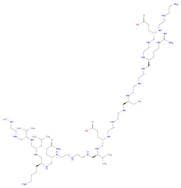
CAS 131438-79-4
:Amyloid beta-protein fragment 1-40
Description:
Amyloid beta-protein fragment 1-40 (Aβ1-40) is a peptide that plays a significant role in the pathogenesis of Alzheimer's disease. It is derived from the amyloid precursor protein (APP) through enzymatic cleavage by beta-secretase and gamma-secretase. This fragment consists of 40 amino acids and is one of the most prevalent forms of amyloid beta in the brain. Aβ1-40 is known for its propensity to aggregate, forming oligomers and fibrils that contribute to amyloid plaque formation, a hallmark of Alzheimer's disease. The peptide is hydrophobic, which influences its aggregation behavior and interactions with cell membranes. Aβ1-40 can induce neurotoxicity and disrupt synaptic function, leading to cognitive decline. Its solubility and aggregation properties are influenced by factors such as pH, temperature, and ionic strength. Research on Aβ1-40 is crucial for understanding Alzheimer's disease mechanisms and developing potential therapeutic strategies. The CAS number 131438-79-4 uniquely identifies this specific peptide in chemical databases, facilitating its study in various scientific contexts.
Formula:C194H295N53O58S
Synonyms:- L-Valine,L-a-aspartyl-L-alanyl-L-a-glutamyl-L-phenylalanyl-L-arginyl-L-histidyl-L-a-aspartyl-L-serylglycyl-L-tyrosyl-L-a-glutamyl-L-valyl-L-histidyl-L-histidyl-L-glutaminyl-L-lysyl-L-leucyl-L-valyl-L-phenylalanyl-L-phenylalanyl-L-alanyl-L-a-glutamyl-L-a-aspartyl-L-valylglycyl-L-seryl-L-asparaginyl-L-lysylglycyl-L-alanyl-L-isoleucyl-L-isoleucylglycyl-L-leucyl-L-methionyl-L-valylglycylglycyl-L-valyl-
- Amyloidb-peptide(1-40)(human)
- H-asp-ala-glu-phe-gly-his-asp-ser-gly-phe-glu-val-arg-his-asp-ser-gly-phe-glu-val-arg-his-gln-lys-leu-val-gly-phe-phe-ala-glu-asp-val-gly-ser-asn-lys-gly-ala-ile-ile-gly-leu-met-val-gly-gly-val-val-oh
- ss-Amyloid (1-40), rat
- Beta-Amyloid Protein(1-40)
- Beta-Amyloid 1-40,human
- Abeta 1-40
- β-Amyloid(1-40)Human
Sort by
Purity (%)
0
100
|
0
|
50
|
90
|
95
|
100
Found 14 products.
Amyloid β-Protein (1-40)
CAS:Amyloid β-peptide (1-40) showed both neurotrophic and neurotoxic effects in dependence on the neuronal age and the concentration of the β-protein. Aβ 1-40 has been used as well as Aβ 1-42 to detect amyloid β-protein multimers in the cerebrospinal fluid of Alzheimer’s disease patients. The sequence of this peptide corresponds to the sequence of human, bovine, canine, feline, ovine, guinea pig, and rabbit Aβ40. The inverted sequence can be used as inactive control in experiments employing Aβ 1-40. For detailed descriptions of the preparation of wild-type and mutant Aβ 1-40 monomers and protofibrils please see the paper of Jan, Hartley, and Lashuel.Formula:C194H295N53O58SPurity:95.9%Color and Shape:White LyophilisateMolecular weight:4329.86Amyloid β-Protein (1-40)
CAS:Compared to the TFA salt, the HCl salt of amyloid β-protein (1-40) easily forms β-structures in PBS within a few hours at 25°C. β-structure formation is essential for amyloid peptide toxicity.Formula:C194H295N53O58SPurity:93.7%Color and Shape:White LyophilisateMolecular weight:4329.86Amyloid β-Protein (1-40) (HFIP-treated)
CAS:The peptide was obtained by dissolving Amyloid β-Protein (1-40) in HFIP, aliquoting, and removing the solvent as described in the literature. The morphology of the resulting peptide was studied by transmission electron microscopy (TEM). The magenta arrow points to the nucleation centers where aggregation starts. The yellow arrow indicates the fibrils which are formed as long thin helical structures with regular twists.Formula:C194H295N53O58SPurity:95.1%Color and Shape:White Solid MaterialMolecular weight:4329.86β-Amyloid (1-40)
CAS:Amyloid β1-40 is one of the fragments generated after cleavage of the amyloid peptide precursor protein by β and γ secretases.Formula:C194H295N53O58SPurity:98%Color and Shape:SolidMolecular weight:4329.82β-Amyloid (1-40)
CAS:Custom research peptide; min purity 95%. For different specs please use the Peptide Quote ToolFormula:C194H295N53O58S1Molecular weight:4,329.86 g/molAmyloid beta peptide(1-40) trifluoroxalate - synthetic
CAS:Amyloid beta peptide (Aβ) is a neurotrophic factor that is involved in the pathogenic mechanism of Alzheimer's disease. This drug inhibits the production of Aβ by binding to the enzyme, secretase. It has been shown that Aβ binds to a transporter protein and is transported into cells, where it accumulates in the cytoplasm. The physiological levels of Aβ are regulated by proteins called "gene chaperones" which prevent Aβ from aggregating into plaques. Dextran sulfate inhibits this process by binding to amyloid and preventing it from accumulating in the cytoplasm. Amyloid beta peptide trifluoroxalate (ATFX) has been shown to inhibit the production of Aβ with structural analysis, inhibition of cellular uptake and secretion, and inhibition of fibrillization. ATFX also has potential as a biomarker for Alzheimer's disease because it can be detected at low concentrations in urine or serumFormula:C194H295N53O58S·C2HF3O2Purity:Min. 95%Color and Shape:White PowderMolecular weight:4,443.83 g/molAmyloid Beta-Protein (Human, 1-40) (HCl Form)
CAS:Amyloid beta-protein (Aβ) is a peptide that is derived from amyloid precursor protein (APP). Aβ is the main component of amyloid plaques which are found in the brains of people with Alzheimer's disease. It has been shown to be a ligand for LRP1 and LRP2, two receptors involved in the clearance of APP. Amyloid beta-protein (Aβ) is an activator of ion channels in cell membranes and can affect the activity of several types of ion channels, including high-voltage activated potassium channels and low-voltage activated calcium channels.
Formula:C194H295N53O58SPurity:Min. 95%Molecular weight:4,329.89 g/molAmyloid Beta-Protein (Human, 1-40) (TFA Form)
CAS:Amyloid beta-protein (Aβ) is a peptide that is believed to play an important role in the development of Alzheimer's disease. Aβ is produced by proteolytic cleavage from the amyloid precursor protein and is released into the extracellular space, where it can interact with other cells. The protein has been shown to activate ion channels and inhibit cell proliferation. It also binds to receptors on cells, which leads to downstream effects such as inhibition of ligand binding and activation of G-protein coupled receptor signaling pathways.Formula:C194H295N53O58SPurity:Min. 95%Molecular weight:4,329.8 g/molAmyloid beta-Protein (1-40) trifluoroacetate salt
CAS:Amyloid beta-protein (Aβ) is a protein that is involved in the metabolic processes that are thought to be associated with Alzheimer's disease. Aβ is a peptide of 39-43 residues and is found in amyloid plaques, which are aggregates of Aβ. The amino acid sequence of human Aβ has been determined by sequencing the cDNA and gene for this protein. The structure of the protein has been studied using molecular modeling, kinetic data, and predictive biomarker studies. Cleavage products have been identified from the protein, including beta-amyloid peptide (1-40), which can be used as a diagnostic marker for Alzheimer's disease. Structural analysis has also shown lysine residues that may serve as pharmaceutical targets for therapeutic intervention.Formula:C194H295N53O58SPurity:Min. 95%Molecular weight:4,329.81 g/mol(Asn7)-Amyloid b-Protein (1-40) trifluoroacetate salt
CAS:(Asn7)-Amyloid b-Protein (1-40) trifluoroacetate salt H-Asp-Ala-Glu-Phe-Arg-His-Asn-Ser-Gly-Tyr-Glu-Val-His-His-Gln-Lys The product is a compound that has been shown to inhibit the formation of beta amyloid peptides in the brain. It binds to the beta amyloid peptide and prevents its aggregation, thereby preventing the formation of plaques and inhibiting neuronal cell death. The product contains no detectable levels of trehalose, which makes it ideal for use in brain imaging studies. This product may also be used as a predictive biomarker for Alzheimer's disease because it can be detected in cerebrospinal fluid and plasma.Formula:C194H296N54O57SPurity:Min. 95%Molecular weight:4,328.82 g/molAmyloid beta-Protein (1-40) hydrochloride salt
CAS:Amyloid beta-protein (1-40) hydrochloride salt H-Asp-Ala-Glu-Phe-Arg-His-Asp-Ser-Gly-Tyr-Glu-Val-His-His-Gln is a secretase inhibitor that binds to the active site of the enzyme and blocks its activity. Amyloid beta protein (1 - 40) hydrochloride salt H has been shown to inhibit the production of amyloid, which is linked to Alzheimer's disease. The amino acid sequence of this compound is identical to that of the human amyloid beta protein. The inhibition of enzymes such as aspartyl proteases, metalloproteases, and serine proteases may be responsible for its therapeutic effects in metabolic disorders.Formula:C194H295N53O58SPurity:Min. 95%Molecular weight:4,329.81 g/molAMYLOID β-PROTEIN (HUMAN, 1-40) TRIFLUOROACETATE
CAS:Formula:C67H142N25O6Purity:95%Molecular weight:1394.0083