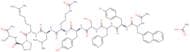
CAS 145672-81-7
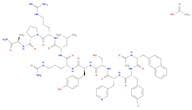
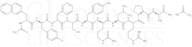
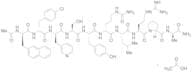
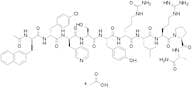
:N-acetyl-3-(2-naphthalenyl)-D-alanyl-4-chloro-D-phenylalanyl-3-(3-pyridinyl)-D-alanyl-L-seryl-L-tyrosyl-N5-(aminocarbonyl)-D-ornithyl-L-leucyl-L-arginyl-L-prolyl-, acetate (salt)
Description:
N-acetyl-3-(2-naphthalenyl)-D-alanyl-4-chloro-D-phenylalanyl-3-(3-pyridinyl)-D-alanyl-L-seryl-L-tyrosyl-N5-(aminocarbonyl)-D-ornithyl-L-leucyl-L-arginyl-L-prolyl-, acetate (salt), with CAS number 145672-81-7, is a complex synthetic peptide that exhibits a range of characteristics typical of peptide compounds. It is likely to be a white to off-white solid, soluble in polar solvents such as water and methanol, and may have limited solubility in non-polar solvents. The presence of various amino acid residues suggests potential biological activity, possibly as a pharmaceutical agent or research compound. Its structure includes multiple chiral centers, indicating that it may exhibit stereospecific properties. The acetate salt form implies enhanced stability and solubility, which is beneficial for formulation in biological studies. As with many peptides, it may be sensitive to hydrolysis and degradation under certain conditions, necessitating careful handling and storage. Overall, this compound's unique structure and functional groups suggest potential applications in medicinal chemistry and biochemistry.
Formula:C70H92ClN17O14xC2H4O2
InChI:InChI=1/C70H92ClN17O14.C2H4O2/c1-39(2)31-52(61(94)82-51(15-9-28-77-69(73)74)68(101)88-30-10-16-58(88)67(100)79-40(3)59(72)92)83-60(93)50(14-8-29-78-70(75)102)81-63(96)54(34-43-20-25-49(91)26-21-43)86-66(99)57(38-89)87-65(98)56(36-45-11-7-27-76-37-45)85-64(97)55(33-42-18-23-48(71)24-19-42)84-62(95)53(80-41(4)90)35-44-17-22-46-12-5-6-13-47(46)32-44;1-2(3)4/h5-7,11-13,17-27,32,37,39-40,50-58,89,91H,8-10,14-16,28-31,33-36,38H2,1-4H3,(H2,72,92)(H,79,100)(H,80,90)(H,81,96)(H,82,94)(H,83,93)(H,84,95)(H,85,97)(H,86,99)(H,87,98)(H4,73,74,77)(H3,75,78,102);1H3,(H,3,4)/t40-,50-,51+,52+,53-,54-,55+,56-,57-,58?;/m1./s1
Sort by
Purity (%)
0
100
|
0
|
50
|
90
|
95
|
100
Found 6 products.
Cetrorelix (acetate)
CAS:Formula:C72H96ClN17O16Purity:99%Color and Shape:SolidMolecular weight:1491.0899Cetrorelix Acetate
CAS:Controlled ProductApplications Cetrorelix acetate is an gonadotropin-releasing hormone antagonist and is used to treat hormone-sensitive cancers of the prostate and breast.
References Hosseini, M.A., et al.: Gynecol. Endocrinol., 28, 853 (2012); Rashidi, B., et al.: Iran. J. Reprod. Med., 9, 315 (2011); Wiser, A., et al.: Open. J. Obstetics. Gynecol., 1, 31 (2011);Formula:C70H92ClN17O14·C2H4O2Color and Shape:White To Off-WhiteMolecular weight:1491.09Cetrorelix Acetate
CAS:Cetrorelix Acetate is gonadotropin-releasing hormone (GnRH) receptor antagonist with an IC50 of 1.21 nM.Formula:C70H92ClN17O14·xC2H4O2Purity:97.96%Color and Shape:SolidMolecular weight:1491.11Cetrorelix Acetate
CAS:Controlled ProductCetrorelix acetate is a peptide that belongs to the group of group p2. It has been used in an experimental model as a treatment for metabolic disorders. Cetrorelix acetate has been shown to be an antagonist for the luteinizing hormone receptor (LHR), which leads to decreased levels of testosterone and increases in luteinizing hormone. Cetrorelix acetate also blocks the release of follicle-stimulating hormone from the anterior pituitary gland, leading to reduced levels of progesterone and estradiol. This drug has been shown to have pro-apoptotic effects on testicular cells in rats, as well as chemiluminescent properties. The injection solution contains cetrorelix acetate, trifluoroacetic acid, and histological analysis reagents.Formula:C70H92ClN17O14·C2H4O2Purity:Min. 95%Molecular weight:1,491.11 g/mol