CAS 1918-00-9
:3,6-dichloro-O-anisic acid plant cell*culture tes
Description:
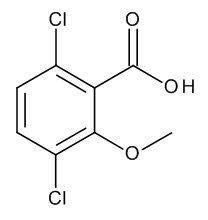
3,6-Dichloro-O-anisic acid, with the CAS number 1918-00-9, is a chemical compound that belongs to the class of chlorinated aromatic acids. It is characterized by the presence of two chlorine atoms at the 3 and 6 positions of the aromatic ring, along with a methoxy group (-OCH3) at the ortho position relative to the carboxylic acid group (-COOH). This compound exhibits properties typical of chlorinated aromatic acids, including potential herbicidal activity, making it of interest in agricultural applications. Its structure allows for interactions with plant cell cultures, influencing growth and development. The presence of chlorine atoms can enhance the compound's stability and lipophilicity, affecting its bioavailability and mode of action in biological systems. Additionally, 3,6-dichloro-O-anisic acid may undergo various chemical reactions, including esterification and substitution, which can be exploited in synthetic chemistry. Safety and handling precautions are essential when working with this compound, as with many chlorinated organic substances, due to potential toxicity and environmental concerns.
Formula:C8H6Cl2O3
InChI:InChI=1S/C8H6Cl2O3/c1-13-7-5(10)3-2-4(9)6(7)8(11)12/h2-3H,1H3,(H,11,12)
InChI key:InChIKey=IWEDIXLBFLAXBO-UHFFFAOYSA-N
SMILES:C(O)(=O)C1=C(OC)C(Cl)=CC=C1Cl
Synonyms:- 2,5-Dichloro-6-methoxybenzoic acid
- 2-Methoxy-3,6-dichlorobenzoic acid
- 3,6-Dichloro-2-methoxybenzoic acid
- 3,6-Dichloro-o-anisic acid
- Aviator
- Banvel
- Banvel 480
- Banvel 70WP
- Banvel SGF
- Benzoic acid, 3,6-dichloro-2-methoxy-
- Celebrity B
- DC
- Decamba
- Dianat
- Dicamba
- Mais Banvel WG
- Mdba
- Mediben
- Vanquish
- Velsicol 58CS11
- Velsicol Compound R
- See more synonyms
Filter by
Purity percentage
0
100
|
0
|
50
|
90
|
95
|
100
- Lower prices
- Higher prices
- Lower purities
- Higher purities
- Faster estimated delivery
Dicamba
CAS:Formula:C8H6Cl2O3Purity:>98.0%(GC)(T)Color and Shape:White to Almost white powder to crystalMolecular weight:221.03Dicamba
CAS:DicambaFormula:C8H6Cl2O3Purity:By hplc: 99.91% (Typical Value in Batch COA)Color and Shape:SolidMolecular weight:221.037443,6-Dichloro-2-methoxybenzoic acid
CAS:Formula:C8H6Cl2O3Purity:95.0%Color and Shape:SolidMolecular weight:221.03Dicamba 10 µg/mL in Acetonitrile
CAS:Formula:C8H6Cl2O3Color and Shape:Single SolutionMolecular weight:221.04Pesticide-Mix 95 1000 µg/mL in Ethyl acetate
CAS:Controlled Product- 120-36-5
- 1689-83-4
- 1689-84-5
- 1918-00-9
- 25057-89-0
- 50-31-7
- 55335-06-3
- 93-65-2
- 93-76-5
- 94-74-6
- 94-75-7
- 94-81-5
- 94-82-6
Formula:C7H3Cl3O2Color and Shape:MixtureMolecular weight:225.46Pesticide-Mix 128 20 µg/mL in Acetonitrile
CAS:Controlled Product- 120-36-5
- 1702-17-6
- 1918-00-9
- 1918-02-1
- 25057-89-0
- 314-40-9
- 55335-06-3
- 69335-91-7
- 69806-34-4
- 882-09-7
- 93-65-2
- 93-72-1
- 93-76-5
- 94-74-6
- 94-75-7
- 94-81-5
- 94-82-6
Formula:C8H5Cl3O3Color and Shape:MixtureMolecular weight:255.48HJ 1022-2019 Phenoxycarboxylic Pesticides Mixture 10 100 µg/mL in Acetone
CAS:Controlled ProductColor and Shape:MixturePesticide Mixture 254 200 µg/mL in Acetonitrile
CAS:Controlled Product- 114311-32-9
- 133-90-4
- 1702-17-6
- 1918-00-9
- 1918-02-1
- 25057-89-0
- 55335-06-3
- 81334-34-1
- 81335-37-7
- 81335-77-5
- 93-65-2
- 94-74-6
- 94-75-7
Formula:C8H6Cl2O3Color and Shape:ColourlessMolecular weight:221.04LC PestiMix 10 10 µg/mL in Acetonitrile
CAS:Controlled Product- 119515-38-7
- 120-36-5
- 120068-36-2
- 139542-32-8
- 149878-40-0
- 158063-66-2
- 1689-84-5
- 1702-17-6
- 1918-00-9
- 1918-02-1
- 207502-65-6
- 33089-74-6
- 4710-17-2
- 519-02-8
- 521-88-0
- 534-52-1
- 55335-06-3
- 58667-63-3
- 86-86-2
- 87-86-5
- 88-85-7
- 93-65-2
- 94-74-6
- 94-75-7
- 94-81-5
Color and Shape:MixtureDicamba 100 µg/mL in Acetonitrile
CAS:Controlled ProductFormula:C8H6Cl2O3Color and Shape:ColourlessMolecular weight:221.04EPA Method 515.2 Herbicide Mixture 402 100-1000 µg/mL in Methanol
CAS:Controlled ProductColor and Shape:MixtureDicamba
CAS:Applications Dicamba is a herbicide. Dicamba functions by increasing plant growth rate. At sufficient concentrations, the plant outgrows its nutrient supplies and dies. Dicamba has been approved by the EPA for use on genetically modified soybeans and cotton.Environmental toxin on US EPA Toxic Release Inventory list (TRI) list.
References Oehler, D.D., et al.: J. Agric. Food Chem., 28, 685 (1980); Griffin, J., et al.: Weed Techno., 27, 696 (2013); Chem. and Eng. News, Nov. 14, 2016, p. 17Formula:C8H6Cl2O3Color and Shape:NeatMolecular weight:221.04Dicamba
CAS:Formula:C8H6Cl2O3Purity:≥ 95%Color and Shape:White to off-white crystalline powderMolecular weight:221.03Dicamba in Methanol
CAS:MethanolFormula:C8H6Cl2O3Color and Shape:COLOURLESS CRYSTALS.Molecular weight:221.03