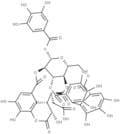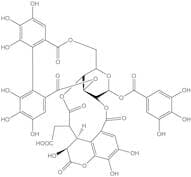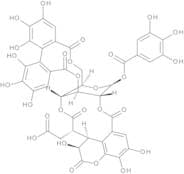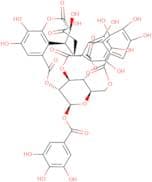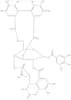
CAS 23094-71-5
:Chebulagic acid
Description:
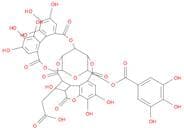
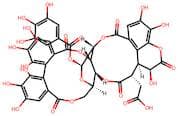
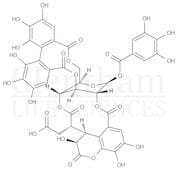
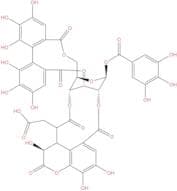
Chebulagic acid is a naturally occurring polyphenolic compound primarily found in the fruit of the Terminalia chebula tree, which is commonly used in traditional medicine. It is classified as a tannin and is known for its antioxidant properties, contributing to its potential health benefits. The chemical structure of chebulagic acid features multiple hydroxyl groups, which enhance its ability to scavenge free radicals and exhibit anti-inflammatory effects. This compound has garnered interest for its potential therapeutic applications, including its role in promoting digestive health and its possible anticancer properties. Additionally, chebulagic acid may influence various biochemical pathways, making it a subject of research in pharmacology and nutraceuticals. Its solubility in water and organic solvents varies, which can affect its bioavailability and efficacy in different formulations. Overall, chebulagic acid represents a significant area of study in natural product chemistry and its implications for health and wellness.
Formula:C41H30O27
InChI:InChI=1S/C41H30O27/c42-13-1-8(2-14(43)24(13)49)35(56)68-41-34-33-31(64-39(60)12(6-19(47)48)22-23-11(38(59)67-34)5-17(46)27(52)32(23)65-40(61)30(22)55)18(63-41)7-62-36(57)9-3-15(44)25(50)28(53)20(9)21-10(37(58)66-33)4-16(45)26(51)29(21)54/h1-5,12,18,22,30-31,33-34,41-46,49-55H,6-7H2,(H,47,48)
InChI key:InChIKey=HGJXAVROWQLCTP-UHFFFAOYSA-N
SMILES:C(C(O)=O)C1C2C=3C(C(=O)OC4C5C(OC1=O)C(OC4OC(=O)C6=CC(O)=C(O)C(O)=C6)COC(=O)C=7C(C=8C(C(=O)O5)=CC(O)=C(O)C8O)=C(O)C(O)=C(O)C7)=CC(O)=C(O)C3OC(=O)C2O
Synonyms:- 10,24-(Epoxymethano)-11H-dibenzo[8,9:10,11][1,6]dioxacyclododecino[2,3-d]pyrano[4,3,2-ij][2,6]benzodioxacycloundecin, β-D-glucopyranose deriv.
- Chebulagic acid
- β-D-Glucopyranose, cyclic 3,6-[(1R)-4,4′,5,5′,6,6′-hexahydroxy[1,1′-biphenyl]-2,2′-dicarboxylate] 1-(3,4,5-trihydroxybenzoate), cyclic 2→5:4→1-ester with (2S)-[(3S,4S)-5-carboxy-3,4-dihydro-3,7,8-trihydroxy-2-oxo-2H-1-benzopyran-4-yl]butanedioic acid
- β-D-Glucopyranose, cyclic 3,6-[(1R)-4,4′,5,5′,6,6′-hexahydroxy[1,1′-biphenyl]-2,2′-dicarboxylate] 1-(3,4,5-trihydroxybenzoate), cyclic 2→2:4→1-ester with (2S)-[(3S,4S)-5-carboxy-3,4-dihydro-3,7,8-trihydroxy-2-oxo-2H-1-benzopyran-4-yl]butanedioic acid
- β-D-Glucopyranose, cyclic 3,6-[(1R)-4,4′,5,5′,6,6′-hexahydroxy[1,1′-biphenyl]-2,2′-dicarboxylate] 1-(3,4,5-trihydroxybenzoate), cyclic 2→2:4→1-ester with (2S)-2-[(3S,4S)-5-carboxy-3,4-dihydro-3,7,8-trihydroxy-2-oxo-2H-1-benzopyran-4-yl]butanedioic acid
Sort by
Purity (%)
0
100
|
0
|
50
|
90
|
95
|
100
Found 10 products.
Chebulagic Acid
CAS:Other glycosides, natural or reproduced by synthesis, and their salts, ethers, esters and other derivativesFormula:C41H30O27Color and Shape:Off-White PowderMolecular weight:954.09745Chebulagic acid
CAS:Formula:C41H30O27Purity:≥ 95.0%Color and Shape:White, off-white or pale brown powderMolecular weight:954.66Chebulagic acid
CAS:Chebulagic acid, isolated from the fruits of Terminalia, it shows potent COX–LOX dual inhibition activity with IC50 values of 15 ± 0.288, 0.92 ± 0.011 and 2.1 ± 0.057 μM for COX-1, COX-2 and 5-LOX respectively, it also shows anti-proliferative activity against HCT-15, COLO-205, MDA-MB-231, DU-145 and K562 cell lines, it induces apoptosis in COLO-205 cell line.Formula:C41H30O27Purity:95%~99%Color and Shape:PowderMolecular weight:954.664Chebulagic acid
CAS:Chebulagic acid, isolated from the Terminalia chebula Retz, is a COX-LOX dual inhibitor.Formula:C41H30O27Purity:97.82% - 99.8%Color and Shape:SolidMolecular weight:954.66Ref: TM-TQ0180
1mg74.00€5mg157.00€10mg225.00€1mL*10mM (DMSO)244.00€25mg376.00€50mg560.00€100mg798.00€Chebulagic acid
CAS:Natural glycosideFormula:C41H30O27Purity:≥ 90.0 % (HPLC)Color and Shape:PowderMolecular weight:954.67Chebulagic acid
CAS:Controlled ProductChebulagic acid is a type of polyphenolic compound, which is derived from the dried fruits of the Terminalia chebula plant, an important species in traditional medicine practices such as Ayurveda. This compound exhibits significant bioactivity primarily due to its antioxidant and anti-inflammatory properties. The mode of action of chebulagic acid involves the scavenging of free radicals and modulation of oxidative stress pathways, thereby protecting cells from oxidative damage.Formula:C41H30O27Purity:Min. 95%Color and Shape:PowderMolecular weight:954.66 g/mol