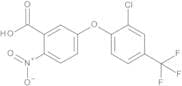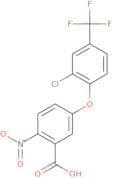
CAS 50594-66-6
:Acifluorfen
Description:
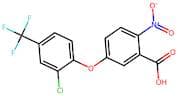
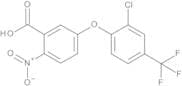
Acifluorfen is a selective herbicide primarily used for controlling broadleaf weeds and certain grasses in various crops. It belongs to the class of compounds known as diphenyl ethers and is characterized by its ability to inhibit the enzyme protoporphyrinogen oxidase, which is crucial in the biosynthesis of chlorophyll. This inhibition leads to the accumulation of toxic porphyrin compounds, resulting in plant death. Acifluorfen is typically applied post-emergence and is effective in crops such as soybeans and peanuts. The substance is a colorless to pale yellow solid at room temperature and is moderately soluble in water, with higher solubility in organic solvents. Its stability is influenced by environmental factors, and it is generally considered to have low toxicity to mammals, though it can be harmful to aquatic organisms. Proper handling and application are essential to minimize environmental impact and ensure safety.
Formula:C14H7ClF3NO5
InChI:InChI=1S/C14H7ClF3NO5/c15-10-5-7(14(16,17)18)1-4-12(10)24-8-2-3-11(19(22)23)9(6-8)13(20)21/h1-6H,(H,20,21)
InChI key:InChIKey=NUFNQYOELLVIPL-UHFFFAOYSA-N
SMILES:O(C1=CC(C(O)=O)=C(N(=O)=O)C=C1)C2=C(Cl)C=C(C(F)(F)F)C=C2
Synonyms:- 2-Nitro-5-(2-chloro-4-(trifluoromethyl)phenoxy)benzoic acid
- 2-Nitro-5-(2-chloro-4-trifluoromethylphenoxy)benzoic acid
- 3-Carboxy-2′-chloro-4′-trifluoromethyl-4-nitrodiphenyl ether
- 5-(2-Chloro-Α,Α,Α-Trifluoro-P-Tolyloxy)-2-Nitrobenzoic Acid
- 5-[2-Chloro-4-(trifluoromethyl)phenoxy]-2-nitrobenzoic acid
- Acifluorfen
- Acifluorfen H
- Acifluorofen
- Benzoic acid, 5-[2-chloro-4-(trifluoromethyl)phenoxy]-2-nitro-
- Carbofluorfen
- Ppg-847
Sort by
Purity (%)
0
100
|
0
|
50
|
90
|
95
|
100
Found 9 products.
Chlorinated Acids Mix 1 100 µg/mL in Acetonitrile
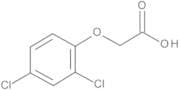
CAS:Controlled ProductFormula:C8H6Cl2O3Color and Shape:MixtureMolecular weight:221.04EPA Method 515.2 Herbicide Mixture 402 100-1000 µg/mL in Methanol
CAS:Controlled ProductColor and Shape:MixtureAcifluorfen
CAS:Acifluorfen: PROTOX inhibitor herbicide causing photooxidative damage in plants; may induce liver tumors in rodents.
Formula:C14H7ClF3NO5Purity:99.60%Color and Shape:SolidMolecular weight:361.66Acifluorfen (90%)
CAS:Controlled ProductApplications Acifluorfen is an herbicide against broadleaf weeds. An environmental toxin relating to in vivo toxicity of nitroaromatics.Environmental toxin on US EPA Toxic Release Inventory list (TRI) list.
Not a dangerous good if item is equal to or less than 1g/ml and there is less than 100g/ml in the package
References Gooch, A. et al.: Env. Toxicol. Chem., 36, 2227 (2017);Formula:C14H7ClF3NO5Purity:90%Color and Shape:Light BrownMolecular weight:361.66Acifluorofen
CAS:Acifluorfen is a herbicide that is used to control broadleaf weeds and grasses. It inhibits the photosynthetic activity of plants by inhibiting the synthesis of chlorophyll. Acifluorfen has been shown to be carcinogenic in rats and mice, but not in other species, such as dogs. Acifluorfen's potential for carcinogenicity may be due to its ability to bind to DNA and inhibit transcription or replication, which can lead to cell death. Acifluorfen also binds to many other proteins with varying degrees of affinity. The conformational properties of acifluorfen are similar to those of the plant hormone auxin. This similarity has led researchers to speculate that acifluorfen may have some physiological effects on plants similar to those of auxin, including an effect on locomotor activity.Formula:C14H7ClF3NO5Purity:Min. 95%Molecular weight:361.66 g/mol