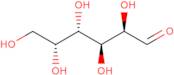
CAS 59-23-4
:Galactose
Description:
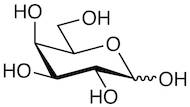
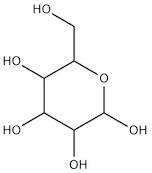
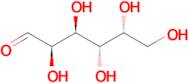
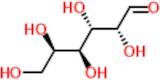
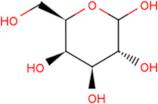
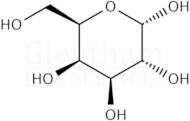
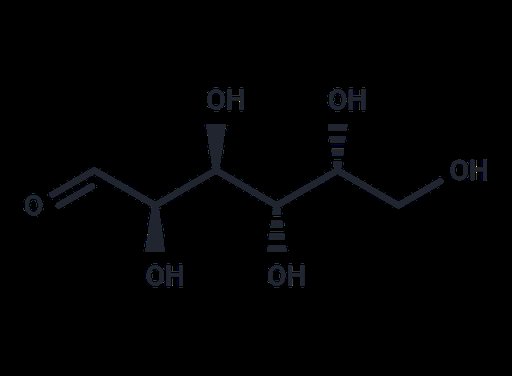
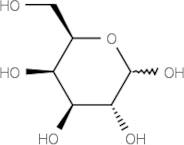
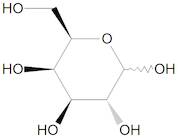
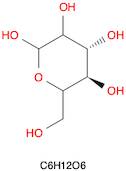
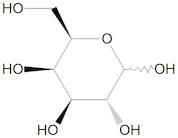
Galactose is a monosaccharide, a simple sugar that is an important carbohydrate in biology. It is an aldohexose, meaning it contains six carbon atoms and an aldehyde group. Galactose is typically found in dairy products and is a component of lactose, the sugar present in milk. It exists in two anomeric forms, alpha and beta, which differ in the orientation of the hydroxyl group at the first carbon. Galactose is a white, crystalline solid that is soluble in water and has a sweet taste, although it is less sweet than glucose. It plays a crucial role in various biological processes, including the synthesis of glycoproteins and glycolipids, which are essential for cell recognition and signaling. In the human body, galactose is metabolized primarily in the liver, where it can be converted into glucose for energy. Its CAS number is 59-23-4, which uniquely identifies this compound in chemical databases. Overall, galactose is vital for numerous physiological functions and is a key component of various biomolecules.
Formula:C6H12O6
InChI:InChI=1S/C6H12O6/c7-1-3(9)5(11)6(12)4(10)2-8/h1,3-6,8-12H,2H2/t3-,4+,5+,6-/m0/s1
InChI key:InChIKey=GZCGUPFRVQAUEE-KCDKBNATSA-N
SMILES:[C@@H]([C@@H]([C@H](C=O)O)O)([C@@H](CO)O)O
Synonyms:- 2,3,4,5,6,-Pentahydroxy-hexanal
- <span class="text-smallcaps">D</span>-(+)-Galactose
- D(+)Galactose anhydrous
- D(+)galactose sigmaultra
- Gal
- Galactosa
- Galactose
- Galactose, <span class="text-smallcaps">D</span>-
- Galactose, D-
- Galactose, Pure
- alpha-D-galactopyranose
- alpha-Galactose(D)
- D-Glactose
- D-(+)-Galactose
- D(+)-Galactose
- D-(+)-Galactose
- D-Galactose
- See more synonyms
Filter by
Purity percentage
0
100
|
0
|
50
|
90
|
95
|
100
- Lower prices
- Higher prices
- Lower purities
- Higher purities
- Faster estimated delivery
D-(+)-Galactose Anhydrous
CAS:Formula:C6H12O6Purity:>98.0%(HPLC)Color and Shape:White powder to crystalMolecular weight:180.16D-(+)-Galactose, 98%
CAS:D(+)-galactose, 56-40-6, also known as aldehydo-D-galacto-hexose, is a monosaccharide and a component of glycolipids and glycoproteins. Learn more at Thermo Fisher Scientific.Formula:C6H12O6Purity:98%Color and Shape:White, Powder or crystalline powderMolecular weight:180.16Galactose
CAS:Sugars, chemically pure, other than sucrose, lactose, maltose, glucose and fructose; sugar ethers and sugar esters, and their salts, nesoiFormula:C6H12O6Color and Shape:White Crystals PrismsMolecular weight:180.16D(+)-Galactose (Ph. Eur.) pure, pharma grade
CAS:D(+)-Galactose (Ph. Eur.) pure, pharma gradeFormula:C6H12O6Molecular weight:180.16D-Galactose
CAS:D-Galactose (Alpha-D-galactose) is an aldohexose that exists naturally in the D-form in lactose, cerebrosides, gangliosides, and mucoproteins.Formula:C6H12O6Purity:99.29% - 99.98%Color and Shape:White SolidMolecular weight:180.16D-Galactose
CAS:D-GalactoseFormula:C6H12O6Purity:99% (Typical Value in Batch COA)Color and Shape:White Solid-PowderMolecular weight:180.15588D-(+)-Galactose, Ph. Eur. grade
CAS:Formula:C6H12O6Purity:≥ 98.0%Color and Shape:White to almost white, crystalline or finely granulated powderMolecular weight:180.16D-(+)-Galactose, non-animal origin
CAS:Formula:C6H12O6Purity:≥ 98.0%Color and Shape:White to almost white crystalline powderMolecular weight:180.16D-Galactose (Standard)
CAS:D-Galactose (Standard) is the standard substance of D-Galactose, and it is applicable for quantitative analysis, quality control, and related research in biochemical experiments. D-Galactose is a naturally occurring hexose and a C-4 epimer of glucose. It can combine with glucose to form lactose and is commonly used to establish animal models of aging.Formula:C6H12O6Color and Shape:SolidMolecular weight:180.16D-(+)-Galactose
CAS:D-(+)-Galactose analytical standardFormula:C6H12O6Purity:(HPLC) ≥95%Color and Shape:PowderMolecular weight:180.17D-Galactose
CAS:Applications A C-4 epimer of Glucose (G595000) found in milk and sugar beets as well as being synthesized by the body. Potential use in oral therapy for nephrotic syndrome in focal and segmental glomerulosclerosis.
References De Smet, E. et al.: Nephrol. Dial. Transplant., 24, 2938 (2009); Kivele, R. et al.: Carb. Pol., 85, 645 (2011);Formula:C6H12O6Color and Shape:NeatMolecular weight:180.16D-Galactose
CAS:(2R,3S,4S,5R)-2,3,4,5,6-PentahydroxyhexanalFormula:C6H12O6Purity:95%Molecular weight:180.16D-(+)-Galactose
CAS:Formula:C6H12O6Purity:≥ 99.0%Color and Shape:White to off-white crystalline powderMolecular weight:180.16D-Galactose non-animal origin
CAS:Galactose from plant origin, animal free productionFormula:C6H12O6Purity:Min. 99.0 Area-%Color and Shape:White PowderMolecular weight:180.16 g/mol