CAS 870-50-8
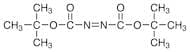
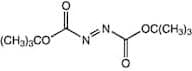
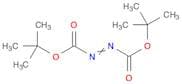
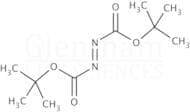
:Di-tert-butyl azodicarboxylate
Description:
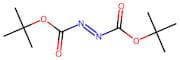
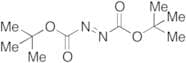
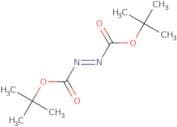
Di-tert-butyl azodicarboxylate (DBAD) is an organic compound characterized by its azodicarboxylate structure, featuring two tert-butyl groups attached to the nitrogen atoms of the azo functional group. It is typically a colorless to pale yellow liquid with a distinctive odor. DBAD is known for its stability under normal conditions but can decompose upon exposure to heat or light, releasing nitrogen gas. This compound is often used as a reagent in organic synthesis, particularly in radical reactions and as a source of free radicals in polymerization processes. Its solubility in organic solvents makes it versatile for various applications in chemical synthesis. Additionally, DBAD is recognized for its role as a chain transfer agent in the production of polymers, contributing to the control of molecular weight and polymer architecture. Safety precautions are necessary when handling this compound, as it can be hazardous if ingested or inhaled, and appropriate protective measures should be taken to mitigate any risks associated with its use.
Formula:C10H18N2O4
InChI:InChI=1S/C10H18N2O4/c1-9(2,3)15-7(13)11-12-8(14)16-10(4,5)6/h1-6H3
InChI key:InChIKey=QKSQWQOAUQFORH-UHFFFAOYSA-N
SMILES:O(C(C)(C)C)C(N=NC(OC(C)(C)C)=O)=O
Synonyms:- 1,2-Diazenedicarboxylic acid, 1,2-bis(1,1-dimethylethyl) ester
- Azodicarboxylic acid di-tert-butyl ester
- Bis(1,1-dimethylethyl)azodicarboxylate
- Dbad
- Di-Tert-Butyl Diazene-1,2-Dicarboxylate
- Di-tert-butyl azodiformate
- Di-tert-butyl diazodicarboxylate
- Diazenedicarboxylic acid, bis(1,1-dimethylethyl) ester
- Formic acid, azodi-, di-tert-butyl ester
- NSC 109889
- di-tert-butyl (E)-diazene-1,2-dicarboxylate
- See more synonyms
Sort by
Purity (%)
0
100
|
0
|
50
|
90
|
95
|
100
Found 8 products.
Di-tert-butyl Azodicarboxylate (20% in Toluene)
CAS:Formula:C10H18N2O4Color and Shape:Light yellow to Brown clear liquidMolecular weight:230.26Di-tert-butyl azodicarboxylate, 98%
CAS:Di-tert-butyl azodicarboxylate is a reagent used in the preparation of acyl hydrazinedicarboxylates. It is also used in the electrophilic amination of beta-keto esters catalyzed by an axially chiral guanidine. It serves as a precursor in an enantioselective synthesis of 3,6-dihyropyridazines employiFormula:C10H18N2O4Purity:98%Color and Shape:Yellow, Crystals or powder or crystalline powder or fused solid or flakesMolecular weight:230.26Di-tert-butyl diazene-1,2-dicarboxylate
CAS:Formula:C10H18N2O4Purity:95%Color and Shape:SolidMolecular weight:230.2609Ref: IN-DA003PRR
1gTo inquire5g22.00€10g26.00€1kg159.00€25g28.00€50g38.00€5kgTo inquire100g53.00€500g113.00€Di-tert-butylazodicarboxylate
CAS:Formula:C10H18N2O4Purity:97%Color and Shape:Solid, Powder or Crystalline Powder or Solid or FlakesMolecular weight:230.264Di-(tert-butyl) diazene-1,2-dicarboxylate
CAS:Di-(tert-butyl) diazene-1,2-dicarboxylateFormula:C10H18N2O4Purity:98%Color and Shape: yellow crystalsMolecular weight:230.26091g/molDi-tert-butyl Azodicarboxylate
CAS:Controlled ProductApplications Di-tert-butyl azodicarboxylate is a reagent used in the preparation of acyl hydrazinedicarboxylates via photoorganocatalytic hydroacylation of dialkyl azodicarboxylates with aldehydes in presence of phenylglyoxylic acid as photocatalyst.
References Papadopoulos, G. N., et al.: Chem. Eur. J., 20, 13811 (2014);Formula:C10H18N2O4Color and Shape:YellowMolecular weight:230.26Di-tert-butyl azodicarboxylate
CAS:Di-tert-butyl azodicarboxylate (DTBA) is an organic compound that is used in organic synthesis as a dienophile. DTBA reacts with various electrophiles to form dihydro derivatives through a transfer mechanism, which can be monitored by the change in magnetic resonance spectroscopy signals. The reaction of DTBA with trifluoroacetic acid and hydrogen chloride forms the desired product, 3-amino-2,4,6-trichloropyridine. DTBA is also used for the synthesis of 1,4-dihydropyridines from 2-aminobenzene derivatives and bromoacetaldehyde diethyl acetal. This process is catalyzed by palladium on carbon. DTBA is asymmetric at position C5 and C6 because it has two chiral centers: one at C3 and one at C5 or C6. The use of this reagent allows for the scalableFormula:C10H18N2O4Purity:Min. 98%Color and Shape:PowderMolecular weight:230.26 g/mol