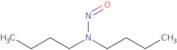
CAS 924-16-3
:N-Nitrosodibutylamine
Description:
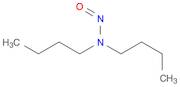
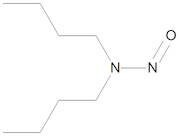
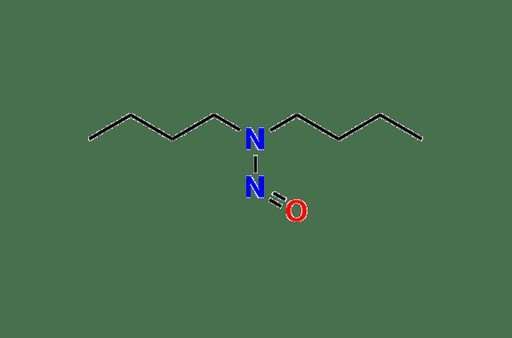
N-Nitrosodibutylamine (CAS 924-16-3) is an organic compound classified as a nitrosamine, which is a group of compounds known for their potential carcinogenic properties. It is formed by the reaction of dibutylamine with nitrous acid. This substance typically appears as a colorless to pale yellow liquid with a characteristic odor. N-Nitrosodibutylamine is soluble in organic solvents but has limited solubility in water. It is known to be stable under normal conditions but can decompose upon exposure to heat or light, potentially releasing toxic gases. Due to its nitrosamine structure, it is of significant concern in toxicology and environmental science, as nitrosamines are often associated with various health risks, including cancer. Handling this compound requires strict safety precautions, including the use of personal protective equipment, due to its hazardous nature. Regulatory agencies monitor its use and presence in various products, particularly in the context of food safety and industrial applications.
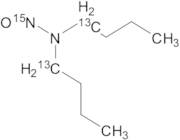
Formula:C8H18N2O
InChI:InChI=1S/C8H18N2O/c1-3-5-7-10(9-11)8-6-4-2/h3-8H2,1-2H3
InChI key:InChIKey=YGJHZCLPZAZIHH-UHFFFAOYSA-N
SMILES:N(CCCC)(CCCC)N=O
Synonyms:- 1-Butanamine, N-butyl-N-nitroso-
- Dibutylamine, N-nitroso-
- Di-n-butylnitrosamine
- N-Butyl-N-nitroso-1-butanamine
- Dibutylnitrosamine
Filter by
Purity percentage
0
100
|
0
|
50
|
90
|
95
|
100
- Lower prices
- Higher prices
- Lower purities
- Higher purities
- Faster estimated delivery
N-Butyl-N-nitroso-1-butanamine
CAS:Formula:C8H18N2OPurity:97%Color and Shape:LiquidMolecular weight:158.2413N-Nitroso-Di-N-butylamine
CAS:Controlled ProductStability Light Sensitive
Applications N-Nitroso-di-n-butylamine (cas# 924-16-3) is a compound useful in organic synthesis.Formula:C8H18N2OColor and Shape:NeatMolecular weight:158.24N,N-dibutylnitrosamine (NDBA)
CAS:Formula:C8H18N2OColor and Shape:Pale yellow liquid.Molecular weight:158.24N-Nitroso-di-n-butylamine (NDBA) in Methanol
CAS:MethanolFormula:C8H18N2OColor and Shape:Pale yellow liquid.Molecular weight:158.24N-Nitroso-di-n-butylamine (NDBA) in Methanol
CAS:MethanolFormula:C8H18N2OColor and Shape:Pale yellow liquid.Molecular weight:158.24N-Nitroso-di-n-butylamine
CAS:N-Nitroso-di-n-butylamine is a nitrosamine that is a product of wastewater treatment. It has been shown to inhibit mitochondrial function and induce liver lesions in rats at high doses. N-Nitroso-di-n-butylamine is structurally similar to the natural substrate ribose, which leads to inhibition of xanthine oxidase, an enzyme involved in purine metabolism. The structural analysis revealed the presence of reactive sites that are susceptible to attack by nucleophiles, such as hydroxyl radicals or hydrogen peroxide. This indicates that N-Nitroso-di-n-butylamine may be a precursor for other carcinogenic compounds. NADH is reduced by NADH dehydrogenase (complex I) in mitochondria to produce NAD+, which subsequently donates electrons to the electron transport chain and generates ATP. The ability of NNDB to inhibit complex I activity was assessed using hl60Formula:C8H18N2OPurity:Min. 95%Molecular weight:158.24 g/mol