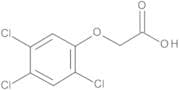
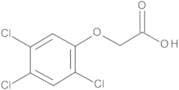
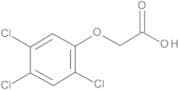
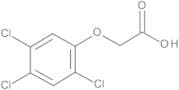
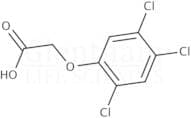
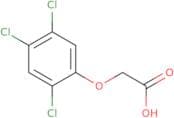
CAS 93-76-5
:Trichlorophenoxyacetic acid
- (2,4,5-Trichloor-Fenoxy)-Azijnzuur[Qr]
- (2,4,5-Trichloor-fenoxy)-azijnzuur
- (2,4,5-Trichlor-Phenoxy)-Essigsaeure[Qr]
- (2,4,5-Trichlor-phenoxy)-essigsaeure
- (2,4,5-Trichlorophenoxy)-Aceticaci
- (2,4,5-Trichlorophenoxy)Ethanoicacid
- (2,4,5-Trichlorophenoxy)acetic acid
- 2,4,5-T
- 2,4,5-Trichlorophenoxyacetate
- 2,4,5-Trichlorophenoxyacetica
- 2-(2,4,5-Trichlorophenoxy)acetic acid
- Acetic acid, (2,4,5-trichlorophenoxy)-
- Acetic acid, 2-(2,4,5-trichlorophenoxy)-
- Arbokan
- BCF-Bushkiller
- Forst U 46
- Fortex
- Nsc 430
- Trichlorophenoxyacetic acid
- Trioxon
- Verton 2T
- See more synonyms
2,4,5-T 100 µg/mL in Acetonitrile
CAS:Controlled ProductFormula:C8H5Cl3O3Color and Shape:Single SolutionMolecular weight:255.48HJ 1022-2019 Pesticides Mixture 14 500 µg/mL in Acetone
CAS:Controlled ProductColor and Shape:MixturePesticide-Mix 128 20 µg/mL in Acetonitrile
CAS:Controlled Product- 120-36-5
- 1702-17-6
- 1918-00-9
- 1918-02-1
- 25057-89-0
- 314-40-9
- 55335-06-3
- 69335-91-7
- 69806-34-4
- 882-09-7
- 93-65-2
- 93-72-1
- 93-76-5
- 94-74-6
- 94-75-7
- 94-81-5
- 94-82-6
Formula:C8H5Cl3O3Color and Shape:MixtureMolecular weight:255.48HJ 1022-2019 Phenoxycarboxylic Pesticides Mixture 10 100 µg/mL in Acetone
CAS:Controlled ProductColor and Shape:MixtureEPA Method 515.2 Underivatized Mixture 404 100-500 µg/mL in Methanol
CAS:Controlled ProductColor and Shape:MixturePesticide-Mix 95 1000 µg/mL in Ethyl acetate
CAS:Controlled Product- 120-36-5
- 1689-83-4
- 1689-84-5
- 1918-00-9
- 25057-89-0
- 50-31-7
- 55335-06-3
- 93-65-2
- 93-76-5
- 94-74-6
- 94-75-7
- 94-81-5
- 94-82-6
Formula:C7H3Cl3O2Color and Shape:MixtureMolecular weight:225.462,4,5-T 10 µg/mL in Acetonitrile
CAS:Formula:C8H5Cl3O3Color and Shape:Single SolutionMolecular weight:255.482,4,5-Trichlorophenoxyacetic Acid
CAS:Controlled ProductApplications 2,4,5-Trichlorophenoxyacetic Acid is suitable for plant cell culture testing. Post-emergence herbicide.
Not a dangerous good if item is equal to or less than 1g/ml and there is less than 100g/ml in the package
References Smith, J., et al.: Science, 203, 1090 (1979), Salunkhe, C., et al.: Plant Cell Reports, 18, 670 (1999), Jheng, F., et al.: Plant Sci., 170, 1133 (2006),Formula:C8H5Cl3O3Color and Shape:NeatMolecular weight:255.482,4,5-Trichlorophenoxyacetic acid
CAS:Controlled Product2,4,5-Trichlorophenoxyacetic acid (2,4,5-T) is a herbicide that inhibits the growth of plants by inhibiting photosynthesis. It can be found in the environment as a contaminant of manufactured items such as vinyl chloride and polyurethane. 2,4,5-T is also used to produce dioxin and polychlorinated biphenyls (PCBs). The mechanism of toxicity involves inhibition of the activity of an enzyme called acetolactate synthase (ALS), which is responsible for synthesizing an important amino acid called L-alanine. ALS inhibitors are toxic to animals because they inhibit the formation of L-alanine and disrupt cellular energy production. In CD-1 mice, 2,4,5-T has been shown to have an inhibitory dose at 1 mg/kg body weight with long-term toxicity at doses up to 5 mg/kg body weight. 2,4,5
Formula:Cl3C6H2OCH2CO2HPurity:Min. 95%Color and Shape:PowderMolecular weight:255.48 g/mol