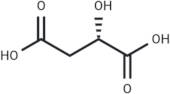
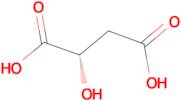
CAS 97-67-6
:L-Malic acid
Description:
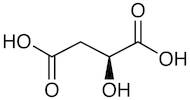
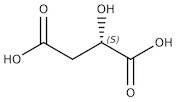
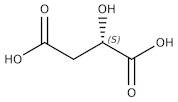
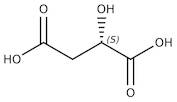
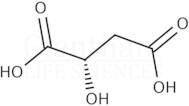
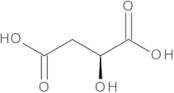
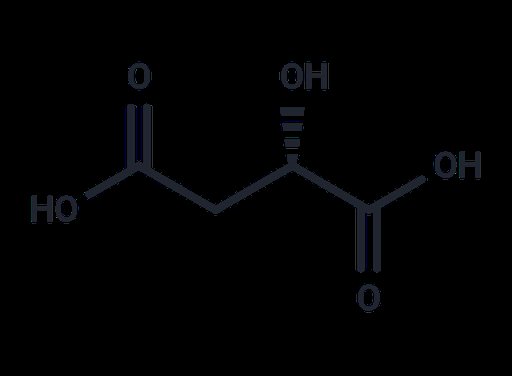
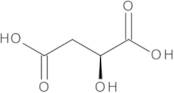
L-Malic acid, with the CAS number 97-67-6, is a naturally occurring organic compound classified as a dicarboxylic acid. It is a colorless, odorless crystalline solid that is soluble in water and has a slightly tart flavor, commonly found in various fruits, particularly apples. L-Malic acid plays a crucial role in the Krebs cycle, a key metabolic pathway for energy production in living organisms. Its molecular formula is C4H6O5, and it features two carboxyl functional groups (-COOH), which contribute to its acidity and reactivity. L-Malic acid is used in the food industry as a flavoring agent and acidulant, enhancing the taste of beverages and candies. Additionally, it has applications in the cosmetic and pharmaceutical industries due to its ability to act as a pH regulator and a chelating agent. The compound is generally recognized as safe (GRAS) when used in food products, and its biodegradable nature makes it an environmentally friendly option in various applications.
Formula:C4H6O5
InChI:InChI=1S/C4H6O5/c5-2(4(8)9)1-3(6)7/h2,5H,1H2,(H,6,7)(H,8,9)/t2-/m0/s1
InChI key:InChIKey=BJEPYKJPYRNKOW-REOHCLBHSA-N
SMILES:[C@H](CC(O)=O)(C(O)=O)O
Synonyms:- (-)-(S)-Malic acid
- (-)-<span class="text-smallcaps">L</span>-Malic acid
- (-)-Hydroxysuccinic acid
- (-)-L-Malic acid
- (-)-Malic acid
- (2S)-2-Hydroxybutanedioic acid
- (2S)-2-Hydroxysuccinic acid
- (2S)-Malic acid
- (S)-2-Hydroxysuccinic acid
- <span class="text-smallcaps">L</span>-Apple acid
- Acide L-malique
- Apple acid
- Butanedioic acid, 2-hydroxy-, (2S)-
- Butanedioic acid, hydroxy-, (S)-
- L-Apfelsaure
- Malic Acid, L-
- Malic acid, <span class="text-smallcaps">L</span>-
- Nsc 9232
- S-2-Hydroxybutanedioic acid
- acido L-malico
- L-Hydroxysuccinic acid
- (S)-(-)-Hydroxysuccinic acid
- L-Maleic Acid
- (2S)-2-hydroxybutanedioate
- Butanedioic acid, hydroxy-, (2S)-
- (S)-HYDROXYBUTANEDIOIC ACID
- HYDROXYBUTANEDIOIC ACID
- L-(-)-APPLE ACID
- 1-HYDROXYSUCCINIC ACID
- L-HYDROXYBUTANEDIOIC ACID
- 2-HYDROXYSYCCINIC ACID
- (S)-2-HYDROXYBUTANEDICARBOXYLIC ACID
- L(-)-MALATE
- NATURAL APPLE ACID
- See more synonyms
Filter by
Purity percentage
0
100
|
0
|
50
|
90
|
95
|
100
- Lower prices
- Higher prices
- Lower purities
- Higher purities
- Faster estimated delivery
L-(-)-Malic Acid
CAS:Formula:C4H6O5Purity:>98.0%(T)Color and Shape:White to Almost white powder to crystalMolecular weight:134.09L-(-)-Malic acid, 99%
CAS:L-(-)-Malic acid is used as a food additive, Selective -amino protecting reagent for amino acid derivatives. Versatile synthon for the preparation of chiral compounds including -opioid receptor agonists, 1,25-dihydroxyvitamin D3 analogue, and phoslactomycin B. This Thermo Scientific Chemicals brandFormula:C4H6O5Purity:99%Color and Shape:White, Powder or crystals or crystalline powderMolecular weight:134.09L-(-)-Malic acid, 97%
CAS:L-(-)-Malic acid is used as Selective -amino protecting reagent for amino acid derivatives. Versatile synthon for the preparation of chiral compounds including -opioid rece. It also acts as active ingredient in many sour or tart foods. It is used as synthesizing disincrustant and fluorescent whiteniFormula:C4H6O5Purity:97%Color and Shape:White, Crystals or powder or crystalline powderMolecular weight:134.09L-Malic acid, ≥99%
CAS:Thermo Scientific L-Malic acidFormula:C4H6O5Purity:99%Color and Shape:White crystalline powderMolecular weight:134.09L-(-)-Malic acid
CAS:Formula:C4H6O5Purity:(Titration) ≥ 99.0%Color and Shape:White to almost white powder or crystalsMolecular weight:134.09(S)-(-)-Malic-2,3,3-d3 Acid93% enantiomeric purity)
CAS:Formula:HOOCCD2CD(OH)COOHPurity:98 atom % DColor and Shape:White SolidMolecular weight:137.04035(S)-2-Hydroxysuccinic acid
CAS:Formula:C4H6O5Purity:98%Color and Shape:SolidMolecular weight:134.0874(S)-Malic acid (Standard)
CAS:(S)-Malic acid (Standard) is a reference standard for the natural fruit acid, used in quantitative analysis and quality control.Formula:C4H6O5Molecular weight:134.09L-(-)-Malic Acid
CAS:Applications The naturally occuring isomer is the L-form which has been found in apples and many other fruits and plants. Selective α-amino protecting reagent for amino acid derivatives. Versatile synthon for the preparation of chiral compounds including κ-opioid receptor agonists, 1α,25-dihydroxyvitamin D3 analogue, and phoslactomycin B.
References Rindi, G., et al.: Biochem. J., 80, 214 (1961), Wolfgang, M., et al.: J. Biol. Chem., 281, 37265 (2006), Navarro, D., et al.: Metab. Brain Dis., 23, 115 (2008),Formula:C4H6O5Color and Shape:NeatMolecular weight:134.09L-(-)-Malic acid
CAS:L-(-)-Malic acidFormula:C4H6O5Purity:98%Color and Shape:White SolidMolecular weight:134.08743(S)-Malic acid
CAS:(S)-Malic acid ((S)-2-Hydroxysuccinic acid) is a naturally occurring dicarboxylic acid that is the source of the sweet and sour flavour of fruits.Formula:C4H6O5Purity:99.72% - 99.98%Color and Shape:White SolidMolecular weight:134.09