Enzyme
Enzyme inhibitors are molecules that bind to enzymes and decrease their activity. These inhibitors are widely used in research to study enzyme kinetics, regulation, and the role of specific enzymes in metabolic pathways. Enzyme inhibitors are also crucial in drug development, as many therapeutic agents function by inhibiting enzymes involved in disease processes. By targeting enzymes, these inhibitors can modulate biochemical pathways and offer potential treatments for various diseases. At CymitQuimica, we provide a comprehensive selection of high-quality enzyme inhibitors to support your research in biochemistry, pharmacology, and drug discovery.
Subcategories of "Enzyme"
- Carbonic Anhydrase(178 products)
- Hydroxylase(30 products)
- MPO(2 products)
- Reductase(52 products)
- Tyrosinase(67 products)
Found 3587 products of "Enzyme"
Sort by
Purity (%)
0
100
|
0
|
50
|
90
|
95
|
100
Malate dehydrogenase,buffered aqueous glycerol solution, 600-1000 units/mg protein (biuret)
CAS:<p>Malic dehydrogenase is a mitochondrial isozyme and an important catalyst in the tricarboxylic acid cycle. The enzyme catalyzes the following reaction: Oxaloacetate + β-NADH → L-Malate + β-NADOne unit will convert 1.0 μmole of oxalacetate and β-NADH to L-malate and β-NAD per min at pH 7.5 at 25 °C.</p>Purity:Min. 95%Creatinase
<p>Creatinase is an enzyme (EC 3.5.3.3) that catalyzes the conversion of creatine to sarcosine and urea.</p>Diaphorase (from Clostridium kluyveri)
CAS:<p>Diaphorase (lipoyl dehydrogenase, EC 1.8.1.4) is an NAD+/NADH-dependent oxidoreductase. One unit of diaphorase will convert 1.0 μmole NADH into NAD+ the presence of substrate at pH 7.5 and 25 °C.</p>Purity:Min. 95%Chitinase
CAS:<p>Chitinase (systematic name (1→4)-2-acetamido-2-deoxy-β-D-glucan glycanohydrolase, EC 3.2.1.14) is a hydrolase that breaks down glycosidic bonds in chitin. One unit of chitinase will yield 1.0 mg of N-acetyl-D-glucosamine from chitin per hour at pH 6.0 and 25 °C.</p>Formula:C17H16N8ZnPurity:Min. 95%Molecular weight:397.74 g/molUrate oxidase (from Yeast)
CAS:<p>Urate Oxidase, also known as uricase, catalizes the following reaction: Uric acid + O2 + H2O → 5-hydroxyisourate + H2O2.</p>Formula:C18H26N5O14PPurity:Min. 95%Molecular weight:567.4 g/molβ-Glucuronidase from Helix pomatia - Type H-2, aqueous solution, ≥85,000 units/mL
CAS:<p>β-Glucuronidase (EC 3.2.1.31) is an enzyme that hydrolyzes glucuronides. It can also be used to cleave benzodiazepine and steroid conjugates. One unit of β-Glucuronidase will hydrolyze a chromogenic substrate mimic 4-nitrophenyl-β-D-glucuronide to produce 1.0 μmole of 4-nitrophenol per minute at pH 5.0 and 37 °C.</p>Purity:Min. 95%Color and Shape:Clear LiquidAcid phosphatase
CAS:<p>One unit will hydrolyse 1.0μmol of 4-nitrophenyl phosphate per minute at 37°C and pH 4.8. Substrate for enzyme analysis is the 4-nitrophenyl phosphate disodium hexahydrate (EN08508).</p>Formula:C6H10O2Purity:Min. 95%Molecular weight:114.14 g/molLipoxidase
CAS:<p>Lipoxidase is an enzyme, which is typically sourced from various plant tissues, animals, and some microorganisms. It functions by catalyzing the oxidation of polyunsaturated fatty acids in the presence of oxygen. This enzymatic action results in the formation of lipid hydroperoxides, which are key intermediates in various biochemical pathways, including those involved in cell signaling and the modulation of gene expression.</p>Purity:Min. 95%EUCODIS® CalB02 IA, engineered variant of Candida antarctica Lipase B, immobilized by adsorption on hydrophobic carrier - ELCB02IA
<p>Lipases belong to the family of esterases and naturally act on triglycerides at lipid-water interfaces. Lipases/esterases can be used as versatile tools in hydrolytic reactions, esterifications and transesterification reactions in industrial and food applications. The CalB02 IA lipase has been immobilized on a hydrophobic carrier by adsorption. The immobilized CalB02 lipase has a temperature optimum in the 40 - 50 °C range and pH optimum between pH 5 and 8.</p>Chloroperoxidase, aqueous suspension
CAS:<p>Chloroperoxidase (also known as chloride peroxidase, systemic name chloride:hydrogen-peroxide oxidoreductase, EC 1.11.1.10) is an enzyme that catalyzes chlorination of organic compounds. Overall reaction is the following:R-H + Cl− + H2O2 + H+ → R-Cl + 2 H2O; reaction intermediate is hypochlorous acid (HOCl). One unit of chloroperoxidase will convert 1.0 μmole of substrate per minute.</p>Color and Shape:PowderCitrate lyase from klebsiella pneumonia ≥0.20 unit/mg solid
CAS:<p>Citrate lyase (also known as ATP citrate synthase, EC 2.3.3.8) is an enzyme that catalyzes the following reaction:citrate + ATP + CoA → oxaloacetate + Acetyl-CoA + ADP + PiEnzymatic activity: One unit will convert 1.0 micromole of citrate to oxalacetate per minute at pH 7.6 and 25 °C in the presence of required cofactors. Citrate lyase is supplied lyophylized, with activity ≥0.20 unit/mg solid.</p>Purity:Min. 95%C. rugosa Lipase 02, CRL 2 from Candida rugosa - ELCR02
<p>Lipases belong to the family of esterases and naturally act on triglycerides at lipid-water interfaces. Lipases/esterases can be used as versatile tools in hydrolytic reactions, esterifications and transesterification reactions in industrial and food applications. The Lipase 02 from the yeast Candida rugosa has a temperature optimum in the 30 - 50 °C range and pH optimum between pH 7 and 8.</p>C. rugosa Lipase 03, CRL 3 from Candida rugosa - ELCR03
<p>Lipases belong to the family of esterases and naturally act on triglycerides at lipid-water interfaces. Lipases/esterases can be used as versatile tools in hydrolytic reactions, esterifications and transesterification reactions in industrial and food applications. The Lipase 03 from the yeast Candida rugosa has a temperature optimum in the 30 - 50 °C range and pH optimum between pH 7 and 8.</p>Proteinase, Bacillus subtilis, sutilain
CAS:<p>Proteinase, Bacillus subtilis, sutilain is a proteolytic enzyme, which is derived from the bacterium Bacillus subtilis. This enzyme exhibits a serine-type mechanism of action, characterized by its ability to cleave peptide bonds in proteins efficiently. It catalyzes the hydrolysis of proteins into peptides and amino acids, facilitating the breakdown of complex proteins into simpler, soluble forms.</p>Purity:Min. 95%Color and Shape:PowderC. rugosa Lipase 01, CRL 1 from Candida rugosa - ELCR01
<p>Lipases belong to the family of esterases and naturally act on triglycerides at lipid-water interfaces. Lipases/esterases can be used as versatile tools in hydrolytic reactions, esterifications and transesterification reactions in industrial and food applications. The Lipase 01 from the yeast Candida rugosa has a temperature optimum in the 30 - 50 °C range and pH optimum between pH 7 and 8.</p>Carboxypeptidase Y, from S. cerevisiae, recombinant, lyophilized - ECPY001
CAS:<p>Carboxypeptidase Y (EC 3.4.16.1) is an exopeptidase enzyme. It hydrolyzes peptide bonds of C-terminal residues and it remains active in the presence of urea at low to moderate concentrations. One unit of the Carboxypeptidase Y will hydrolyze 1.0 μmole of a chromogenic peptide substrate, releasing C-terminal alanine and generating a light-absorbing product. Carboxypeptidase Y has been obtained from yeast S. cerevisiae, has a broad substrate specificity and can therefore be used in sequence analysis of proteins. Carboxypeptidase Y has a temperature optimum in the 20 – 30 °C range and pH optimum between pH 6 and 7.</p>Protease from Streptomyces griseus
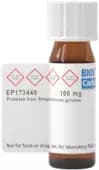
CAS:<p>Protease enzymes break down proteins and are essential for many biological processes, including digestion, cellular regulation and blood clotting. They are also used in many industrial and biotechnological applications for example in food processing and in detergents.</p>Purity:Min. 95%Color and Shape:PowderRibonuclease T1 from aspergillus oryzae
CAS:<p>Ribonuclease T1 is an endonuclease enzyme, which is derived from the fungus Aspergillus oryzae. It specifically cleaves single-stranded RNA at the 3' end of guanosine residues, which involves hydrolyzing the phosphodiester bond to produce 3′-phosphomononucleotides and 5′-hydroxylated oligonucleotides. This enzyme’s high specificity and catalytic efficiency make it valuable for various applications.</p>Purity:Min. 95%Formaldehyde Dehydrogenase
CAS:<p>Formaldehyde dehydrogenase (EC 1.2.1.46) is an enzyme that catalyzes the following reaction: formaldehyde + NAD+ + H2O ⇌ formate + NADH + H+ One unit of formaldehyde dehydrogenase will convert 1.0 µmole of formaldehyde to formic acid per minute at pH 7.5 and 37°C in the presence of NAD+.NAD+ is available here.</p>Glutathione Reductase, baker's yeast
CAS:<p>Glutathione Reductase, baker's yeast, is an enzyme derived from the yeast species *Saccharomyces cerevisiae*. This enzyme is sourced from baker's yeast, providing a renewable and consistent product for various biochemical applications. Its mode of action involves catalyzing the reduction of glutathione disulfide (GSSG) to the sulfhydryl form glutathione (GSH), using NADPH as an electron donor. This reaction is crucial for maintaining the intracellular redox balance by regenerating GSH, the primary cellular antioxidant.</p>