Organic Halides
In this category, you can find organic molecules containing one or more halogen atoms in their structure. These organic halides include brominated, iodinated, chlorinated, and cyclic halide compounds. Organic halides are widely used in organic synthesis, pharmaceuticals, agrochemicals, and materials science due to their reactivity and ability to undergo a variety of chemical transformations. At CymitQuimica, we offer a comprehensive selection of high-quality organic halides to support your research and industrial applications, ensuring reliable and effective performance in your synthetic and analytical projects.
Subcategories of "Organic Halides"
Found 20442 products of "Organic Halides"
Sort by
Purity (%)
0
100
|
0
|
50
|
90
|
95
|
100
N-Methyl-N-phenylcarbamoyl chloride
CAS:N-Methyl-N-phenylcarbamoyl chloride is a fluorinated compound that has been shown to be resistant to treatments with chlorides. It is used for kinetic studies of amines and other functional assays. Deuterium isotope effects have been observed in chloride ion binding experiments, which indicate that the molecule has a greater affinity for the chloride ion than does its non-deuterated counterpart.Formula:C8H8ClNOPurity:Min. 95%Color and Shape:PowderMolecular weight:169.61 g/mol(Des-Gly10,D-Pyr 1,D-Leu6,Pro-NHEt 9)-LHRH trifluoroacetate salt
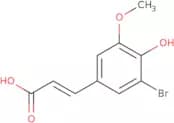
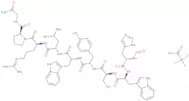
Please enquire for more information about (Des-Gly10,D-Pyr 1,D-Leu6,Pro-NHEt 9)-LHRH trifluoroacetate salt including the price, delivery time and more detailed product information at the technical inquiry form on this pageFormula:C59H84N16O12Purity:Min. 95%Molecular weight:1,209.4 g/mol3-(3-Bromo-4-hydroxy-5-methoxyphenyl)acrylic acid
CAS:3-(3-Bromo-4-hydroxy-5-methoxyphenyl)acrylic acid is a polyphenol that can be found in plants and food. It has been shown to have antimicrobial properties against certain bacteria and fungi, such as Staphylococcus aureus, Clostridium perfringens, and Candida albicans. 3-(3-Bromo-4-hydroxy-5-methoxyphenyl)acrylic acid is synthesized by means of the condensation of p-coumaric acid with acrylic acid in the presence of a base catalyst. This compound undergoes biotransformations such as hydroxylation and oxidation to form 3-(3,4′-dihydroxyphenyl)acrylic acid (DHPAA). The compound is also able to react with other phenolic compounds such as cinnamic acid under certain conditions.Formula:C10H9BrO4Purity:Min. 95%Color and Shape:PowderMolecular weight:273.08 g/mol(Arg8)-Vasopressin (free acid) trifluoroacetate salt
CAS:Please enquire for more information about (Arg8)-Vasopressin (free acid) trifluoroacetate salt including the price, delivery time and more detailed product information at the technical inquiry form on this page
Formula:C46H64N14O13S2Purity:Min. 95%Molecular weight:1,085.22 g/mol(Met(O)35)-Amyloid b-Protein (25-35) trifluoroacetate salt
CAS:Please enquire for more information about (Met(O)35)-Amyloid b-Protein (25-35) trifluoroacetate salt including the price, delivery time and more detailed product information at the technical inquiry form on this pageFormula:C45H81N13O15SPurity:Min. 95%Molecular weight:1,076.27 g/molpTH-Related Protein (1-34) amide (human, mouse, rat) trifluoroacetate salt
CAS:Parathyroid hormone-related protein (PTHrP) is a peptide hormone produced by the parathyroid gland that functions as a phosphatase, inhibiting alkaline phosphatase. It also has an inhibitory effect on osteoclastic bone resorption and stimulates osteoblastic bone formation. PTHrP has been shown to be useful in treating osteoporosis and Paget's disease. It also has been used in conjunction with dexamethasone to treat patients with malignancies of the head and neck. PTHrP is an inhibitor of protein kinase A and phosphodiesterases, which are enzymes that regulate cellular processes such as proliferation and differentiation.Formula:C180H288N58O47Purity:Min. 95%Molecular weight:4,016.58 g/mol3,4-Dichlorothiophenol
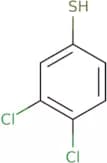
CAS:3,4-Dichlorothiophenol is a chemical compound that belongs to the group of reactive compounds. It can be used as a chemical intermediate for the synthesis of other organic compounds. 3,4-Dichlorothiophenol is an inhibitor of methylating enzymes such as glyoxalase I and II and glyceraldehyde-3-phosphate dehydrogenase. This inhibition leads to the accumulation of methylglyoxal and 3-deoxyglucosone in cells, which are potent inhibitors of protein glycosylation. 3,4-Dichlorothiophenol also inhibits nucleophilic attack on DNA by epoxide hydrolases such as epoxide hydrolase 1 and 2. This inhibition results in the accumulation of reactive metabolites that are covalently adducted with DNA bases.Formula:C6H4Cl2SPurity:Min. 95%Molecular weight:179.07 g/mol4-Iodo-1-methylpyrazole
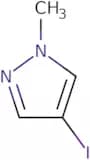
CAS:4-Iodo-1-methylpyrazole is a reductive agent that is used in organic synthesis. It can be used as a reducing agent for the conversion of aldehydes and ketones to alcohols. 4-Iodo-1-methylpyrazole can be crystallized from diethyl etherate and blood. The product yield from this reaction is high, but it requires an oxidant such as trifluoride or plavix to react with the diacetates. 4-Iodo-1-methylpyrazole can also be synthesized by reacting allylsilanes with iodine gas in the presence of a base. This synthesis method produces 4-iodo-1-methylpyrazole in good yield and with little difficulty.Formula:C4H5IN2Purity:Min. 95%Color and Shape:White To Light (Or Pale) Yellow To Tan SolidMolecular weight:208 g/molOsteogenic Growth Peptide (10-14) trifluoroacetate salt
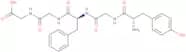
CAS:Osteogenic growth peptide is a cyclic peptide that has been shown to activate the production of collagen and other proteins in fibroblasts. It has also been found to promote hematopoietic cell proliferation, as well as stimulate growth in cultured cells. Osteogenic growth peptide is an analog of TGF-β1, but it differs by having a tyrosine residue at the 10th position instead of an arginine residue. This difference in amino acid sequence alters the activity of this peptide and produces a new compound with different biological effects.Formula:C24H29N5O7Purity:Min. 95%Molecular weight:499.52 g/molN-Me-Abz-Amyloid beta/A4 Protein Precursor770 (708-715)-Lys(Dnp)-D-Arg-D-Arg-D-Arg amide trifluoroacetate salt
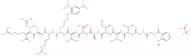
CAS:Please enquire for more information about N-Me-Abz-Amyloid beta/A4 Protein Precursor770 (708-715)-Lys(Dnp)-D-Arg-D-Arg-D-Arg amide trifluoroacetate salt including the price, delivery time and more detailed product information at the technical inquiry form on this pageFormula:C70H116N26O18Purity:Min. 95%Molecular weight:1,609.83 g/mol2-(4-Bromobenzo[d][1,3]dioxole-5-carboxamido)acetic acid
CAS:2-(4-Bromobenzo[d][1,3]dioxole-5-carboxamido)acetic acid is a fine chemical that is used in research and as a reagent. It is also used as a building block for more complex compounds and as a versatile scaffold in organic synthesis. 2-(4-Bromobenzo[d][1,3]dioxole-5-carboxamido)acetic acid can be reacted with other chemicals to create new compounds. This chemical has been shown to have antihistamine properties and may also function as an antipsychotic drug.Formula:C9H6BrNO5Purity:Min. 95%Molecular weight:288.05 g/molFormyl-(D-Trp6)-LHRH (2-10) trifluoroacetate salt
CAS:Please enquire for more information about Formyl-(D-Trp6)-LHRH (2-10) trifluoroacetate salt including the price, delivery time and more detailed product information at the technical inquiry form on this pageFormula:C60H77N17O12Purity:Min. 95%Molecular weight:1,228.36 g/mol1b-(4-Fluorophenyl)hexahydro-',7-dihydroxy-7-(1-methylethyl)-1a-phenyl-7a-[(phenylamino)carbonyl]-3H-oxireno[3,4]pyrrolo[2,1-b][1,3] oxazine-3-butanoic Acid
CAS:Please enquire for more information about 1b-(4-Fluorophenyl)hexahydro-',7-dihydroxy-7-(1-methylethyl)-1a-phenyl-7a-[(phenylamino)carbonyl]-3H-oxireno[3,4]pyrrolo[2,1-b][1,3] oxazine-3-butanoic Acid including the price, delivery time and more detailed product information at the technical inquiry form on this pageFormula:C33H35FN2O7Purity:Min. 95%Molecular weight:590.64 g/molFibronectin CS-1 Fragment (1978-1985) trifluoroacetate salt
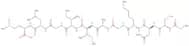
CAS:Fibronectin CS-1 Fragment (1978-1985) trifluoroacetate salt H-Glu-Ile-Leu-Asp-Val-Pro-Ser-Thr-OH trifluoroacetate salt is a peptidomimetic with peroxidase activity. It has the ability to bind to red blood cells and monoclonal antibodies, which are used in spatially specific immunoassays. Fibronectin CS-1 Fragment (1978-1985) trifluoroacetate salt H-Glu-Ile-Leu-Asp-Val-Pro-Ser-Thr-OH trifluoroacetate salt also has an effect on hyperresponsiveness and can be used as a costimulatory antigen for cancer immunotherapy.Formula:C38H64N8O15Purity:Min. 95%Molecular weight:872.96 g/mol3-Fluoro-4-nitroaniline
CAS:3-Fluoro-4-nitroaniline is an asymptomatic infection that inhibits the growth of bacteria by blocking the synthesis of proteins. This drug binds to the hydroxyl group, which is part of the amine function, and forms a covalent bond to the amino function in bacterial ribosomes. 3-Fluoro-4-nitroaniline blocks the formation of a tetrahydropyran ring in bacterial cells, preventing them from growing and multiplying. 3-Fluoro-4-nitroaniline also has been shown to have anticancer properties. It can inhibit tumor cell proliferation by inhibiting DNA synthesis and protein synthesis. The anticancer effects are due to its ability to inhibit cancer cell growth through inhibition of cellular enzymes such as topoisomerase II and cytosolic ribonucleotide reductase.Purity:Min. 95%Mating Factor a trifluoroacetate salt
CAS:Please enquire for more information about Mating Factor a trifluoroacetate salt including the price, delivery time and more detailed product information at the technical inquiry form on this pageFormula:C82H114N20O17S·xC2HF3O2Purity:Min. 95%Molecular weight:1,683.97 g/mol4-Bromobenzo[d]oxazole
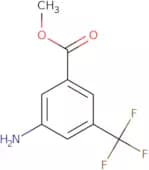
CAS:Please enquire for more information about 4-Bromobenzo[d]oxazole including the price, delivery time and more detailed product information at the technical inquiry form on this pagePurity:Min. 95%Methyl 3-amino-5-(trifluoromethyl)benzoate
CAS:Please enquire for more information about Methyl 3-amino-5-(trifluoromethyl)benzoate including the price, delivery time and more detailed product information at the technical inquiry form on this page
Formula:C9H8F3NO2Purity:Min. 95%Molecular weight:219.16 g/mol(R)-(+)-3-Chloro-1-phenyl-1-propanol
CAS:(R)-(+)-3-Chloro-1-phenyl-1-propanol is a substrate for the lactamase of bacteria. The immobilized lipase catalyzes the hydrolysis reaction in which the lactam ring is broken, yielding a propiophenone intermediate. This intermediate can be converted to (S)-(+)-3-chloro-1-phenylpropanol by treatment with an alcohol oxidase or by hydrolysis with hydrogen peroxide. The product has been shown to have antidepressant activity and may modulate the dry weight of bacteria. In vivo studies show that this compound has a high concentration in rats and mice, but it is not active in humans.Formula:C9H11ClOPurity:Min. 95%Color and Shape:White To Yellow SolidMolecular weight:170.64 g/molCys-Gly-Lys-Lys-Gly-Amyloid b-Protein (36-42) trifluoroacetate salt
CAS:Please enquire for more information about Cys-Gly-Lys-Lys-Gly-Amyloid b-Protein (36-42) trifluoroacetate salt including the price, delivery time and more detailed product information at the technical inquiry form on this pageFormula:C47H86N14O13SPurity:Min. 95%Molecular weight:1,087.34 g/mol




![2-(4-Bromobenzo[d][1,3]dioxole-5-carboxamido)acetic acid](/_next/image/?url=https%3A%2Fstatic.cymitquimica.com%2Fproducts%2F3D%2Fthumb-webp%2FFB66447.webp&w=3840&q=75)
![1b-(4-Fluorophenyl)hexahydro-',7-dihydroxy-7-(1-methylethyl)-1a-phenyl-7a-[(phenylamino)carbonyl]-…](/_next/image/?url=https%3A%2Fstatic.cymitquimica.com%2Fproducts%2F3D%2Fthumb-webp%2FFF171220.webp&w=3840&q=75)


![4-Bromobenzo[d]oxazole](/_next/image/?url=https%3A%2Fstatic.cymitquimica.com%2Fproducts%2F3D%2Fthumb-webp%2FFB142711.webp&w=3840&q=75)