


Biochemicals and Reagents
Subcategories of "Biochemicals and Reagents"
- Biomolecules(98,622 products)
- By Biological Target(100,423 products)
- By Pharmacological Effects(6,927 products)
- Cryopreservatives(21 products)
- Desinfectants and Related Compounds(28 products)
- Hormones(353 products)
- Plant Biology(6,913 products)
- Secondary Metabolites(14,362 products)
Found 130307 products of "Biochemicals and Reagents"
Amyloid beta-Protein (1-11) trifluoroacetate salt
CAS:Please enquire for more information about Amyloid beta-Protein (1-11) trifluoroacetate salt including the price, delivery time and more detailed product information at the technical inquiry form on this page
Formula:C56H76N16O22Purity:Min. 95%Molecular weight:1,325.3 g/molRef: 3D-FA108822
Discontinued productDisulfide biotin azide
CAS:Extraordinary strength of the streptavidin-biotin interaction allows for efficient capturing of even highly dilute targets; however, it makes recovery of proteins from affinity resins challenging. Conventional methods to elute biotinylated proteins from immobilized avidin include the following: (i) denaturation of streptavidin by boiling the resin in a denaturing buffer that may include high concentrations of chaotropic salts, (ii) trypsin digestion of proteins while they are bound to the resin, or (iii) elution of proteins with excess free biotin. These protocols can co-elute contaminant proteins by releasing nonspecifically bound proteins and/or naturally biotinylated proteins concurrently with labeled proteins. In addition, some of these methods can cause elution of high levels of resin-based peptides along with the proteins of interest, resulting in further sample contamination.
Disulfide Biotin Azide probe eliminates a major limitation of the streptavidin-biotin affinity purification. This reagent contains a biotin moiety linked to an azide moiety through a spacer arm containing a cleavable disulfide linker. Captured biomolecules can be efficiently released under mild conditions (50 mM dithiothreitol, 10 mM 2-mercaptoethanol or 1% sodium borohydride) and the small molecular fragment (188.25 Da) left on the labeled protein following cleavage. These features make the cleavable probe especially attractive for use in biomolecular labeling and proteomic studies.Formula:C27H48N8O7S3Purity:Min 95%Molecular weight:692.92 g/molFmoc-Glu(OtBu)-Wang resin (100-200 mesh)
Please enquire for more information about Fmoc-Glu(OtBu)-Wang resin (100-200 mesh) including the price, delivery time and more detailed product information at the technical inquiry form on this page
Purity:Min. 95%Ref: 3D-FF111727
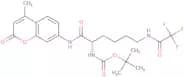
Discontinued productBoc-Lys(Tfa)-AMC
CAS:Boc-Lys(Tfa)-AMC is a small molecule that inhibits the acetylation of histone H3 and has anticancer activity. Acetylation increases the rate of transcription and replication, whereas Boc-Lys(Tfa)-AMC inhibits this process by preventing acetylation. This drug also binds to δ-opioid receptors in cancer cells, triggering a redox signal that leads to inhibition of cancer cell proliferation. The mechanism of this drug's anticancer activity is unknown, but it may be due to its ability to inhibit enzyme activities or disulfide bond formation in vivo.
Formula:C23H28F3N3O6Purity:Min. 95%Molecular weight:499.48 g/molRef: 3D-FB110609
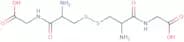
Discontinued product(H-Cys-Gly-OH)2
CAS:Disulfide bond is a covalent chemical bond that links two sulfur atoms to each other. Disulfides are the major form of sulfur-containing proteins, and are important in many biological processes, such as postnatal development, biliary function, hepatitis diagnosis and cancer. Disulfide bonds can be detected using chromatographic methods such as high performance liquid chromatography (HPLC) or gas chromatography (GC). The biosynthesis of disulfides is an essential process in the metabolism of glutathione. Disulfide bonds are formed by the oxidation of two sulfhydryl groups (-SH) in a protein by reactive oxygen species (ROS), which results in the formation of a single disulfide bond between two cysteine residues. This reaction requires glutathione as a cofactor, which catalyzes the formation of -S-S- bridges between two cysteine residues by reducing them to their corresponding thiols (-SH). Glutathione also
Formula:C10H18N4O6S2Purity:Min. 95%Molecular weight:354.41 g/molCyclopyrimorate
CAS:Cyclopyrimorate is a small molecule that has been shown to inhibit the activity of protein kinase C (PKC). Cyclopyrimorate is a potent activator of PKC, and it has been shown to interact with both the ligand binding domain and the activation domain. This inhibitor binds to the ATP binding site on PKC, blocking access by ATP and inhibiting phosphorylation. Cyclopyrimorate has also been shown to have effects on ion channels, including voltage-gated potassium channels, calcium activated potassium channels, and nicotinic acetylcholine receptors. Cyclopyrimorate is a research tool for studying protein interactions in cells. It can be used as an antibody against PKC for immunocytochemistry or Western blotting experiments.
Formula:C19H20ClN3O4Purity:Min. 95%Molecular weight:389.8 g/molH-D-Phe-pip-Arg-pna acetate
CAS:H-D-Phe-pip-Arg-pna acetate is an allosteric modulator that binds to the active site of thrombin. It inhibits activation of zymogen thrombin by binding to its receptor, thereby inhibiting clotting and coagulation. This compound has been shown to inhibit the activation of pyogenes by preventing the formation of fibrin clots, which are essential for bacterial growth. H-D-Phe-pip-Arg-pna acetate has also been shown to have an inhibitory effect on activated coagulation.
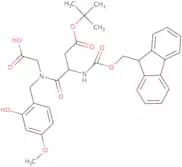
Formula:C27H36N8O5Purity:Min. 95%Molecular weight:552.6 g/molFmoc-D-Asp(OtBu)-(Hmb)Gly-OH
CAS:Please enquire for more information about Fmoc-D-Asp(OtBu)-(Hmb)Gly-OH including the price, delivery time and more detailed product information at the technical inquiry form on this page
Formula:C33H36N2O9Purity:Min. 95%Molecular weight:604.65 g/molKeratinocyte Growth Factor, from E. coli
CAS:Please enquire for more information about Keratinocyte Growth Factor, from E. coli including the price, delivery time and more detailed product information at the technical inquiry form on this page
Purity:Min. 95%Ref: 3D-BK183962
Discontinued productVilaprisan
CAS:Vilaprisan is a synthetic peptide that can act as an inhibitor or activator of protein interactions. It binds to the ligand-binding site of receptor proteins and blocks ion channels, which leads to inhibition of the flow of ions across cell membranes. Vilaprisan has been shown to be a research tool for studying the workings of ion channels and antibodies in cells. Vilaprisan is also used as a reagent to identify and characterize antibodies that are specific for certain receptors, including those with high purity.
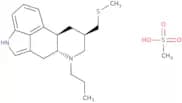
Formula:C27H29F5O4SPurity:Min. 95%Color and Shape:PowderMolecular weight:544.60 g/molPergolide mesylate
CAS:Controlled ProductD1 and D2 dopamine agonist
Formula:C20H30N2O3S2Purity:Min. 95%Color and Shape:White To Off-White SolidMolecular weight:410.6 g/molR-Avanafil
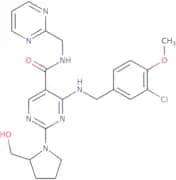
CAS:Please enquire for more information about R-Avanafil including the price, delivery time and more detailed product information at the technical inquiry form on this page
Formula:C23H26ClN7O3Purity:Min. 95%Molecular weight:483.9 g/mol[Ala5, beta-Ala8]-Neurokinin A (4-10)
Catalogue peptide; min. 95% purity
Formula:C35H56N8O9SMolecular weight:765 g/molTachykinin (111-129) Beta-Prepro (Human)
Catalogue peptide; min. 95% purity
Formula:C96H156N34O31SMolecular weight:2,314.59 g/molbeta-Amyloid (17-40)
Catalogue peptide; min. 95% purity
Formula:C110H178N26O31SMolecular weight:2,392.86 g/mol(Arg13)-Amyloid b-Protein (1-40) trifluoroacetate salt
CAS:Please enquire for more information about (Arg13)-Amyloid b-Protein (1-40) trifluoroacetate salt including the price, delivery time and more detailed product information at the technical inquiry form on this pageFormula:C194H300N54O58SPurity:Min. 95%Molecular weight:4,348.85 g/molRef: 3D-FA110203
Discontinued productLys-(Tyr8)-Bradykinin
Catalogue peptide; min. 95% purity
Formula:C56H85N17O13Molecular weight:1,204.41 g/molAngiotensin II Receptor, AT2, Amino Terminal Fragment
Catalogue peptide; min. 95% purity
Formula:C79H125N23O28SMolecular weight:1,877.08 g/mol[Tyr27]-pTH (27-48) (human)
Catalogue peptide; min. 95% purity
Formula:C104H159N29O31Molecular weight:2,311.60 g/mol



![[Ala5, beta-Ala8]-Neurokinin A (4-10)](/_next/image/?url=https%3A%2Fstatic.cymitquimica.com%2Fproducts%2F3D%2Fthumb-webp%2FVAC-00317.webp&w=3840&q=75)


![[Tyr27]-pTH (27-48) (human)](/_next/image/?url=https%3A%2Fstatic.cymitquimica.com%2Fproducts%2F3D%2Fthumb-webp%2FVAC-00893.webp&w=3840&q=75)