Antibiotics
Antibiotics are compounds designed to destroy or inhibit the growth of various microorganisms, playing a crucial role in treating infections and preventing the spread of diseases. This category offers a diverse range of active ingredients specifically for research in the biochemical field. These compounds are essential tools in studying bacterial mechanisms, resistance patterns, and the development of new therapeutic agents. Researchers can explore a wide variety of antibiotics to understand their effects, optimize their use, and develop novel treatments to combat emerging microbial threats. The availability of such a broad spectrum of antibiotics supports advanced research and innovation in microbiology and pharmaceutical sciences.
Subcategories of "Antibiotics"
- Macrolide Antibiotics(26 products)
- Steroidal Antibiotics(31 products)
- Tetracycline Antibiotics(20 products)
- β-Lactam Antibiotics(11 products)
Found 4097 products of "Antibiotics"
Sort by
Purity (%)
0
100
|
0
|
50
|
90
|
95
|
100
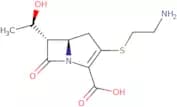
Thienamycin
CAS:<p>Thienamycin is a β-lactam antibiotic, which originates from the fermentation of the bacterium *Streptomyces cattleya*. Its mode of action involves inhibiting the synthesis of bacterial cell walls. Thienamycin accomplishes this by binding to penicillin-binding proteins (PBPs) critical for peptidoglycan construction, thereby disrupting cell wall integrity and leading to bacterial lysis.</p>Formula:C11H16N2O4SPurity:80%MinColor and Shape:PowderMolecular weight:272.32 g/molSulfadiazine
CAS:<p>Sulfadiazine is a sulfonamide antibiotic with action on bacterial folate synthesis inhibition and is used for treating toxoplasmosis and urinary tract infections.</p>Formula:C10H10N4O2SPurity:Min. 95%Color and Shape:PowderMolecular weight:250.28 g/molFinafloxacin
CAS:Finafloxacin is a fluoroquinolone antibacterial agent, which is a synthetic compound derived from the quinolone family. It functions through the inhibition of bacterial DNA gyrase and topoisomerase IV, crucial enzymes in the replication, transcription, and repair of bacterial DNA. This mechanism leads to the prevention of bacterial cell division and ultimately results in cell death.Formula:C20H19FN4O4Purity:Min. 95%Molecular weight:398.39 g/molEnrofloxacin HCl
CAS:<p>Enrofloxacin HCl is a fluoroquinolone antibiotic, which is a synthetic compound derived from chemical synthesis. Its mode of action involves the inhibition of bacterial DNA gyrase and topoisomerase IV, critical enzymes in bacterial DNA replication and transcription processes. This action disrupts bacterial cellular division and transcription, leading to cell death.</p>Formula:C19H22FN3O3•HClPurity:Min. 95%Molecular weight:395.86 g/molClindamycin-2,3-diphosphate
<p>Clindamycin-2,3-diphosphate is a biochemical compound, which is derived from the antibiotic clindamycin, sourced through chemical modification to include diphosphate groups. Its mode of action involves inhibiting bacterial protein synthesis by binding to the 50S ribosomal subunit, thus interfering with peptide chain initiation and elongation. This disruption effectively halts bacterial growth, particularly in Gram-positive bacteria, and is crucial in combatting infections resistant to other antibiotics.</p>Formula:C18H35ClN2O11P2SPurity:Min. 95%Molecular weight:584.94 g/molCefazolin, Antibiotic for Culture Media Use Only
CAS:<p>Cefazolin is a semi-synthetic, non-beta lactam antibiotic used for the treatment of a variety of bacterial infections. It inhibits cell wall synthesis by binding to one or more of penicillin-binding proteins (PBPs), which are bacterial transpeptidases that crosslink peptidoglycan strands. Cefazolin binds to PBPs present on the surface of all Gram-negative bacteria as well as many Gram-positive bacteria. It is not effective against methicillin-resistant staphylococcus and MRSA unless combined with another antibiotic such as vancomycin or flucloxacillin. A study showed that cefazolin can decrease inflammation and tumor necrosis factor-beta levels in pregnant women with systemic inflammatory disease. It has been tested in the development of an anti-inflammatory agent for use in patients with autoimmune diseases such as rheumatoid arthritis and lupus erythe.</p>Formula:C14H14N8O4S3Molecular weight:454.51 g/molErythromycin B
CAS:<p>Erythromycin B is a semisynthetic macrolide antibiotic, which is derived from the actinomycete *Saccharopolyspora erythraea*. Its mode of action involves inhibiting bacterial protein synthesis by binding to the 50S ribosomal subunit. This interference with protein synthesis effectively hampers bacterial growth, making it a potent bacteriostatic agent.</p>Formula:C37H67NO12Purity:90%NmrMolecular weight:717.93 g/molStreptidine
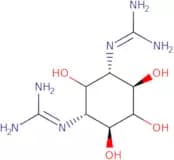
CAS:<p>Streptidine is an amino cyclitol, which is a component of certain aminoglycoside antibiotics. This compound originates from the actinomycete *Streptomyces griseus*, a soil bacterium known for its ability to produce a variety of antibiotics. Streptidine plays a crucial role in the mechanism of aminoglycosides by contributing to the binding affinity of these antibiotics to the bacterial ribosome.</p>Formula:C8H18N6O4Purity:Min. 95%Molecular weight:262.13895Dihydrostreptomycin sesquisulfate
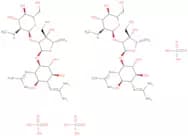
CAS:<p>Dihydrostreptomycin sesquisulfate is an aminoglycoside antibiotic, which is derived from the bacterium Streptomyces griseus. Its mode of action involves binding to the 30S subunit of the bacterial ribosome, leading to the disruption of protein synthesis. This binding interferes with the initiation complex formation, causing misreading of mRNA and ultimately inhibiting bacterial growth.</p>Formula:C21H41N7O12•(H2SO4)1Purity:Min. 95%Molecular weight:730.71 g/molPazufloxacin
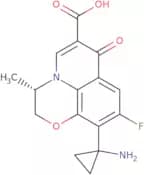
CAS:<p>Pazufloxacin is an antibacterial agent, which is a synthetic derivative originating from the fluoroquinolone class of compounds. This source categorizes it alongside a group of broad-spectrum antibiotics known for their efficacy against a wide variety of bacterial pathogens. The mode of action of pazufloxacin involves the inhibition of bacterial DNA gyrase and topoisomerase IV. These are essential enzymes for bacterial DNA replication, transcription, repair, and recombination processes. By inhibiting these enzymes, pazufloxacin disrupts the bacterial DNA processes, ultimately leading to cell death.</p>Formula:C16H15FN2O4Purity:Min. 95%Molecular weight:318.3 g/molCephamycin C
CAS:<p>Cephamycin C is a cephalosporin antibiotic, which is a type of β-lactam antibiotic. It is derived from the fermentation process of certain Streptomyces species and other actinomycetes. Its mode of action involves inhibiting bacterial cell wall synthesis by binding to penicillin-binding proteins (PBPs). This inhibition disrupts the structural integrity of the bacterial cell wall, leading to cell lysis and death.</p>Formula:C16H22N4O9SPurity:Min. 95%Color and Shape:PowderMolecular weight:446.4 g/molPirlimycin HCl
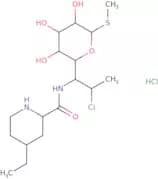
CAS:<p>Pirlimycin HCl is an antibacterial product, which is a semi-synthetic derivative of the natural antibiotic lincomycin produced by Streptomyces lincolnensis. Its mode of action involves the inhibition of bacterial protein synthesis by binding to the 50S ribosomal subunit, thereby preventing the elongation of peptide chains. This action is particularly effective against Gram-positive bacteria, including Staphylococcus and Streptococcus species.</p>Formula:C17H31ClN2O5S·HClPurity:Min. 95%Color and Shape:White PowderMolecular weight:447.42 g/molLoracarbef monohydrate
CAS:<p>Loracarbef monohydrate is a synthetic antibiotic, which is derived from carbacephem compounds with a mode of action that involves inhibiting bacterial cell wall synthesis. This is achieved by binding to penicillin-binding proteins, thereby blocking the cross-linking of peptidoglycan chains which are crucial for bacterial cell wall structural integrity.</p>Formula:C16H16ClN3O4·H2OPurity:Min. 95%Molecular weight:367.78 g/molCefacetrile sodium
CAS:<p>Cefacetrile sodium is a broad-spectrum antibiotic belonging to the cephalosporin class. It is a semi-synthetic derivative sourced from cephalosporin C, a naturally occurring compound derived from the Acremonium fungus. Its mode of action involves the inhibition of bacterial cell wall synthesis. This occurs by binding to penicillin-binding proteins within the bacterial cell membrane, ultimately leading to cell lysis and death due to the inability to synthesize peptidoglycan, a critical component of the bacterial cell wall.</p>Formula:C13H13N3NaO6SPurity:Min. 95%Molecular weight:362.31 g/molChlortetracycline-13C-d3 hydrochloride
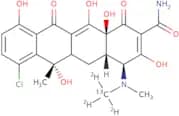
Controlled Product<p>Chlortetracycline-13C-d3 hydrochloride is a stable isotope-labeled antibiotic with action on bacterial protein synthesis inhibition and is used for research in bacterial resistance and analytical studies.</p>Formula:C2113CH21D3Cl2N2O8Color and Shape:PowderMolecular weight:519.35 g/molClindamycin-d3 hydrochloride
CAS:Controlled Product<p>Clindamycin-d3 hydrochloride is an isotopically labeled pharmaceutical compound, specifically designed for use in the field of analytical chemistry and pharmacokinetics. It is derived from clindamycin, a known antibiotic sourced from modifications of the naturally occurring compound lincomycin, produced by the actinobacterium Streptomyces lincolnensis. The incorporation of deuterium atoms, replacing hydrogen, allows for its use in sophisticated analytical methods such as mass spectrometry, where it serves to trace the metabolic pathways and to quantify the bioavailability and distribution of clindamycin in biological systems with high precision.</p>Formula:C18H30ClD3N2O5S•HClPurity:Min. 95%Molecular weight:464.46 g/molLincomycin 2-palmitate hydrochloride
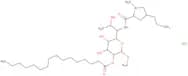
CAS:<p>Lincomycin 2-palmitate hydrochloride is a semi-synthetic antibiotic, derived from the natural antibiotic lincomycin through chemical modification. It is sourced from fermentative processes involving the bacterium *Streptomyces lincolnensis*. The compound exerts its action by inhibiting protein synthesis in susceptible bacteria. This occurs through its binding to the 50S subunit of the bacterial ribosome, thereby hindering peptide chain elongation and ultimately arresting bacterial growth.</p>Formula:C34H65ClN2O7SPurity:Min. 95%Molecular weight:681.41 g/molMitomycin D
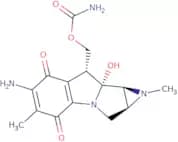
CAS:<p>Mitomycin D is an antibiotic and chemotherapeutic agent known for its ability to inhibit DNA synthesis, making it a potent antitumor agent. It is derived from the bacterium *Streptomyces caespitosus*. Mitomycin D functions as a DNA crosslinking agent by alkylating the DNA strands, which interferes with DNA replication and transcription. This mechanism leads to the cessation of cellular division and ultimately induces apoptosis in rapidly dividing cells.</p>Formula:C15H18N4O5Purity:Min. 95%Molecular weight:334.33 g/molHypothemycin
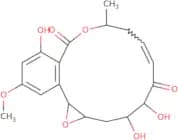
CAS:<p>Hypothemycin is a natural product that serves as a potent inhibitor of protein kinases. It is derived from the fungus Hypomyces subiculosus and belongs to the class of resorcylic acid lactones. Its mode of action involves binding covalently to the ATP-binding site of kinases, leading to the inhibition of their activity. This covalent modification is achieved through the formation of a Michael-type addition with a reactive ene-diene functionality within its structure. By targeting these critical enzymes, hypothemycin disrupts key signaling pathways that are essential for cell growth and proliferation.</p>Purity:Min. 95%Phleomycin
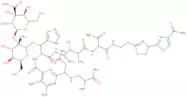
CAS:<p>Phleomycin is an antibiotic, which is derived from the bacterium *Streptomyces verticillus*. Its mode of action involves binding to DNA and inducing breaks by generating free radicals in the presence of oxygen and ferrous ions, leading to cell death. Phleomycin is prominently used in molecular biology applications as a selective agent in the generation of stable transfectants. It is particularly effective in selecting for cells that have integrated vectors conferring resistance, such as the Sh ble gene used in yeast, plant, and mammalian cell systems. Due to its potent DNA-cleaving ability, Phleomycin is valuable in studies requiring stringent selection pressure. Researchers commonly utilize it in experiments focusing on genetic modification and cellular resistance development.</p>Formula:C51H75N17O21S2Purity:Min. 95%Molecular weight:1,326.38 g/mol