Hydrocarbon Building Blocks
Hydrocarbon building blocks are organic compounds consisting solely of carbon and hydrogen atoms. These fundamental structures serve as the basis for synthesizing a wide variety of complex molecules. Hydrocarbon building blocks are used in the development of pharmaceuticals, polymers, and other organic compounds. At CymitQuimica, we offer a broad range of high-quality hydrocarbon building blocks to facilitate your synthetic and research projects.
Subcategories of "Hydrocarbon Building Blocks"
Found 5575 products of "Hydrocarbon Building Blocks"
Sort by
Purity (%)
0
100
|
0
|
50
|
90
|
95
|
100
3,3'-Diindolymethane (synthetic)
CAS:<p>3,3'-Diindolylmethane, also known as DIM, is natural compound derived from indole. In a recent study, DIM was evaluated as a potential agent for preventing biofilm formation by Streptococcus mutans, which is a major cause of dental caries. The researchers found that DIM significantly inhibited biofilm formation (by 92%) and reduced the production of extracellular polymeric substances (EPS), which are important for biofilm stability particularly under acidic conditions. The study suggests that 3,3'-diindolylmethane has anti-biofilm and anti-virulence properties against S. mutans, and it is a potential candidate for reducing biofilm formation and preventing dental caries.<br>It has been also reported that 3,3'-diindolymethane can act as a chemopreventive agent. DIM has estrogenic effects without interacting with the binding domain of the estrogen receptors. This study found that DIM could suppress cell growth and disrupt cell cycle progression of young adult mouse colonocytes (YAMCs) in vitro. Moreover, DIM altered gene expression associated with apoptosis and cell proliferation, and it induced transcriptional activity of the estrogen receptor (ER), which was inhibited by an ER antagonist.</p>Formula:C17H14N2Purity:Min. 95%Color and Shape:PowderMolecular weight:246.31 g/mol6-N-Biotinylaminohexanol
CAS:<p>6-N-Biotinylaminohexanol is a fine chemical that is used as a reagent or as a speciality chemical in research. This compound has also been shown to be a versatile building block for the synthesis of complex compounds and useful scaffolds for medicinal chemistry. 6-N-Biotinylaminohexanol is soluble in organic solvents, such as alcohols and ethers, but insoluble in water. It can be used as an intermediate in organic synthesis or as a reactant for the preparation of other chemicals.</p>Formula:C16H29N3O3SPurity:Min. 95%Color and Shape:PowderMolecular weight:343.49 g/mol9-Fluorenemethanol
CAS:<p>9-Fluorenemethanol is a chemical compound that is used as a reagent in analytical chemistry. It reacts with zirconium oxide to form 9-fluorenylmethyl zirconium chloride, which can be used to detect the presence of ethyl formate by fluorescence resonance spectroscopy. The reaction solution is heated at 100°C for about 4 hours and then cooled to room temperature. The isolated yield of 9-fluorenylmethyl zirconium chloride is determined by the detection time and thermodynamic parameters. This compound can also be used in acylation reactions.</p>Formula:C14H12OPurity:Min. 95%Color and Shape:White PowderMolecular weight:196.24 g/mol3-Isopropylamino)-1,2-propanediol
CAS:<p>3-Isopropylamino)-1,2-propanediol is a chiral molecule that can exist in two forms, or enantiomers. The two enantiomers of 3-isopropylamino)-1,2-propanediol are mirror images of each other and have different physical properties. One form has a hydroxyl group at the 3 position and the other has a hydroxyl group at the 1 position. These two forms are called R-(+)-3-isopropylamino)-1,2-propanediol and S-(−)-3-isopropylamino)-1,2-propanediol. 3-Isopropylamino)-1,2-propanediol is used in biotechnology to produce chiral compounds and as an intermediate in bioscience research. It is also used as an organic solvent in biochemistry and stereochemistry experiments.</p>Formula:C6H15NO2Purity:Min. 95%Color and Shape:White to off-white solid.Molecular weight:133.19 g/mol1,3-Thiazol-2-ylmethanol
CAS:<p>1,3-Thiazol-2-ylmethanol is a macrocyclic compound that has a structure similar to that of the natural product phenylbutazone. It is synthesized from 1,3-thiazol-2-amine and benzaldehyde by dehydrogenative condensation. The ligand binds with metal ions via its thionyl group. The metal ion coordinates with the chloride anion and the ligand to produce a planar geometry. This process also produces a distillate that contains phenylbutazone as a major product.</p>Formula:C4H5NOSPurity:Min. 95%Color and Shape:White PowderMolecular weight:115.15 g/molN-Methyl methanesulfonamide
CAS:<p>N-Methyl methanesulfonamide is an amide compound that has a vibrational frequency of 1605 cm-1. It is used in the manufacture of covid-19, a pandemic influenza virus vaccine. Covid-19 contains N-methyl methanesulfonamide as one of its ingredients. The vaccine has been shown to have a constant temperature and an inhibitory effect on the production of tyrosine kinase, which is a protein that regulates cell growth and division. The reaction product also inhibits sulfoxide reductase, an enzyme that catalyzes the reduction of sulfoxides. N-Methyl methanesulfonamide is susceptible to acidic hydrolysis and can be structurally represented as follows:</p>Formula:C2H7NO2SPurity:Min. 95%Color and Shape:Light (Or Pale) Yellow To Amber To Brown LiquidMolecular weight:109.15 g/mol2,3-Dichloro-1-propanol
CAS:<p>2,3-Dichloro-1-propanol is a metabolic byproduct of chlorinated solvents. It has been shown to be toxic to mitochondria and can cause mitochondrial membrane potential disruption in rat liver cells. The chemical reacts with fatty acids to form a reactive carbonyl group that can react with the hydrogen bond of membrane phospholipids. This reaction disrupts the structure of the lipid bilayer, leading to mitochondrial degeneration. 2,3-Dichloro-1-propanol also reacts with glutathione and carbonic anhydrase, which leads to the formation of reactive intermediates that react with DNA or proteins. These reactions are responsible for the observed toxicity effects in animals.</p>Formula:C3H6Cl2OPurity:Min. 95%Color and Shape:Clear LiquidMolecular weight:128.98 g/molN-Butanesulfonyl-O-[4-(4-pyridinyl)-butyl]-(S)-tyrosine
CAS:<p>N-Butanesulfonyl-O-[4-(4-pyridinyl)-butyl]-(S)-tyrosine is a synthetic amino acid. It is soluble in water and forms hydrates. The yield of this reaction is 60%. The molecular weight of this compound is 233.3 g/mol. This compound has been shown to have proteolytic activity, which may be due to its ability to cleave peptide bonds in proteins. N-Butanesulfonyl-O-[4-(4-pyridinyl)-butyl]-(S)-tyrosine may also be used as an intermediate for the synthesis of other compounds, such as aminoglycosides and antibiotics. This chemical can be synthesized by reacting L-tyrosine with butanesulfonyl chloride in the presence of sodium hydroxide and an organic base, such as pyridine. The solvents used in this process are chloroform, dich</p>Formula:C22H30N2O5SPurity:Min. 95%Color and Shape:PowderMolecular weight:434.55 g/mol2-Oxa-6-azaspiro[3.4]octane
CAS:<p>2-Oxa-6-azaspiro[3.4]octane is an epidermal growth factor (EGF) inhibitor that has shown inhibitory activities against a number of different EGFR-related cell lines, including parental and mutant cell lines. This drug has been shown to inhibit the proliferation of cancer cells in vitro by binding to the epidermal growth receptor (EGFR). 2-Oxa-6-azaspiro[3.4]octane also inhibits the activity of tyrosine kinases and factor receptors, which are involved in the development of cancer cells. It is a potent inhibitor of TK1 and TK2 tyrosine kinases, and is more potent than piperazine or morpholine, which are other EGF inhibitors.</p>Formula:C6H11NOPurity:Min. 95%Color and Shape:White PowderMolecular weight:113.16 g/molSodium trifluoromethanesulfonate
CAS:<p>Sodium trifluoromethanesulfonate is an inorganic salt that is used as a reagent in organic synthesis. It is prepared by treating sodium metal with hydrogen fluoride and carbon disulfide. Sodium trifluoromethanesulfonate can be used to form stable complexes with copper(II) chloride, which are useful for the synthesis of organic compounds. This compound has been shown to undergo intermolecular hydrogen bonding interactions with glycol ethers, which are model systems for polymers. Sodium trifluoromethanesulfonate also has the ability to form hydrogen bonds with water molecules, which is important for its use in electrolytes. The structural analysis of sodium trifluoromethanesulfonate reveals that it contains one asymmetric center, which may be responsible for its ability to form hydrogen bonds.</p>Formula:CHF3O3S•NaPurity:Min. 95%Color and Shape:White PowderMolecular weight:173.07 g/mol4-(Chloromethyl)styrene (stabilized with TBC + ONP + 2-Nitro-p-cresol)
CAS:Formula:C9H9ClPurity:>90.0%(GC)Color and Shape:Light yellow to Yellow to Orange clear liquidMolecular weight:152.623,4-Dihydro-2H-pyran-2-methanol
CAS:<p>3,4-Dihydro-2H-pyran-2-methanol is a tetrahydropyran alcohol that has been shown to be able to form cationic polymers in the presence of a ring-opening metathesis polymerization catalyst. The chloride anion is also capable of initiating the polymerization reaction. This compound has potential applications as a drug delivery agent or biomaterials scaffold due to its ability to act as a linker for the synthesis of biocompatible polymers. 3,4-Dihydro-2H-pyran-2-methanol can also be used in molecular modelling studies to explore the reactivity between hydroxy groups and nucleophiles.</p>Formula:C6H10O2Purity:Min. 95%Color and Shape:Colorless PowderMolecular weight:114.14 g/molRef: 10-F621580
1g285.00€5g895.00€10g1,656.00€2.5g643.00€50mg75.00€100mg86.00€250mg136.00€500mg252.00€[S(R)]-N-[(S)-[3-(Benzyloxy)-2-(dicyclohexylphosphino)phenyl]-(2-naphthalenyl)methyl]-2-methyl-2-propanesulfinamide
CAS:Purity:95%Molecular weight:639.88[S(R)]-N-[(1S)-1-[2-(Di-tert-butylphosphanyl)phenyl]-2,2-dimethylpropyl]-2-methyl-2-propanesulfinamide
CAS:Purity:95%Molecular weight:411.63[S(R)]-N-[(R)-(3,5-Di-tert-butyl-4-methoxyphenyl)[2-(diphenylphosphino)-4,5-dimethoxyphenyl]-2-methyl-2-propanesulfinamide
CAS:Purity:95%Molecular weight:673.893-(4-Methylthiobenzoyl)propionic acid
CAS:Formula:C11H12O3SPurity:97.0%Color and Shape:SolidMolecular weight:224.27[S(R)]-N-[(R)-[2-(Diadamantanphosphino)phenyl]phenylmethyl]-2-methyl-2-propanesulfinamide
CAS:Purity:97%Molecular weight:587.852-((tert-Butoxycarbonyl)amino)-4-methylpyrimidine-5-carboxylic acid
CAS:Purity:97%Molecular weight:253.258[S(R)]-N-[(S)-[2-(Diphenylphosphino)-4,5-dimethoxyphenyl]-1-naphthalenylmethyl]-2-methyl-2-propanesulfinamide
CAS:Purity:95%Molecular weight:581.715-{[4-(diethylamino)phenyl]methylidene}-2-sulfanylideneimidazolidin-4-one
CAS:Purity:97%Molecular weight:275.374-(Trifluoromethyl)benzamidoxime
CAS:Formula:C8H7F3N2OPurity:97.0%Color and Shape:Solid, Crystalline Powder or PowderMolecular weight:204.152[S(R)]-N-[(1S)-1-(2′,6′-Diisopropyl)-(1,1′-biphenyl)-2-yl]-2-(diphenylphosphino)ethyl]-2-methyl-2-propanesulfinamide
CAS:Purity:95%Molecular weight:569.79trans-2-(2-Methoxyphenyl)-5-oxotetrahydrofuran-3-carboxylic acid
CAS:Purity:98%Molecular weight:236.223[S(R)]-N-[(R)-[5-(Diphenylphosphino)-9,9-dimethyl-9H-xanthen-4-yl]phenylmethyl]-2-methyl-2-propanesulfinamide
CAS:Purity:97%Color and Shape:SolidMolecular weight:603.76[S(R)]-N-[(S)-[3,5-Di-tert-butyl-4-methoxyphenyl][(3-benzyloxy-2-(dicyclohexylphosphino)phenyl)methyl]-2-methyl-2-propanesulfinamide
CAS:Purity:95%Molecular weight:732.06[S(R)]-N-[(R)-[4-(1,1-Dimethylethyl)phenyl][5-(diphenylphosphino)-9,9-dimethyl-9H-xanthen-4-yl]methyl]-2-methyl-2-propanesulfinamide
CAS:Purity:95%Molecular weight:659.87[S(R)]-N-[(1R)-1-[5-(Diphenylphosphino)-9,9-dimethyl-9H-xanthen-4-yl]-2,2-dimethylpropyl]-2-methyl-2-propanesulfinamide
CAS:Purity:95%Molecular weight:583.77[S(R)]-N-[(R)-[2-(Diphenylphosphino)phenyl](4-methoxyphenyl)methyl]-2-methyl-2-propanesulfinamide
CAS:Purity:95%Molecular weight:501.62(Z)-N-[2-(1-methyl-1H-imidazol-2-yl)-1-phenylethylidene]hydroxylamine
CAS:Purity:97%Molecular weight:215.256(2-Chloro-(3-pyridyl))-N-(5-methylisoxazol-3-yl)formamide
CAS:Formula:C10H8ClN3O2Purity:97.0%Color and Shape:SolidMolecular weight:237.643-Trimethylsilyl-2-propynl)triphenylphosphoniumBromide
CAS:<p>S20260 - 3-Trimethylsilyl-2-propynl)triphenylphosphoniumBromide</p>Formula:C24H26BrPSiPurity:98.0%Molecular weight:453.4352-(5-METHYL-1,2-OXAZOL-3-YL)BUT-3-YN-2-OL
CAS:Formula:C8H9NO2Purity:95.0%Color and Shape:LiquidMolecular weight:151.1651-Heptynyltrimethylsilane
CAS:<p>S09310 - 1-Heptynyltrimethylsilane</p>Formula:C10H20SiColor and Shape:LiquidMolecular weight:168.355(2S,4R)-1-(tert-Butoxycarbonyl)-4-(prop-2-yn-1-yl)pyrrolidine-2-carboxylic acid
CAS:Formula:C13H19NO4Purity:95.0%Color and Shape:LumpsMolecular weight:253.298(4-Pyridinylethynyl)trimethylsilane
CAS:Formula:C10H13NSiPurity:95%Color and Shape:LiquidMolecular weight:175.3068-Bromo-7-(but-2-yn-1-yl)-3-methyl-1H-purine-2,6(3H,7H)-dione
CAS:Formula:C10H9BrN4O2Purity:98%Color and Shape:SolidMolecular weight:297.1124-Pentynyl methanesulfonate
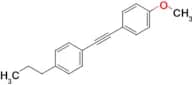
CAS:Formula:C6H10O3SPurity:97%Color and Shape:Liquid, OilMolecular weight:162.21-(2-(4-METHOXYPHENYL)ETHYNYL)-4-PROPYLBENZENE
CAS:Formula:C18H18OPurity:98%Color and Shape:No data available.Molecular weight:250.3413-(2-naphthyl)prop-2-ynoic acid
CAS:Formula:C13H8O2Purity:95.0%Color and Shape:SolidMolecular weight:196.205