Silanes
Subcategories of "Silanes"
Found 1234 products of "Silanes"
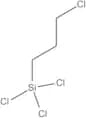
3-CHLOROPROPYLTRICHLOROSILANE
CAS:Formula:C3H6Cl4SiPurity:97%Color and Shape:Straw LiquidMolecular weight:211.98DIPHENYLDIMETHOXYSILANE, 98%
CAS:Arylsilane Cross-Coupling Agent
The cross-coupling reaction is a highly useful methodology for the formation of carbon-carbon bonds. It involves two reagents, with one typically being a suitable organometallic reagent - the nucleophile - and the other a suitable organic substrate, normally an unsaturated halide, tosylate or similar - the electrophile.
Aromatic Silane - Conventional Surface Bonding
Aliphatic, fluorinated aliphatic or substituted aromatic hydrocarbon substituents are the hydrophobic entities which enable silanes to induce surface hydrophobicity. The organic substitution of the silane must be non-polar. The hydrophobic effect of the organic substitution can be related to the free energy of transfer of hydrocarbon molecules from an aqueous phase to a homogeneous hydrocarbon phase. A successful hydrophobic coating must eliminate or mitigate hydrogen bonding and shield polar surfaces from interaction with water by creating a non-polar interphase. Although silane and silicone derived coatings are in general the most hydrophobic, they maintain a high degree of permeability to water vapor. This allows coatings to breathe and reduce deterioration at the coating interface associated with entrapped water. Since ions are not transported through non-polar silane and silicone coatings, they offer protection to composite structures ranging from pigmented coatings to rebar reinforced concrete. A selection guide for hydrophobic silanes can be found on pages 22-31 of the Hydrophobicity, Hydrophilicity and Silane Surface Modification brochure.
Diphenyldimethoxysilane; Dimethoxydiphenylsilane
Viscosity, 25°C: 8.4 cStAlternative to phenyltrimethoxysilane for the cross-coupling of a phenyl groupIntermediate for high temperature silicone resinsDialkoxy silaneFormula:C14H16O2SiPurity:98%Color and Shape:Straw LiquidMolecular weight:244.36ACRYLOXYMETHYLTRIMETHOXYSILANE
CAS:Acrylate Functional Trialkoxy Silane
Silane coupling agents have the ability to form a durable bond between organic and inorganic materials to generate desired heterogeneous environments or to incorporate the bulk properties of different phases into a uniform composite structure. The general formula has two classes of functionality. The hydrolyzable group forms stable condensation products with siliceous surfaces and other oxides such as those of aluminum, zirconium, tin, titanium, and nickel. The organofunctional group alters the wetting or adhesion characteristics of the substrate, utilizes the substrate to catalyze chemical transformations at the heterogeneous interface, orders the interfacial region, or modifies its partition characteristics, and significantly effects the covalent bond between organic and inorganic materials.
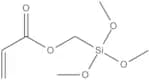
Acryloxymethyltrimethoxysilane
Coupling agent for UV curable systemsComonomer for ormosilsUsed in microparticle surface modificationComonomer for free-radical polymerizaitonInhibited with MEHQFormula:C7H14O5SiPurity:97%Color and Shape:Straw LiquidMolecular weight:206.27METHACRYLOXYPROPYLTRIMETHOXYSILANE
CAS:Methacrylate Functional Trialkoxy Silane
Silane coupling agents have the ability to form a durable bond between organic and inorganic materials to generate desired heterogeneous environments or to incorporate the bulk properties of different phases into a uniform composite structure. The general formula has two classes of functionality. The hydrolyzable group forms stable condensation products with siliceous surfaces and other oxides such as those of aluminum, zirconium, tin, titanium, and nickel. The organofunctional group alters the wetting or adhesion characteristics of the substrate, utilizes the substrate to catalyze chemical transformations at the heterogeneous interface, orders the interfacial region, or modifies its partition characteristics, and significantly effects the covalent bond between organic and inorganic materials.
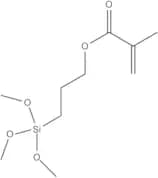
Methacryloxypropyltrimethoxysilane, 3-(Trimethoxysilyl)propyl methacrylate, MEMO
Viscosity: 2 cStSpecific wetting surface: 314 m2/gCopolymerization parameters-e, Q: 0.07, 2.7Coupling agent for radical cure polymer systems and UV cure systemsWidely used in unsaturated polyester-fiberglass compositesCopolymerized with styrene in formation of sol-gel compositesAnalog of (3-acryloxypropyl)trimethoxysilane (SIA0200.0)Used in microparticle surface modification and dental polymer compositesSlower hydrolysis rate than methacryloxymethyltrimethoxysilane (SIM6483.0)Comonomer for free-radical polymerizaitonDetermined by TGA a 25% weight loss of dried hydrolysates at 395°Inhibited with MEHQ, HQFormula:C10H20O5SiPurity:97%Color and Shape:Straw LiquidMolecular weight:248.35(N,N-DIMETHYLAMINO)DIMETHYLSILANE, 95%
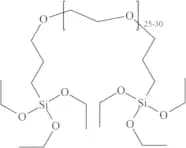
CAS:Formula:C4H13NSiPurity:95%Color and Shape:Straw LiquidMolecular weight:103.24BIS(3-TRIETHOXYSILYLPROPYL)POLYETHYLENE OXIDE (25-30 EO)
CAS:Dipodal PEG Silane (1,400-1,600 g/mol)
PEO, Triethoxysilane termination utilized for hydrophilic surface modificationDual functional PEGylation reagentHydrogen bonding hydrophilic silaneHydrolytically stable hydrophilic silaneFormula:CH3O(C2H4O)6-9(CH2)3Si(OCH3)3Color and Shape:Off-White SolidMolecular weight:1400-1600n-OCTYLDIMETHYLMETHOXYSILANE
CAS:Alkyl Silane - Conventional Surface Bonding
Aliphatic, fluorinated aliphatic or substituted aromatic hydrocarbon substituents are the hydrophobic entities which enable silanes to induce surface hydrophobicity. The organic substitution of the silane must be non-polar. The hydrophobic effect of the organic substitution can be related to the free energy of transfer of hydrocarbon molecules from an aqueous phase to a homogeneous hydrocarbon phase. A successful hydrophobic coating must eliminate or mitigate hydrogen bonding and shield polar surfaces from interaction with water by creating a non-polar interphase. Although silane and silicone derived coatings are in general the most hydrophobic, they maintain a high degree of permeability to water vapor. This allows coatings to breathe and reduce deterioration at the coating interface associated with entrapped water. Since ions are not transported through non-polar silane and silicone coatings, they offer protection to composite structures ranging from pigmented coatings to rebar reinforced concrete. A selection guide for hydrophobic silanes can be found on pages 22-31 of the Hydrophobicity, Hydrophilicity and Silane Surface Modification brochure.
n-Octyldimethylmethoxysilane; Methoxydimethyloctylsilane; Dimethylmethoxysilyloctane
Monoalkoxy silaneFormula:C11H26OSiPurity:97%Color and Shape:Straw LiquidMolecular weight:202.42PHENETHYLDIMETHYLCHLOROSILANE
CAS:Aromatic Silane - Conventional Surface Bonding
Aliphatic, fluorinated aliphatic or substituted aromatic hydrocarbon substituents are the hydrophobic entities which enable silanes to induce surface hydrophobicity. The organic substitution of the silane must be non-polar. The hydrophobic effect of the organic substitution can be related to the free energy of transfer of hydrocarbon molecules from an aqueous phase to a homogeneous hydrocarbon phase. A successful hydrophobic coating must eliminate or mitigate hydrogen bonding and shield polar surfaces from interaction with water by creating a non-polar interphase. Although silane and silicone derived coatings are in general the most hydrophobic, they maintain a high degree of permeability to water vapor. This allows coatings to breathe and reduce deterioration at the coating interface associated with entrapped water. Since ions are not transported through non-polar silane and silicone coatings, they offer protection to composite structures ranging from pigmented coatings to rebar reinforced concrete. A selection guide for hydrophobic silanes can be found on pages 22-31 of the Hydrophobicity, Hydrophilicity and Silane Surface Modification brochure.
Phenethyldimethylchlorosilane; 2-(Chlorodimethylsilylethyl)benzene; Chlorodimethyl(2-phenylethyl)silane
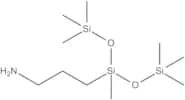
Contains α-, β-isomersFormula:C10H15ClSiPurity:97%Color and Shape:Pale Yellow LiquidMolecular weight:198.773-AMINOPROPYLMETHYLBIS(TRIMETHYLSILOXY)SILANE
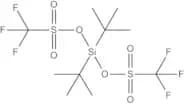
CAS:Formula:C10H29NO2Si3Purity:97%Color and Shape:Straw LiquidMolecular weight:279.61DI-t-BUTYLSILYLBIS(TRIFLUOROMETHANESULFONATE), 95%
CAS:Bridging Silicon-Based Blocking Agent
Used as a protecting group for reactive hydrogens in alcohols, amines, thiols, and carboxylic acids. Organosilanes are hydrogen-like, can be introduced in high yield, and can be removed under selective conditions. They are stable over a wide range of reaction conditions and can be removed in the presence of other functional groups, including other protecting groups. The tolerance of silylated alcohols to chemical transformations summary is presented in Table 1 of the Silicon-Based Blocking Agents brochure.
Di-tert-butylsilylbis(trifluoromethanesulfonate); Di-t-butylsilylbis(triflate); DTBS
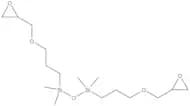
More reactive than SID3205.0Converts 1,3-diols to cyclic protected 1,3-diolsReacts with 1,3-diols in preference to 1,2-diolsSummary of selective deprotection conditions is provided in Table 7 through Table 20 of the Silicon-Based Blocking Agents brochureFormula:C10H18F6O6S2SiPurity:95%Color and Shape:Straw LiquidMolecular weight:440.461,3-BIS(GLYCIDOXYPROPYL)TETRAMETHYLDISILOXANE
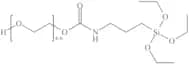
CAS:Formula:C16H34O5Si2Purity:97%Color and Shape:Straw LiquidMolecular weight:362.61N-(TRIETHOXYSILYLPROPYL)-O-POLYETHYLENE OXIDE URETHANE, 95%
CAS:N-(triethoxysilylpropyl)-O-polyethylene oxide urethane; O-polyethylene oxide-N-(triethoxysilylpropyl)-urethane
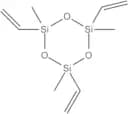
Hydroxy functional trialkoxy silaneContains some bis(urethane) analogViscosity: 75-125 cStHydrophilic surface modifierForms PEGylated glass surfaces suitable for capillary electrophoresisFormula:C10H22NO4SiO(CH2CH2O)4-6HPurity:95%Color and Shape:Straw LiquidMolecular weight:400-5001,3,5-TRIVINYL-1,3,5-TRIMETHYLCYCLOTRISILOXANE
CAS:Alkenylsilane Cross-Coupling Agent
The cross-coupling reaction is a highly useful methodology for the formation of carbon-carbon bonds. It involves two reagents, with one typically being a suitable organometallic reagent - the nucleophile - and the other a suitable organic substrate, normally an unsaturated halide, tosylate or similar - the electrophile.
1,3,5-Trivinyl-1,3,5-trimethylcyclotrisiloxane; D’3; Trimethyltrivinylcyclotrisiloxane; Trivinyltrimethylcyclotrisiloxane; 2,4,6-Trimethyl-2,4,6-trivinylcyclotrisiloxane
Reagent formation of styrenes and dienes.Undergoes “living” anion ring-opening polymerizationReagent for vinylations via cross-coupling protocolsExtensive review of silicon based cross-coupling agents: Denmark, S. E. et al. "Organic Reactions, Volume 75" Denmark, S. E. ed., John Wiley and Sons, 233, 2011Formula:C9H18O3Si3Purity:97%Color and Shape:LiquidMolecular weight:258.5VINYLMETHYLDIETHOXYSILANE
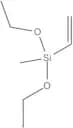
CAS:Olefin Functional Dialkoxy Silane
Silane coupling agents have the ability to form a durable bond between organic and inorganic materials to generate desired heterogeneous environments or to incorporate the bulk properties of different phases into a uniform composite structure. The general formula has two classes of functionality. The hydrolyzable group forms stable condensation products with siliceous surfaces and other oxides such as those of aluminum, zirconium, tin, titanium, and nickel. The organofunctional group alters the wetting or adhesion characteristics of the substrate, utilizes the substrate to catalyze chemical transformations at the heterogeneous interface, orders the interfacial region, or modifies its partition characteristics, and significantly effects the covalent bond between organic and inorganic materials.
Vinylmethyldiethoxysilane; Methylvinyldiethoxysilane; (Diethoxymethyl)silylethylene
Used in microparticle surface modificationDipole moment: 1.27 debyeCopolymerization parameters- e,Q; -0.86, 0.020Chain extender, crosslinker for silicone RTVs and hydroxy-functional resinsFormula:C7H16O2SiPurity:97%Color and Shape:LiquidMolecular weight:160.291,2-BIS(TRICHLOROSILYL)ETHANE, 95%
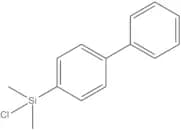
CAS:Formula:C2H4Cl6Si2Purity:95%Color and Shape:Off-White SolidMolecular weight:296.944-BIPHENYLYLDIMETHYLCHLOROSILANE
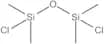
CAS:Formula:C14H15ClSiPurity:97%Color and Shape:Off-White SolidMolecular weight:246.811,3-DICHLOROTETRAMETHYLDISILOXANE
CAS:Alkyl Silane - Conventional Surface Bonding
Aliphatic, fluorinated aliphatic or substituted aromatic hydrocarbon substituents are the hydrophobic entities which enable silanes to induce surface hydrophobicity. The organic substitution of the silane must be non-polar. The hydrophobic effect of the organic substitution can be related to the free energy of transfer of hydrocarbon molecules from an aqueous phase to a homogeneous hydrocarbon phase. A successful hydrophobic coating must eliminate or mitigate hydrogen bonding and shield polar surfaces from interaction with water by creating a non-polar interphase. Although silane and silicone derived coatings are in general the most hydrophobic, they maintain a high degree of permeability to water vapor. This allows coatings to breathe and reduce deterioration at the coating interface associated with entrapped water. Since ions are not transported through non-polar silane and silicone coatings, they offer protection to composite structures ranging from pigmented coatings to rebar reinforced concrete. A selection guide for hydrophobic silanes can be found on pages 22-31 of the Hydrophobicity, Hydrophilicity and Silane Surface Modification brochure.
1,3-Dichlorotetramethyldisiloxane; Tetramethyldichlorodisiloxane; 1,3-Dichloro-1,1,3,3-tetramethyldisiloxane
Vapor pressure, 25 °C: 8 mmDiol protection reagentFormula:C4H12Cl2OSi2Purity:97%Color and Shape:Straw Amber LiquidMolecular weight:203.22[(5-BICYCLO[2.2.1]HEPT-2-ENYL)ETHYL]TRIETHOXYSILANE, tech, endo/exo isomers
CAS:Olefin Functional Trialkoxy Silane
Silane coupling agents have the ability to form a durable bond between organic and inorganic materials to generate desired heterogeneous environments or to incorporate the bulk properties of different phases into a uniform composite structure. The general formula has two classes of functionality. The hydrolyzable group forms stable condensation products with siliceous surfaces and other oxides such as those of aluminum, zirconium, tin, titanium, and nickel. The organofunctional group alters the wetting or adhesion characteristics of the substrate, utilizes the substrate to catalyze chemical transformations at the heterogeneous interface, orders the interfacial region, or modifies its partition characteristics, and significantly effects the covalent bond between organic and inorganic materials.
[(5-Bicyclo[2.2.1]hept-2-enyl)ethyl]triethoxysilane; (Norbornenyl)ethyltriethoxysilane; Triethoxysilylethylnorbornene
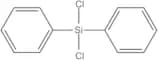
Endo/exo isomersUsed in microparticle surface modificationComonomer for polyolefin polymerizationFormula:C15H28O3SiPurity:techMolecular weight:284.47DIPHENYLDICHLOROSILANE, 99%
CAS:Bridging Silicon-Based Blocking Agent
Used as a protecting group for reactive hydrogens in alcohols, amines, thiols, and carboxylic acids. Organosilanes are hydrogen-like, can be introduced in high yield, and can be removed under selective conditions. They are stable over a wide range of reaction conditions and can be removed in the presence of other functional groups, including other protecting groups. The tolerance of silylated alcohols to chemical transformations summary is presented in Table 1 of the Silicon-Based Blocking Agents brochure.
Aromatic Silane - Conventional Surface Bonding
Aliphatic, fluorinated aliphatic or substituted aromatic hydrocarbon substituents are the hydrophobic entities which enable silanes to induce surface hydrophobicity. The organic substitution of the silane must be non-polar. The hydrophobic effect of the organic substitution can be related to the free energy of transfer of hydrocarbon molecules from an aqueous phase to a homogeneous hydrocarbon phase. A successful hydrophobic coating must eliminate or mitigate hydrogen bonding and shield polar surfaces from interaction with water by creating a non-polar interphase. Although silane and silicone derived coatings are in general the most hydrophobic, they maintain a high degree of permeability to water vapor. This allows coatings to breathe and reduce deterioration at the coating interface associated with entrapped water. Since ions are not transported through non-polar silane and silicone coatings, they offer protection to composite structures ranging from pigmented coatings to rebar reinforced concrete. A selection guide for hydrophobic silanes can be found on pages 22-31 of the Hydrophobicity, Hydrophilicity and Silane Surface Modification brochure.
Diphenyldichlorosilane; Dichlorodiphenylsilane; DPS
Viscosity, 25 °C: 4.1 cStΔHvap: 62.8 kJ/molDipole moment: 2.6 debyeVapor pressure, 125 °C: 2mm Coefficient of thermal expansion: 0.7 x 10⁻³Specific heat: 1.26 J/g/°Silicone monomerForms diol on contact with waterReacts with alcohols, diols, 2-hydroxybenzoic acidsSummary of selective deprotection conditions is provided in Table 7 through Table 20 of the Silicon-Based Blocking Agents brochureStandard grade available, SID4510.0Formula:C12H10Cl2SiPurity:99%Color and Shape:Colourless LiquidMolecular weight:253.2BIS(TRIETHOXYSILYL)METHANE
CAS:Alkyl Silane - Dipodal Surface Bonding
Aliphatic, fluorinated aliphatic or substituted aromatic hydrocarbon substituents are the hydrophobic entities which enable silanes to induce surface hydrophobicity. The organic substitution of the silane must be non-polar. The hydrophobic effect of the organic substitution can be related to the free energy of transfer of hydrocarbon molecules from an aqueous phase to a homogeneous hydrocarbon phase. A successful hydrophobic coating must eliminate or mitigate hydrogen bonding and shield polar surfaces from interaction with water by creating a non-polar interphase. Although silane and silicone derived coatings are in general the most hydrophobic, they maintain a high degree of permeability to water vapor. This allows coatings to breathe and reduce deterioration at the coating interface associated with entrapped water. Since ions are not transported through non-polar silane and silicone coatings, they offer protection to composite structures ranging from pigmented coatings to rebar reinforced concrete. A selection guide for hydrophobic silanes can be found on pages 22-31 of the Hydrophobicity, Hydrophilicity and Silane Surface Modification brochure.
Non Functional Alkoxy Silane
Silane coupling agents have the ability to form a durable bond between organic and inorganic materials to generate desired heterogeneous environments or to incorporate the bulk properties of different phases into a uniform composite structure. The general formula has two classes of functionality. The hydrolyzable group forms stable condensation products with siliceous surfaces and other oxides such as those of aluminum, zirconium, tin, titanium, and nickel. The organofunctional group alters the wetting or adhesion characteristics of the substrate, utilizes the substrate to catalyze chemical transformations at the heterogeneous interface, orders the interfacial region, or modifies its partition characteristics, and significantly effects the covalent bond between organic and inorganic materials.
Dipodal Silane
Dipodal silanes are a series of adhesion promoters that have intrinsic hydrolytic stabilities up to ~10,000 times greater than conventional silanes and are used in applications such as plastic optics, multilayer printed circuit boards and as adhesive primers for ferrous and nonferrous metals. They have the ability to form up to six bonds to a substrate compared to conventional silanes with the ability to form only three bonds to a substrate. Many conventional coupling agents are frequently used in combination with 10-40% of a non-functional dipodal silane, where the conventional coupling agent provides the appropriate functionality for the application, and the non-functional dipodal silane provides increased durability. Also known as bis-silanes additives enhance hydrolytic stability, which impacts on increased product shelf life, ensures better substrate bonding and also leads to improved mechanical properties in coatings as well as composite applications.
Bis(triethoxysilyl)methane; 4,4,6,6-tetraethoxy-3,7-dioxa-4,6-disilanonane
Intermediate for sol-gel coatings, hybrid inorganic-organic polymersForms methylene-bridged mesoporous structuresForms modified silica membranes that separate propylene/propane mixturesFormula:C13H32O6Si2Purity:97%Color and Shape:LiquidMolecular weight:340.56






![[(5-BICYCLO[2.2.1]HEPT-2-ENYL)ETHYL]TRIETHOXYSILANE, tech, endo/exo isomers](/_next/image/?url=https%3A%2Fstatic.cymitquimica.com%2Fproducts%2F3H%2Fthumb-webp%2FSIB0987.0.webp&w=3840&q=75)