Building Blocks
This section contains fundamental products for the synthesis of organic and biological compounds. Building blocks are the essential starting materials used to construct complex molecules through various chemical reactions. They play a critical role in drug discovery, material science, and chemical research. At CymitQuimica, we offer a diverse range of high-quality building blocks to support your innovative research and industrial projects, ensuring you have the essential components for successful synthesis.
Subcategories of "Building Blocks"
- Boronic Acids & Boronic Acid Derivatives(5,756 products)
- Chiral Building Blocks(1,242 products)
- Hydrocarbon Building Blocks(6,095 products)
- Organic Building Blocks(61,038 products)
Found 196817 products of "Building Blocks"
Sort by
Purity (%)
0
100
|
0
|
50
|
90
|
95
|
100
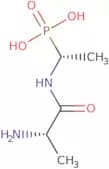
Alafosfalin
CAS:<p>Antibacterial phosphonopeptide mimic of peptidoglycan dipeptide D-Ala-D-Ala</p>Formula:C5H13N2O4PPurity:Min. 98 Area-%Color and Shape:White PowderMolecular weight:196.14 g/molDL-Asparagine monohydrate
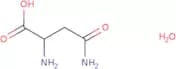
CAS:<p>DL-Asparagine monohydrate is a low potency amino acid that can be used as a biomarker for wastewater treatment. It has been shown to inhibit the activity of enzymes such as guanine nucleotide-binding proteins, toll-like receptors, and response elements. Asparagine also has inhibitory properties against tumour cells in solid tumours.</p>Formula:C4H10N2O4Color and Shape:PowderMolecular weight:150.14 g/mol4-Aminopyridine N-oxide
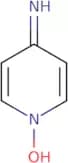
CAS:<p>4-Aminopyridine N-oxide is a white, crystalline solid that is soluble in water and alcohol. It has a molecular weight of 128.2 and formula weight of 135.2. 4-Aminopyridine N-oxide reacts with acid solutions to produce nitrous acid and ammonia gas. The rate of the reaction depends on the concentration of aminopyridine and aniline, as well as the pH of the solution. The acetylation, diazotisation, and kinetics have also been studied extensively for this compound. Nitrous acid can react with amides to form azulene, which can then react with amines to form a molecule containing nitrogen, oxygen, carbon, hydrogen and one other element or compound from each group (e.g., NHCOCH). This reaction is reversible when solvents are present.br> 4-Aminopyridine N-oxide may be used as a precursor for other organic</p>Formula:C5H6N2OPurity:Min. 95%Color and Shape:Slightly Yellow PowderMolecular weight:110.11 g/mol4-Aminoindole hydrochloride
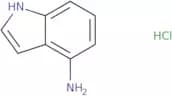
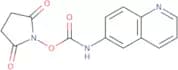
CAS:<p>4-Aminoindole hydrochloride is a white crystalline solid that can be used as a versatile building block in organic synthesis. It is also used as an intermediate in the production of various pharmaceuticals and other chemical compounds. 4-Aminoindole hydrochloride is soluble in most polar solvents, but insoluble in ethers and oils. This compound is also a useful reagent for the conversion of nitrobenzenes to aminobenzoic acids. CAS Number 174854-93-4</p>Formula:C8H9ClN2Purity:Min. 95%Color and Shape:PowderMolecular weight:168.62 g/mol6-Aminoquinolyl-N-hydroxysuccinimidyl carbamate, particle size < 0.25 mm
CAS:<p>6-Aminoquinolyl-N-hydroxysuccinimidylcarbamate reacts rapidly with amino acids to form stable urea derivatives. The use of fluorescence detection techniques allows quantification of amines at pmol levels. 6-Aminoquinolyl-N-hydroxysuccinimidylcarbamate was used in a study to derivatize glycated amino acids with the purpose of developing chromatographic assays for their quantification. Glycation of proteins initially gives rise to early glycation adducts, then progresses to advanced glycation end-products, which are markers for conditions such as diabetes, cataracts, uraemia and Alzheimer's disease. We also offer the product FA36291.</p>Formula:C14H11N3O4Color and Shape:PowderMolecular weight:285.25 g/mol1-Adamantanecarboxylic acid methyl ester
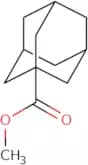
CAS:<p>1-Adamantanecarboxylic acid methyl ester is a specialized chemical compound, classified as an ester derivative from the adamantane structure. It is sourced through the esterification of 1-adamantanecarboxylic acid, often involving methanol as a reagent under catalyzed conditions. The compound's mode of action is primarily as an intermediate in organic synthesis, where it enables the introduction of adamantyl groups into target molecules, influencing molecular structure with its bulky, rigid framework.This ester derivative finds extensive application in the realm of synthetic organic chemistry. It serves as a crucial intermediate in the development of complex organic materials and pharmaceuticals, where the adamantane moiety is required to confer specific steric and electronic properties. The incorporation of adamantane from 1-adamantanecarboxylic acid methyl ester can enhance the thermal stability, lipophilicity, and rigidity of the resultant compounds, making it invaluable for researchers focused on material sciences and drug development. Its versatile reactivity and robust structure make it a sought-after compound for advancing chemical research and innovation.</p>Formula:C12H18O2Purity:Min. 98%Color and Shape:White PowderMolecular weight:194.27 g/mol4-Aminohippuric acid
CAS:<p>4-Aminohippuric acid (4-AHA) is a substance that is used as an analytical tool to measure the amount of inulin in the blood. It is injected intravenously, and the 4-aminohippuric acid enters cells via facilitated transport. In cells, 4-aminohippuric acid binds to pyrazinoic acid to form a fluorescent product that can be detected by a spectrophotometer. This test has been used to study the role of various compounds in the angiotensin system and their effect on renal function.</p>Formula:C9H10N2O3Color and Shape:PowderMolecular weight:194.19 g/molAcrylamide
CAS:<p>Used for gel preparation for protein electrophoresis</p>Formula:C3H5NOPurity:Min. 95%Color and Shape:PowderMolecular weight:71.08 g/molAgaricinic acid
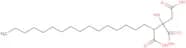
CAS:<p>Organic tricarboxylic acid; inducer of MPT</p>Formula:C22H40O7Purity:Min. 95%Color and Shape:PowderMolecular weight:416.55 g/mol2-Azidoacetic acid
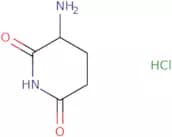
CAS:<p>2-Azidoacetic acid is a versatile chemical building block that can be used to form amides by reaction of the carboxylic acid with a suitable coupling reagent and amine. The azide group can undergo copper(I) catalysed or Huisgen 1,3-dipolar cycloadditin reactions to form triazoles, a common example of click chemistry.</p>Formula:C2H3N3O2Purity:Min. 97.0 Area-%Color and Shape:Colorless Slightly Yellow Clear Liquid PowderMolecular weight:101.06 g/mol3-Aminopiperidine-2,6-dione hydrochloride salt
CAS:<p>3-Aminopiperidine-2,6-dione hydrochloride salt (3AP) is a synthetic agent that has been shown to inhibit prostate cancer cell growth. 3AP inhibits the synthesis of DNA by inhibiting the enzyme benzoate and potently inhibits the enzyme pomalidomide synthetase. This drug also has antiangiogenic properties and has been shown to reduce expression of TNF-α in human myeloid leukemia cells. 3AP is not active against HL60 cells, which are a type of white blood cell. It can be used as an alternative treatment for cancer in patients who have failed to respond to other therapies or who cannot tolerate them.</p>Formula:C5H8N2O2·HClPurity:Min 97.0%Color and Shape:Off-White Slightly Yellow PowderMolecular weight:164.59 g/molAzomethine-H monosodium salt monohydrate
CAS:<p>Azomethine-H is a research chemical that is used as a versatile building block for the synthesis of other compounds. It has been shown to be an intermediate in the synthesis of many complex compounds, and can also be used as a reagent or speciality chemical. Azomethine-H is soluble in water and organic solvents, which makes it useful for reactions involving deprotection, extraction, or alkylation. The CAS registry number for this compound is 304655-82-1.</p>Formula:C17H12NNaO8S2·H2OPurity:Min. 95.0 Area-%Color and Shape:Yellow PowderMolecular weight:463.42 g/mol4-Acetamidobenzoic acid
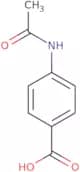
CAS:<p>4-Acetamidobenzoic acid is an aromatic organic compound that is a precursor to many pharmaceuticals, such as acetaminophen, amoxicillin, dapsone, and sulfonamide. It is an intermediate in the formation of 4-hydroxybenzoic acid from benzoic acid. This molecule is also a component of some types of plastics. The chemical's structure and properties are determined by its coordination geometry, which consists of four nitrogen atoms and one hydroxyl group. 4-Acetamidobenzoic acid has been shown to inhibit the growth of certain bacteria by interfering with their metabolic activity. It has also been found to be active against several infectious diseases such as malaria and tuberculosis. The mechanism behind its effectiveness may be due to the fact that it inhibits bacterial fatty acid synthesis or prevents the production of ATP in mitochondria cells.br>br><br>br>br><br>The reaction solution was heated for 20 minutes at 100</p>Formula:C9H9NO3Color and Shape:White PowderMolecular weight:179.17 g/molMethyl 4-(2-chloroethyl)benzoate
CAS:<p>Versatile small molecule scaffold</p>Formula:C10H11ClO2Purity:Min. 95%Molecular weight:198.65 g/mol3-Amino-2-naphthoic acid
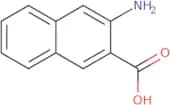
CAS:<p>3-Amino-2-naphthoic acid (3AN) is a metabolite of gabapentin that is excreted in the urine. It has been shown to be present in the urine of patients with chronic kidney disease, and is thought to be involved in the pathogenesis of this disease. 3AN has also been detected in carbon disulphide exposed rats, where it may contribute to renal damage. The biological properties of 3AN are not well understood, but it has been shown to have biochemical properties similar to those of gabapentin. 3AN is active against some bacteria and fungi, but not others. 3AN binds covalently to DNA, forming adducts that inhibit DNA synthesis and transcription. The fluorescence probe methyl anthranilate can be used as a fluorescent dye for detection of 3AN in biological samples.</p>Formula:C11H9NO2Purity:Min. 95%Color and Shape:Yellow PowderMolecular weight:187.19 g/mol2-Amino-3-nitropyridine
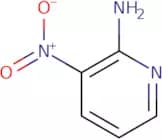
CAS:<p>2-Amino-3-nitropyridine is a synthetic molecule that has the chemical formula C6H7N5O2. It can exist in four different forms, three of which are isomers. These three isomers have different properties, such as melting point and solubility. The synthesis of 2-amino-3-nitropyridine can be achieved through a solid phase synthesis using sodium periodate as the acid catalyst. The reaction mechanism involves nitration of 2-amino pyridine with hydrogen peroxide to produce 3-nitro pyridine followed by hydrolysis to form 2-amino-3 nitropyridine. This reaction produces two dihedral angles in the molecule, one between the nitrogen and oxygen atoms and another between the nitrogen atom and carbon atom bonded to it. The functional groups present on this molecule are an amino group, a nitro group, and an amide group.</p>Purity:Min. 98 Area-%Color and Shape:Yellow SolidMolecular weight:139.11 g/mol1-Adamantanol
CAS:<p>1-Adamantanol is a cyclic molecule with a hydroxyl group. It is produced by the oxidation of 2-methyl-2-adamantanol. 1-Adamantanol has been shown to be an effective substrate for bioremediation in wastewater treatment plants and can be used as a precursor to produce trifluoroacetic acid. The reaction mechanism is thought to involve the oxidation of 1-adamantanol by an oxidizing agent, such as hydrogen peroxide or ozone, to form a radical intermediate that spontaneously reacts with oxygen in solution. The reaction solution can be cooled down or heated up to increase the rate of the reaction. 1-Adamantanol also undergoes thermal expansion when heated up, which may be due to its high boiling point.</p>Formula:C10H16OPurity:Min. 98.5%Color and Shape:White PowderMolecular weight:152.24 g/mol3-Formylindole-5-carboxylic acid methyl ester
CAS:<p>3-Formylindole-5-carboxylic acid methyl ester is a chemical compound that can be used as a building block or intermediate for the synthesis of more complex compounds. 3-Formylindole-5-carboxylic acid methyl ester has a high purity and is an excellent reagent for use in research. This chemical may also be used as a starting material for the synthesis of speciality chemicals and fine chemicals.</p>Formula:C11H9NO3Purity:Min. 98.0 Area-%Molecular weight:203.20 g/mol5-Fluoroindole
CAS:<p>5-Fluoroindole is a reagent that can be used in organic synthesis. It can be used to synthesize a variety of compounds, including pharmaceuticals and agrochemicals. 5-Fluoroindole is also useful as an intermediate for the synthesis of complex molecules or fine chemicals. 5-Fluoroindole can be used as a building block for the preparation of other chemical compounds. It is a versatile building block with many applications in research and industry.</p>Formula:C8H6FNMolecular weight:135.14 g/mol4-Hydroxybenzamide
CAS:<p>4-Hydroxybenzamide is a fatty acid with the hydroxyl group at the 4 position. It has been shown to inhibit the activity of human protein by interfering with hydrogen bonding and amide formation. The chemical structures of 4-hydroxybenzamide have been studied by electrochemical impedance spectroscopy (EIS) and found to be a competitive inhibitor of 1-hydroxy-2-naphthoic acid, an adenosine receptor antagonist, and p-hydroxybenzoic acid. This compound has also been shown to be acutely toxic in rats at high doses.</p>Formula:C7H7NO2Purity:90%Color and Shape:PowderMolecular weight:137.14 g/mol