Building Blocks
This section contains fundamental products for the synthesis of organic and biological compounds. Building blocks are the essential starting materials used to construct complex molecules through various chemical reactions. They play a critical role in drug discovery, material science, and chemical research. At CymitQuimica, we offer a diverse range of high-quality building blocks to support your innovative research and industrial projects, ensuring you have the essential components for successful synthesis.
Subcategories of "Building Blocks"
- Boronic Acids & Boronic Acid Derivatives(5,778 products)
- Chiral Building Blocks(1,242 products)
- Hydrocarbon Building Blocks(6,098 products)
- Organic Building Blocks(61,034 products)
Found 199601 products of "Building Blocks"
Sort by
Purity (%)
0
100
|
0
|
50
|
90
|
95
|
100
(R)-2-(Benzylamino)-3-hydroxypropanoic acid
CAS:<p>(R)-2-(Benzylamino)-3-hydroxypropanoic acid is a methyl ester of the amino acid, L-leucine. It is an efficient reagent for the synthesis of chiral amides and esters, with high stereoselectivity and diastereoselectivity. The use of an allyl group as a protecting group in this synthesis provides a regioisomerically pure product. (R)-2-(Benzylamino)-3-hydroxypropanoic acid has been used in syntheses of sulfamidates with high diastereoselectivity.</p>Formula:C10H13NO3Purity:Min. 95%Molecular weight:195.22 g/mol5-Methyl-2-(propan-2-yl)cyclohexyl 2-chloroacetate
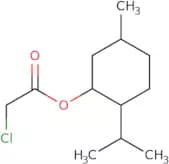
CAS:<p>5-Methyl-2-(propan-2-yl)cyclohexyl 2-chloroacetate is a molecule with a carbonyl group and trifluoroacetic acid. It is used in the preparation of pharmaceuticals, such as cardiotonics, antiarrhythmics, and antianxiety agents. This compound has been shown to be an effective insecticide against mosquitoes. 5-Methyl-2-(propan-2-yl)cyclohexyl 2-chloroacetate is also used in the synthesis of fatty acid esters and hydroxyl groups. <br>The desymmetrization reaction of 5-methylcyclohexanecarboxylic acid with chloroacetic acid under kinetic conditions was successfully carried out using deionized water and sodium hydrogen at room temperature for 16 hours.</p>Formula:C12H21ClO2Purity:Min. 95%Molecular weight:232.74 g/mol2,2-Dimethyl-3-oxopentanal
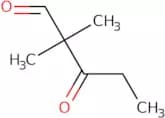
CAS:<p>2,2-Dimethyl-3-oxopentanal is a molecule that forms during the oxidation of isobutene. It is involved in a variety of reactions and has been shown to have surface chemistry properties. The adsorption and desorption of 2,2-dimethyl-3-oxopentanal on a ruthenium surface has been studied by XPS and photoelectron spectroscopy. The molecule has also been shown to form from the gas phase reaction of monoxide and metallic rhodium. This molecule can be used as a ligand in coordination chemistry.</p>Formula:C7H12O2Purity:Min. 95%Molecular weight:128.17 g/molEthyl 5-cyano-6-methylnicotinate
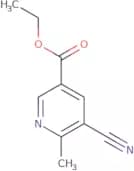
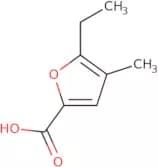
CAS:<p>Versatile small molecule scaffold</p>Formula:C10H10N2O2Purity:Min. 95%Molecular weight:190.2 g/mol5-Ethyl-4-methylfuran-2-carboxylic acid
CAS:<p>Versatile small molecule scaffold</p>Formula:C8H10O3Purity:Min. 95%Molecular weight:154.16 g/mol[3-(Prop-2-en-1-yl)phenyl]methanol
CAS:<p>Versatile small molecule scaffold</p>Formula:C10H12OPurity:Min. 95%Molecular weight:148.2 g/mol(R)-4-Benzyl-5-oxo-3-morpholinecarboxylic acid
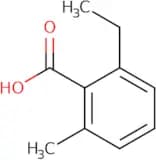
CAS:<p>Versatile small molecule scaffold</p>Formula:C12H13NO4Purity:Min. 95%Molecular weight:235.24 g/mol6-Ethyl-2-methylbenzoic acid
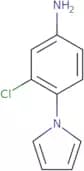
CAS:<p>Versatile small molecule scaffold</p>Formula:C10H12O2Purity:Min. 95%Molecular weight:164.2 g/mol3-Chloro-4-(1H-pyrrol-1-yl)aniline
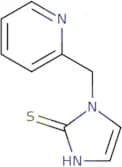
CAS:<p>Versatile small molecule scaffold</p>Formula:C10H9ClN2Purity:Min. 95%Molecular weight:192.64 g/mol1-(Pyridin-2-ylmethyl)-1H-imidazole-2-thiol
CAS:<p>Versatile small molecule scaffold</p>Formula:C9H9N3SPurity:Min. 95%Molecular weight:191.26 g/mol2-[2-(Propan-2-yl)phenyl]propan-2-ol
CAS:<p>Versatile small molecule scaffold</p>Formula:C12H18OPurity:Min. 95%Molecular weight:178.27 g/mol5,6-Dimethyl-2-(morpholin-4-ylmethyl)-3H,4H-thieno[2,3-d]pyrimidin-4-one
CAS:<p>Versatile small molecule scaffold</p>Formula:C13H17N3O2SPurity:Min. 95%Molecular weight:279.36 g/mol2-{[4-(2-Methoxyphenyl)-5-methyl-4H-1,2,4-triazol-3-yl]sulfanyl}acetic acid
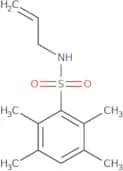
CAS:Versatile small molecule scaffoldFormula:C12H13N3O3SPurity:Min. 95%Molecular weight:279.32 g/mol2,3,5,6-Tetramethyl-N-(prop-2-en-1-yl)benzene-1-sulfonamide
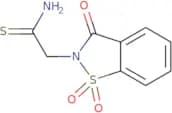
CAS:<p>Versatile small molecule scaffold</p>Formula:C13H19NO2SPurity:Min. 95%Molecular weight:253.4 g/mol2-(1,1,3-Trioxo-2,3-dihydro-1,2-benzothiazol-2-yl)ethanethioamide
CAS:Versatile small molecule scaffoldFormula:C9H8N2O3S2Purity:Min. 95%Molecular weight:256.3 g/mol(2E)-2-Cyano-3-[2,5-dimethyl-1-(3-methylbutyl)-1H-pyrrol-3-yl]acrylic acid
CAS:Controlled Product<p>2-Cyano-3-[2,5-dimethyl-1-(3-methylbutyl)-1H-pyrrol-3-yl]acrylic acid is a research tool that is used to study the function of ion channels and receptors. It is a potent inhibitor of ligand binding to ion channel receptors, such as nicotinic acetylcholine receptor and glycine receptor. It has shown to inhibit the activation of these receptors in vitro with an IC50 value of 0.4 µM. 2Cyano-3-[2,5-dimethyl-1-(3-methylbutyl)-1H-pyrrol-3-yl]acrylic acid has also been shown to be a potent inhibitor of ligand binding to peptide receptors, such as bradykinin B2 receptor and angiotensin II type 1A receptor.</p>Formula:C15H20N2O2Purity:Min. 95%Molecular weight:260.33 g/mol5-Hydroxy-2-(trifluoromethyl)benzonitrile
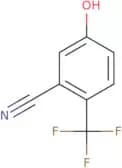
CAS:<p>Versatile small molecule scaffold</p>Formula:C8H4F3NOPurity:Min. 95%Molecular weight:187.12 g/mol3-Hydroxy-4-(trifluoromethyl)benzonitrile
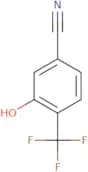
CAS:<p>Versatile small molecule scaffold</p>Formula:C8H4F3NOPurity:Min. 95%Molecular weight:187.12 g/mol3-Nitro-2-(trifluoromethyl)phenol
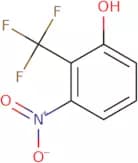
CAS:<p>Versatile small molecule scaffold</p>Formula:C7H4F3NO3Purity:Min. 95%Molecular weight:207.11 g/mol2-Chloro-6-(trifluoromethyl)-3-pyridinol
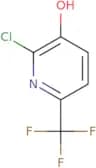
CAS:<p>Versatile small molecule scaffold</p>Formula:C6H3ClF3NOPurity:Min. 95%Molecular weight:197.54 g/mol

![[3-(Prop-2-en-1-yl)phenyl]methanol](/_next/image/?url=https%3A%2Fstatic.cymitquimica.com%2Fproducts%2F3D%2Fthumb-webp%2FGEA96554.webp&w=3840&q=75)
![2-[2-(Propan-2-yl)phenyl]propan-2-ol](/_next/image/?url=https%3A%2Fstatic.cymitquimica.com%2Fproducts%2F3D%2Fthumb-webp%2FGEA98932.webp&w=3840&q=75)
![5,6-Dimethyl-2-(morpholin-4-ylmethyl)-3H,4H-thieno[2,3-d]pyrimidin-4-one](/_next/image/?url=https%3A%2Fstatic.cymitquimica.com%2Fproducts%2F3D%2Fthumb-webp%2FGEB00194.webp&w=3840&q=75)
![2-{[4-(2-Methoxyphenyl)-5-methyl-4H-1,2,4-triazol-3-yl]sulfanyl}acetic acid](/_next/image/?url=https%3A%2Fstatic.cymitquimica.com%2Fproducts%2F3D%2Fthumb-webp%2FGEB00198.webp&w=3840&q=75)
![(2E)-2-Cyano-3-[2,5-dimethyl-1-(3-methylbutyl)-1H-pyrrol-3-yl]acrylic acid](/_next/image/?url=https%3A%2Fstatic.cymitquimica.com%2Fproducts%2F3D%2Fthumb-webp%2FGEB00211.webp&w=3840&q=75)