Amides
Amides are a wide range of chemical compounds that contain at least one heterocyclic ring, which has atoms of at least two different elements in the ring structure, and at least one amide group (-CONH2). These compounds are crucial in the synthesis of pharmaceuticals, polymers, and agrochemicals. Amides exhibit unique properties and reactivity, making them valuable intermediates in organic synthesis. At CymitQuimica, we offer a comprehensive selection of high-quality amides to support your research and industrial needs.
Found 16393 products of "Amides"
Sort by
Purity (%)
0
100
|
0
|
50
|
90
|
95
|
100
2-Amino-5-chloro-N,3-dimethylbenzamide
CAS:<p>2-Amino-5-chloro-N,3-dimethylbenzamide is a synthetic compound. It has been shown to induce necrotic cell death in mammalian cells. This compound was synthesized by the reaction of 2-aminoquinoline with a Grignard reagent, followed by nitration of the resultant amine. The synthesis of this compound was thermodynamically favorable and exhibited good solubility in water. The chlorantraniliprole and anthranilic acid moieties are activated with an acylation reaction, which allows them to bind to the ryanodine receptor and inhibit calcium release from the sarcoplasmic reticulum (SR) with ammonolysis. This inhibition leads to ferroptosis, a type of programmed necrosis.</p>Formula:C9H11ClN2OPurity:Min. 95%Color and Shape:PowderMolecular weight:198.65 g/molBiotinyl-5-aminopentanoyl-Antennapedia Homeobox (43-58) amide trifluoroacetate salt
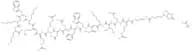
CAS:<p>Please enquire for more information about Biotinyl-5-aminopentanoyl-Antennapedia Homeobox (43-58) amide trifluoroacetate salt including the price, delivery time and more detailed product information at the technical inquiry form on this page</p>Formula:C119H192N38O22S2Purity:Min. 95%Molecular weight:2,571.17 g/molC18-Ceramide
CAS:<p>Inducer of apoptosis; down-regulated in tumors</p>Formula:C36H71NO3Purity:Min. 95%Color and Shape:White/Off-White SolidMolecular weight:565.95 g/molTRAP-5 amide trifluoroacetate salt
CAS:<p>Please enquire for more information about TRAP-5 amide trifluoroacetate salt including the price, delivery time and more detailed product information at the technical inquiry form on this page</p>Formula:C30H51N9O6Purity:Min. 95%Molecular weight:633.78 g/mol(D-Trp6)-LHR
<p>Please enquire for more information about (D-Trp6)-LHR including the price, delivery time and more detailed product information at the technical inquiry form on this page</p>Formula:C83H115N25O17Purity:Min. 95%Molecular weight:1,734.96 g/molN-3,5-Dimethyladamantan-1-yl formamide
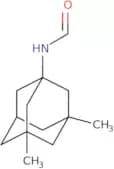
CAS:<p>N-3,5-Dimethyladamantan-1-yl formamide is a hydrocarbon that is synthesized by the amination of 3,5-dimethyladamantane with formic acid in the presence of hydrochloric acid. It is used as a solvent for various chemical reactions and has been shown to be an effective catalyst for the reduction of nitrobenzene to aniline. N-3,5-Dimethyladamantan-1-yl formamide is also a pollutant that can cause environmental pollution when it reacts with chlorine in the atmosphere. The reaction time can be shortened by using acetonitrile as a solvent instead of water.</p>Formula:C13H21NOPurity:Min. 95%Molecular weight:207.31 g/mol(Phe1,Ser2,Tyr6)-PAR-1 (1-6) amide (human) trifluoroacetate salt
CAS:<p>Please enquire for more information about (Phe1,Ser2,Tyr6)-PAR-1 (1-6) amide (human) trifluoroacetate salt including the price, delivery time and more detailed product information at the technical inquiry form on this page</p>Formula:C39H60N10O8Purity:Min. 95%Molecular weight:796.96 g/molDnp-Pro-TNF-α (71-82) amide (human) trifluoroacetate salt
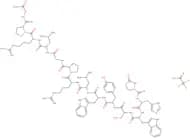
CAS:<p>Please enquire for more information about Dnp-Pro-TNF-alpha (71-82) amide (human) trifluoroacetate salt including the price, delivery time and more detailed product information at the technical inquiry form on this page</p>Formula:C57H94N22O21Purity:Min. 95%Molecular weight:1,423.49 g/molAbz-Amyloid β/A4 Protein Precursor770 (708-715)-Lys(Dnp)-D-Arg-D-Arg-D-Arg amide trifluoroacetate salt
CAS:<p>Please enquire for more information about Abz-Amyloid beta/A4 Protein Precursor770 (708-715)-Lys(Dnp)-D-Arg-D-Arg-D-Arg amide trifluoroacetate salt including the price, delivery time and more detailed product information at the technical inquiry form on this page</p>Formula:C69H114N26O18Purity:Min. 95%Molecular weight:1,595.81 g/molHIV-1 env Protein gp41 (1-23) amide (isolates BRU/JRCSF)
CAS:<p>Please enquire for more information about HIV-1 env Protein gp41 (1-23) amide (isolates BRU/JRCSF) including the price, delivery time and more detailed product information at the technical inquiry form on this page</p>Formula:C95H155N27O26SPurity:Min. 95%Molecular weight:2,123.48 g/molPAR-2 (1-6) amide (mouse, rat) trifluoroacetate salt
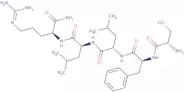
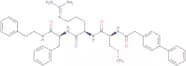
CAS:<p>PAR-2 agonist is a synthetic peptide that activates PAR-2. It binds to PAR-2 receptors, which are present in the mesenteric vasculature and in various other tissues. Activation of PAR-2 leads to an increase in intracellular calcium concentration, activation of protein kinase C, cytosolic calcium ion release, phosphorylation of myosin light chain, muscle cell proliferation, transcription and translation initiation, and increased production of vasoactive intestinal peptide. This drug also has anti-inflammatory effects and stimulates epidermal growth factor (EGF) and thrombin receptor expression as well as growth factor production.</p>Formula:C29H56N10O7Purity:Min. 95%Molecular weight:656.82 g/mol4-Biphenylac-Cys(Me)-D-Arg-Phe-(2-phenylethyl)amide
CAS:<p>4-Biphenylac-Cys(Me)-D-Arg-Phe-(2-phenylethyl)amide is a tetrapeptide that has been shown to have antihypertensive properties. This drug binds to the regulatory proteins of the renin angiotensin system and blocks the production of angiotensin II, which decreases blood pressure. 4-Biphenylac-Cys(Me)-D-Arg-Phe-(2-phenylethyl)amide has also shown to be an effective treatment for skin care products, especially those used for inflammatory skin diseases. 4-Biphenylac-Cys(Me)-D-Arg-Phe-(2-phenylethyl)amide has been shown to be a potent inhibitor of serine proteases and can inhibit cellular proliferation and induce apoptosis in cancer cells.</p>Formula:C41H49N7O4SPurity:Min. 95%Molecular weight:735.94 g/molFITC-epsilonAhx-Antennapedia Homeobox (43-58) amide trifluoroacetate salt
CAS:<p>Please enquire for more information about FITC-epsilonAhx-Antennapedia Homeobox (43-58) amide trifluoroacetate salt including the price, delivery time and more detailed product information at the technical inquiry form on this page</p>Formula:C131H191N37O25S2Purity:Min. 95%Molecular weight:2,748.28 g/molN-Acetyl-L-norleucyl-L-glutaminyl-L-histidyl-D-phenylalanyl-L-arginyl-D-tryptophylglycinamide
CAS:<p>Please enquire for more information about N-Acetyl-L-norleucyl-L-glutaminyl-L-histidyl-D-phenylalanyl-L-arginyl-D-tryptophylglycinamide including the price, delivery time and more detailed product information at the technical inquiry form on this page</p>Formula:C47H65N15O9Purity:Min. 95%Molecular weight:984.11 g/molpTH (1-34) amide (human) trifluoroacetate salt
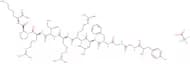
CAS:<p>Parathyroid hormone (PTH) is a peptide hormone that regulates calcium and phosphate balance in the body. PTH is secreted by the parathyroid glands, located near the thyroid gland in the neck. It is also known as parathormone or parathyrin. The active form of PTH, called pTH (1-34) amide, has been shown to stimulate bone resorption and to inhibit bone formation. The amino acid sequence of this hormone starts with arginine and ends with phenylalanine. The N-terminal amino acid residue is an aspartic acid or asparagine and histidine is the only basic residue in this molecule. This molecule has two acidic residues, glutamic acid and aspartic acid, which are found on the side chains of two amino acids: aspartic acid and glutamic acid. Valine is found at position 3 and phenylalanine at position 34.</p>Formula:C181H292N56O50S2Purity:Min. 95%Molecular weight:4,116.73 g/molDynorphin A (1-11) amide trifluoroacetate salt
CAS:<p>Dynorphin A (1-11) amide trifluoroacetate salt is a modified form of the opioid peptide dynorphin, which is a natural ligand for kappa-opioid receptors. It has affinity for the surface receptors and can be used to study the modifications that occur in cell function. Dynorphin A (1-11) amide trifluoroacetate salt has been shown to decrease cell function when it interacts with these surface receptors, which are found in brain homogenates and other tissues. Dynorphin A (1-11) amide trifluoroacetate salt also has an effect on brain cells, which may be due to its ability to alter conformational changes in proteins by binding to them. This can lead to alterations in the structure of certain enzymes or receptor proteins.</p>Formula:C63H104N22O12Purity:Min. 95%Molecular weight:1,361.64 g/mol6-Aminopicolinamide
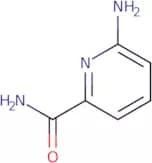
CAS:<p>6-Aminopicolinamide is a metabolite of nicotinamide, which can be found in the urine of humans and animals. 6-Aminopicolinamide has been shown to have anti-leukemic activity against experimental leukemias in animals. The mechanism of action is not well understood but may involve inhibition of nucleotide synthesis or the inhibition of dehydrogenase activity. Clinical trials are underway to determine its efficacy as an anti-tumor agent.</p>Formula:C6H7N3OPurity:Min. 95%Molecular weight:137.14 g/molL-Glutamic acid α-amide
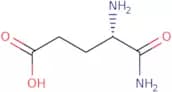
CAS:<p>L-Glutamic acid alpha-amide is an ester hydrochloride that is a tissue culture amide. It is a cyclic peptide analog and a hydroxyl group. L-glutamic acid alpha-amide has been shown to inhibit the inflammatory response in the bowel disease, Crohn's disease, by blocking the toll-like receptor 4 and 5. This drug also inhibits protein synthesis, which may be due to its ability to bind to fatty acids, thereby inhibiting the production of proteins vital for cell division.</p>Formula:C5H10N2O3Purity:Min. 95%Color and Shape:White PowderMolecular weight:146.14 g/molSodium dicyanamide
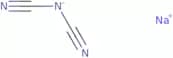
CAS:<p>Sodium dicyanamide is a diphenyl ether that has been shown to be effective in the treatment of polycystic ovarian syndrome. It binds to picolinic acid, which is a cofactor for the enzyme phenylalanine hydroxylase, and inhibits the production of tyrosine. This leads to an increase in the levels of luteinizing hormone and follicle-stimulating hormone, which helps ovulation. Sodium dicyanamide also interacts with hydrogen bond interactions and chelate ligands. The reaction mechanism of this compound is not well understood, but it is known that it can react with oxygen at high temperatures.</p>Formula:C2N3NaPurity:Min. 95%Color and Shape:White PowderMolecular weight:89.03 g/molAntho-RPamide III·HCl Pyr-Val-Lys-Leu-Tyr-Arg-Pro-NH2·HCl
CAS:<p>Please enquire for more information about Antho-RPamide III·HCl Pyr-Val-Lys-Leu-Tyr-Arg-Pro-NH2·HCl including the price, delivery time and more detailed product information at the technical inquiry form on this page</p>Formula:C42H68N12O9·HClPurity:Min. 95%Molecular weight:921.53 g/mol