Carboxylic Acids
Carboxylic acids are organic molecules characterized by having a carboxyl-type functional group (-COOH). These acids are fundamental in various chemical reactions, including esterification, amidation, and decarboxylation. Carboxylic acids are widely used in the production of pharmaceuticals, polymers, and agrochemicals. In this section, you can find a large number of carboxylic acids ready to be used. At CymitQuimica, we provide a broad range of high-quality carboxylic acids to support your research and industrial applications.
Found 12453 products of "Carboxylic Acids"
Sort by
Purity (%)
0
100
|
0
|
50
|
90
|
95
|
100
3,6-Dichlorobenzo[b]thiophene-2-carboxylic acid
CAS:<p>3,6-Dichlorobenzo[b]thiophene-2-carboxylic acid is an extracellular metabolite that is involved in the metabolism of muscle. It is produced as a byproduct of the reaction catalyzed by dehydrogenase, which converts 3,6-dichlorobenzo[b]thiophene to 2-carboxybenzothiophene. This compound has been shown to inhibit the enzyme histidine carboxylate synthetase, which is involved in branched-chain amino acid synthesis. The enzyme can be inhibited by either a wild type or an analog of 3,6-dichlorobenzo[b]thiophene-2-carboxylic acid.</p>Formula:C9H4Cl2O2SPurity:Min. 95%Molecular weight:247.1 g/mol2-Bromo-3-thiophenecarboxylic acid
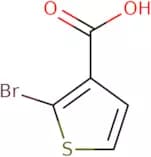
CAS:<p>2-Bromo-3-thiophenecarboxylic acid (BTPC) is a synthetic drug that is used as an analog of sildenafil, which is a PDE5 inhibitor. BTPC has been shown to be a more potent and selective inhibitor of cGMP hydrolysis than sildenafil. It has also been shown to be capable of inhibiting the growth of human lung cancer cells in vitro. BTPC has not yet been tested in vivo, but may offer advantages over other PDE5 inhibitors due to its increased potency and selectivity.</p>Formula:C5H3BrO2SPurity:Min. 97 Area-%Color and Shape:PowderMolecular weight:207.05 g/molBetamethasone 21-acetate
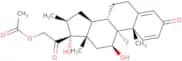
CAS:<p>Betamethasone 21-acetate is a potent corticosteroid that is effective in the treatment of inflammatory conditions, such as asthma and arthritis. It also helps to reduce the symptoms of inflammatory skin diseases, including atopic dermatitis, contact dermatitis, and psoriasis. Betamethasone 21-acetate is used to treat perinatal complications such as preterm labor and neonatal respiratory distress syndrome. This drug has been shown to have a low cardiac effect when administered at a low dose (1 mg/kg). The stability of betamethasone 21-acetate in blood samples is increased by adding benzalkonium chloride or trifluoroacetic acid. Betamethasone 21-acetate has been shown to be absorbed rapidly from the gastrointestinal tract and distributed widely throughout the body. It binds to plasma proteins and has a short elimination half-life of 1.5 hours.</p>Formula:C24H31FO6Purity:Min. 95%Color and Shape:PowderMolecular weight:434.5 g/molBoc-D-aspartic acid β-9-fluorenylmethyl ester
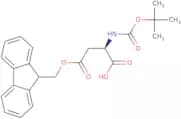
CAS:<p>Please enquire for more information about Boc-D-aspartic acid beta-9-fluorenylmethyl ester including the price, delivery time and more detailed product information at the technical inquiry form on this page</p>Formula:C23H25NO6Purity:Min. 95%Molecular weight:411.45 g/molFmoc-(2S,4S)-4-phenylpyrrolidine-2-carboxylic acid
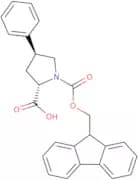
CAS:<p>Please enquire for more information about Fmoc-(2S,4S)-4-phenylpyrrolidine-2-carboxylic acid including the price, delivery time and more detailed product information at the technical inquiry form on this page</p>Formula:C26H23NO4Purity:Min. 95%Molecular weight:413.47 g/molGuanidinoacetic acid
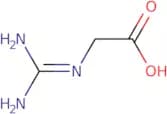
CAS:<p>Guanidinoacetic acid is a metabolite of creatine and is formed by reaction with the amino acid arginine. It is also synthesized from guanidinoacetate, which is derived from the oxidation of arginine. Guanidinoacetic acid can be found in human serum and eye disorders such as glaucoma. The analytical method for guanidinoacetic acid involves the conversion of guanidine to guanidinoacetic acid using nitrous acid, followed by gas chromatographic separation of the products. The concentration of guanidinoacetic acid in human serum has been shown to have an inverse relationship with body mass index (BMI). This means that people with a higher BMI have lower levels of guanidinoacetic acids in their blood than those who are thinner. Guanidinoacetate has also been shown to increase energy metabolism and inhibit glycolysis in humans.</p>Formula:C3H7N3O2Purity:Min. 95%Molecular weight:117.11 g/mol4,4'-Biphenyldisulfonic acid
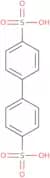
CAS:<p>4,4'-Biphenyldisulfonic acid is a reactive and stable complex that can be used in organic synthesis. It has been shown to react with nitrogen-containing compounds to form stable complexes, such as 4,4'-biphenyldisulfonyl azide and 4,4'-biphenyldisulfonyl chloride. It also reacts with Friedel-Crafts reactions to form biphenyl. The alkali hydrolysis of this compound leads to the formation of sulfonic acids. This reaction also produces carbonyl groups and structural formula. 4,4'-Biphenyldisulfonic acid can be used as an anti-inflammatory agent for the treatment of influenza virus and molybdenum deficiency diseases.</p>Formula:C12H10O6S2Purity:Min. 95%Color and Shape:SolidMolecular weight:314.34 g/mol4-(2-Chlorophenyl)-9-methyl-6H-thieno[3,2-f][1,2,4]triazolo[4,3-a][1,4]diazepine-2-propanoic acid
CAS:Controlled Product<p>Please enquire for more information about 4-(2-Chlorophenyl)-9-methyl-6H-thieno[3,2-f][1,2,4]triazolo[4,3-a][1,4]diazepine-2-propanoic acid including the price, delivery time and more detailed product information at the technical inquiry form on this page</p>Formula:C18H15ClN4O2SPurity:Min. 95%Molecular weight:386.86 g/mol1,4-Piperidinedicarboxylic acid, 4-aMino-, 1-(1,1-diMethylethyl) 4-ethyl ester
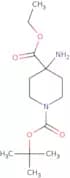
CAS:<p>Please enquire for more information about 1,4-Piperidinedicarboxylic acid, 4-aMino-, 1-(1,1-diMethylethyl) 4-ethyl ester including the price, delivery time and more detailed product information at the technical inquiry form on this page</p>Formula:C13H25N2O4Purity:Min. 95%Molecular weight:273.35 g/molDimethylaminoacetic acid hydrazide dihydrochloride
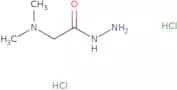
CAS:<p>Please enquire for more information about Dimethylaminoacetic acid hydrazide dihydrochloride including the price, delivery time and more detailed product information at the technical inquiry form on this page</p>Purity:Min. 95%Ethyl 1-N-Boc-3-oxopiperidine-4-carboxylate
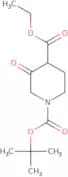
CAS:<p>Please enquire for more information about Ethyl 1-N-Boc-3-oxopiperidine-4-carboxylate including the price, delivery time and more detailed product information at the technical inquiry form on this page</p>Formula:C13H21NO5Purity:Min. 95%Molecular weight:271.31 g/molFmoc-(4-aminomethyl) benzoic acid
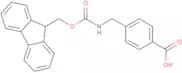
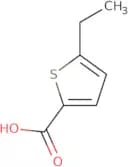
CAS:<p>Please enquire for more information about Fmoc-(4-aminomethyl) benzoic acid including the price, delivery time and more detailed product information at the technical inquiry form on this page</p>Formula:C23H19NO4Purity:Min. 95%Molecular weight:373.4 g/mol5-Ethylthiophene-2-carboxylic acid
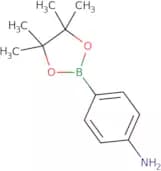
CAS:<p>5-Ethylthiophene-2-carboxylic acid is a chemical compound that has been acetylated. It is often used as an intermediate in organic synthesis, especially as a building block for the production of pharmaceuticals and agrochemicals. 5-Ethylthiophene-2-carboxylic acid can be chromatographically separated by using strategies such as validation, algorithm, and regression. The chemical structure of this compound may be determined by using methods such as fingerprinting and gas chromatography. The structural isomers of this compound are naphthenic (5E) and butyllithium (5B). Chemists use 5E and 5B to profile the properties of this substance.</p>Formula:C7H8O2SPurity:Min. 95%Molecular weight:156.2 g/mol(4-Aminophenyl)boronic acid pinacol ester
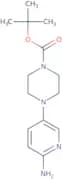
CAS:<p>(4-Aminophenyl)boronic acid pinacol ester is a semiconducting material that can be used in thin film devices. It has been shown to be a good candidate for transistor and device applications due to its high yield, low cost, and high stability. This compound can also be used to modify the structure of other compounds through substitution reactions. (4-Aminophenyl)boronic acid pinacol ester has been synthesized from inexpensive starting materials, such as triphenylamine and amines.</p>Formula:C12H18BNO2Purity:Min. 95%Color and Shape:White PowderMolecular weight:219.09 g/moltert-Butyl 4-(6-aminopyridin-3-yl)piperazine-1-carboxylate
CAS:<p>tert-Butyl 4-(6-aminopyridin-3-yl)piperazine-1-carboxylate is an organic compound that can be synthesized by the reduction of 5-bromo-2-nitro pyridine with a palladium catalyst. It has been shown to inhibit the growth of cancer cells in vitro and in vivo, and is being investigated as a potential treatment for breast cancer.</p>Formula:C14H22N4O2Purity:Min. 95%Molecular weight:278.35 g/molMethyl 4,5-dimethoxy-1-methyl-1H-indole-2-carboxylate
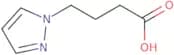
CAS:Controlled Product<p>Please enquire for more information about Methyl 4,5-dimethoxy-1-methyl-1H-indole-2-carboxylate including the price, delivery time and more detailed product information at the technical inquiry form on this page</p>Formula:C13H15NO4Purity:Min. 95%Molecular weight:249.26 g/mol4-(1H-Pyrazol-1-yl)butanoic acid
CAS:<p>Please enquire for more information about 4-(1H-Pyrazol-1-yl)butanoic acid including the price, delivery time and more detailed product information at the technical inquiry form on this page</p>Formula:C7H10N2O2Purity:Min. 95%Molecular weight:154.17 g/molDL-Lactic acid sodium salt, 60% w/w syrup
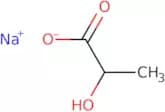
CAS:<p>Lactic acid is a natural product that has been used for many years as an antimicrobial agent in wastewater treatment. It is also used in the food industry to prevent the growth of bacteria and fungi, and as a preservative. Lactic acid has been shown to have a physiological effect on locomotor activity, which may be due to its ability to convert pyruvate into lactate. Lactic acid also inhibits the growth of some bacterial strains by increasing the disulfide bond formation between two cysteine residues. The sodium salt form of lactic acid is more soluble than the acid form and can be used as an experimental model for studying sodium-lactate interactions. Sodium lactate is used in maternal blood transfusions to increase blood pH levels during labor, and is also added to water vapor for humidification purposes.</p>Formula:C3H5O3NaColor and Shape:Colorless Clear LiquidMolecular weight:112.06 g/molHeptadecafluorononanoic acid
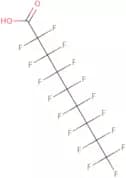
CAS:<p>Heptadecafluorononanoic acid is a long-chain fatty acid that has been used as a building block in the synthesis of polymers. It has been shown to have an effect on locomotor activity and thermal expansion in human serum, as well as on maternal blood. Heptadecafluorononanoic acid has also been found to be effective for the treatment of hepatic steatosis and may have long-term efficacy. This compound is also able to bind with receptors, which can contribute to its biological properties. Heptadecafluorononanoic acid has been shown to inhibit geriatric patients' reaction solution. The analytical method for heptadecafluorononanoic acid consists of gas chromatography with flame ionization detection (GC-FID).</p>Formula:C9HF17O2Purity:Min. 95%Color and Shape:PowderMolecular weight:464.08 g/molNonafluoro-1-butanesulfonic Acid
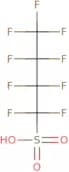
CAS:<p>Nonafluoro-1-butanesulfonic acid (NBS) is a sulfonic acid that is used in the synthesis of sodium salts. NBS has been shown to be toxic to cultured human immunoglobulin cells, with an IC50 of 0.5 mM. It also inhibits the growth of 3T3-L1 preadipocytes and can cause weight gain in animal models. However, NBS has been found to be non-toxic to mice, rats and monkeys after 28 days of continuous dosing with up to 1 g/kg/day. This compound also has been found to have no significant interactions with drugs or other chemicals at concentrations up to 10 times higher than therapeutic doses. A validated analytical method for determining the concentration of NBS in water samples has been developed using liquid chromatography coupled with tandem mass spectrometry (LC/MS/MS).</p>Formula:C4HF9O3SPurity:Min. 95%Color and Shape:Colourless To Pale Yellow LiquidMolecular weight:300.1 g/mol
![3,6-Dichlorobenzo[b]thiophene-2-carboxylic acid](/_next/image/?url=https%3A%2Fstatic.cymitquimica.com%2Fproducts%2F3D%2Fthumb-webp%2FFD57151.webp&w=3840&q=75)

![4-(2-Chlorophenyl)-9-methyl-6H-thieno[3,2-f][1,2,4]triazolo[4,3-a][1,4]diazepine-2-propanoic acid](/_next/image/?url=https%3A%2Fstatic.cymitquimica.com%2Fproducts%2F3D%2Fthumb-webp%2FFC20336.webp&w=3840&q=75)