Glycoscience
Subcategories of "Glycoscience"
- Aminosugars(108 products)
- Glyco-Related Antibodies(283 products)
- Glycolipids(46 products)
- Glycosaminoglycans (GAGs)(55 products)
- Glycosides(419 products)
- Monosaccharides(6,619 products)
- Oligosaccharides(3,711 products)
- Polysaccharides(505 products)
Found 11027 products of "Glycoscience"
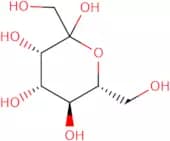
D-Mannoheptulose
CAS:Inhibitor of glucokinases and hexokinasesFormula:C7H14O7Purity:Min. 98.0 Area-%Color and Shape:White PowderMolecular weight:210.18 g/mol3,4,6-Tri-O-benzyl-1-deoxy-D-sorbofuranose
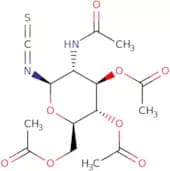
3,4,6-Tri-O-benzyl-1-deoxy-D-sorbofuranose is a custom synthesis of a monosaccharide that can be modified to include other sugars. It is an example of a complex carbohydrate, which are carbohydrates composed of multiple saccharides. Carbohydrates are vital for all living organisms as they provide the basic fuel for cellular respiration and serve as structural components of cells and tissues. 3,4,6-Tri-O-benzyl-1-deoxy-D-sorbofuranose is used in the synthesis of polysaccharides and glycosylations. This compound has been fluorinated to create an important chemical intermediate for synthesizing saccharides with a high purity.Purity:Min. 95%2-Acetamido-3,4,6-tri-O-acetyl-2-deoxy-b-D-glucopyranosyl isothiocyanate
CAS:2-Acetamido-3,4,6-tri-O-acetyl-2-deoxy-b-D-glucopyranosyl isothiocyanate is a synthetic glycosylating agent that has been shown to be effective in the synthesis of complex carbohydrates. It is used for the modification of saccharides and polysaccharides with click chemistry. Click chemistry is an organic reaction that synthesizes carbon–carbon bonds by the addition of a copper catalyst at room temperature without the need for high energy input. 2AATIGI can also be used to modify oligosaccharides and glycosylates proteins. For example, this compound was found to be effective in modifying a protein with a carbohydrate moiety that was derived from 2′,3′,5′ triacetylhexaose (2T3H).Formula:C15H20N2O8SPurity:Min. 95%Color and Shape:Off-White PowderMolecular weight:388.39 g/mol2,3-Di-O-benzoyl-L-threonic acid-1,4-lactone
2,3-Di-O-benzoyl-L-threonic acid-1,4-lactone is a custom synthesis of a fluorinated monosaccharide methylated at the C2 position. It is an oligosaccharide with a saccharide and polysaccharide linkage. The glycosylation of this compound has been modified by the Click chemistry reaction to create new sugar moieties.Purity:Min. 95%Maltohexaose
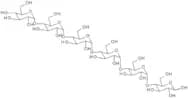
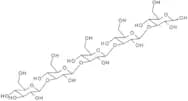
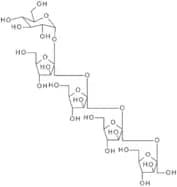
CAS:Maltohexaose is a polysaccharide formed by 6 units of glucose and can be metabolised inside the cell to a substrate-based inhibitor of fucosyltransferases. It can also be converted to GDP-2-deoxy-2-fluoro-L-fucose, a competitive inhibitor of α-1,3-fucosyltransferase. Matohexaose is used as acceptor for measuring the activity of 4-Alpha-Glucanotransferase.Formula:C36H62O31Purity:Min. 70 Area-%Color and Shape:White PowderMolecular weight:990.86 g/molLipopolysaccharide - from Porphyromonas gingivalis
CAS:Lipopolysaccharide (LPS) is a molecule that is produced by Porphyromonas gingivalis. This molecule is also found in the outer membranes of Gram-negative bacteria and has been shown to have many effects on animal tissues. LPS activates HIF-1α, which leads to the production of inflammatory cytokines such as necrosis factor (TNF), and interferon regulatory factors (IRFs). These molecules signal for the production of more LPS. LPS also causes tissue growth and development by activating growth factors such as insulin-like growth factor 1. LPS also activates immune cells through signaling with chemokine receptors, promoting inflammation.Purity:Min. 95%Color and Shape:Solid2,3,4,6-Tetra-O-benzyl-D-mannopyranose
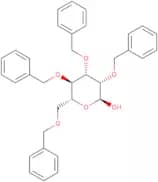
CAS:2,3,4,6-Tetra-O-benzyl-D-mannopyranose is a trisaccharide that consists of two covalently linked glycosyl acceptors and one galacto moiety. This molecule is synthesized by chemoenzymatic synthesis and can be found in the biosynthesis of trehalose. 2,3,4,6-Tetra-O-benzyl-D-mannopyranose is an anomeric form of D-glucopyranose. The anomeric form is determined by the orientation of the hydroxyl group at C1' with respect to the anomeric carbon atom at C2'. This molecule has been isotopically labelled with 13C and 15N for use in studies on carbohydrate metabolism.Formula:C34H36O6Purity:90%Color and Shape:Yellow PowderMolecular weight:540.65 g/molLaminaripentaose
CAS:Ex algal/bacterial polysaccharides-value in b1-3 glucanase assays & diagnosticsFormula:C30H52O26Purity:Min. 85 Area-%Color and Shape:PowderMolecular weight:828.72 g/molLacto-N-hexaose
CAS:Neutral hexasasaccharide naturally present in human breast milk
Formula:C40H68N2O31Purity:Min. 95%Color and Shape:White PowderMolecular weight:1,072.96 g/mol2-Acetamido-2-deoxy-4-O-(b-D-galactopyranosyl)-D-galactopyranose
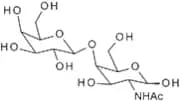
CAS:2-Acetamido-2-deoxy-4-O-(b-D-galactopyranosyl)-D-galactopyranose is a glycan that binds to human lymphocytes and induces their death. It is a glycan that has been shown to be sialylated, which may be due to its high degree of homology with other glycan structures. The 2-acetamido group confers the ability to bind to sialyltransferases, which are enzymes that catalyze the transfer of sialic acid from glucose onto complex carbohydrates. This binding inhibits the enzymatic activity of these enzymes and prevents the addition of sialic acid onto oligosaccharides, preventing antigen presentation. 2-Acetamido-2-deoxy-4-O-(b-D-galactopyranosyl)-D-galactopyranose is also known as "sialic acid" or "Formula:C14H25NO11Purity:Min. 90 Area-%Color and Shape:PowderMolecular weight:383.35 g/molBenzyl 2-acetamido-2-deoxy-4-O-(b-D-galactopyranosyl)-a-D-galactopyranoside
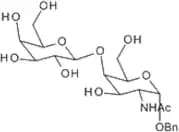
CAS:Benzyl 2-acetamido-2-deoxy-4-O-(b-D-galactopyranosyl)-a-D-galactopyranoside is a synthetic saccharide. The chemical structure of this material has been modified by fluorination, methylation, and click modification. This product is soluble in water and can be used as a starting material for the synthesis of polysaccharides.Formula:C21H31NO11Purity:Min. 95%Molecular weight:473.47 g/mol1,1,1-Kestopentaose
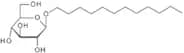
CAS:Non-reducing sucrose analog containing glucose and fructose; prebiotic fibreFormula:C30H52O26Purity:Min. 95 Area-%Color and Shape:White PowderMolecular weight:828.72 g/molDodecyl b-D-galactopyranoside
Dodecyl b-D-galactopyranoside is a methylated sugar that can be used to modify glycoproteins and polysaccharides. Dodecyl b-D-galactopyranoside has been shown to be useful for the synthesis of complex carbohydrate oligosaccharides, as well as for click chemistry, which involves the use of copper (II) ions. This product is available in custom synthesis, high purity, and fluorination.Formula:C18H36O6Purity:Min. 95%Molecular weight:348.48 g/mol2,3:4,5-Di-O-isopropylidene-D-xylitol
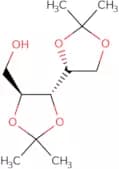
CAS:2,3:4,5-Di-O-isopropylidene-D-xylitol is an acceptor for the Stannic Chloride Reaction. It is a lacto-n-biose derivative of D-xylitol that has been shown to have antibiotic activity against Streptococcus section A and B. The temporary protection of the hydroxyl group in 2,3:4,5diOisopropylidene-Dxylitol with methyl glycosides provides a convenient method for glycosylations. The chloride ion can be replaced by hexaacetate to yield 1amino1deoxyDxylitol hydrochloride, which is a benzyl derivative. This reaction allows for research into the transfer of 2,3:4,5diOisopropylideneDxylitol.Formula:C11H20O5Purity:Min. 95%Color and Shape:Solidified MassMolecular weight:232.27 g/mol1-(3'-Azidopropyl)-3,6-di-O-acetyl-2-deoxy-4-O-[2,4,6-tri-O-acetyl-3-O-(p-phenoxybenzyl)-b-D-galactopyranosyl]-2-phthalimido-b-D-glu copyranoside
This is a synthetic, fluorinated, monosaccharide. It has been custom synthesized and is available in high purity. This compound can be modified with additional functional groups to provide glycosylation or polysaccharides. The CAS number for this product is 538-37-0.Purity:Min. 95%UDP-2-deoxy-2-fluoro-D-glucose sodium salt
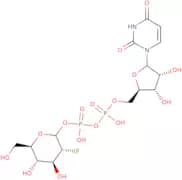
CAS:UDP-2-deoxy-2-fluoro-D-glucose sodium salt (UDPFG) is a fluorinated analog of the sugar donor, UDP-glucose. It is an acceptor for the enzyme, glycosylation protein glucosyltransferase, which catalyzes the transfer of glucose to proteins. This compound has been shown to be an activating sugar donor in vitro and in vivo. In addition, it was found that UDFG can bind to the active site of glucosyltransferase in a hydrogen bond interaction that may be important for catalysis.Formula:C15H21FN2O16P2·2NaPurity:Min. 95%Color and Shape:PowderMolecular weight:568.29 g/mol(2S, 3S, 4S) -1-Butyl-4- (hydroxymethyl) - 3- (phenylmethoxy) - 2- azetidinecarboxylic acid, methyl ester
(2S, 3S, 4S) -1-Butyl-4- (hydroxymethyl) - 3- (phenylmethoxy) - 2- azetidinecarboxylic acid, methyl ester is a product that can be custom synthesized. It can be used for the modification of complex carbohydrates, for example oligosaccharides and polysaccharides. This product has been fluorinated to improve its stability and modify saccharide linkages. The hydroxy methyl group at C2 position in this product is capable of being modified with Click chemistry.Purity:Min. 95%2-Azidomethyl-2-deoxy-5,6-O-isopropylidene-L-gulono-1.4-lactone
2-Azidomethyl-2-deoxy-5,6-O-isopropylidene-L-gulono-1.4-lactone is a custom synthesis of a monosaccharide. This compound has been modified with fluorination, methylation, and click chemistry to create a glycosylated sugar. The CAS number for this compound is 628379-06-8. This synthetic carbohydrate can be used in the modification or synthesis of other carbohydrates.Purity:Min. 95%D-Fructose-1,6-diphosphate magnesium
CAS:D-Fructose-1,6-diphosphate magnesium (DFP) is a water soluble compound that inhibits hexokinases and aldolases. It has been shown to inhibit the activity of these enzymes in experimental models. DFP inhibits the synthesis of glyceraldehyde 3-phosphate and dihydroxyacetone phosphate, which are required for glycolysis, leading to cytosolic calcium ion concentrations increasing. This product also has an effect on energy metabolism by inhibiting mitochondrial oxidative phosphorylation and glutamate dehydrogenase activity. DFP also induces apoptosis in neuronal cells through activation of IL2 receptor and picolinic acid.Formula:C6H12O12P2•MgPurity:Min. 95%Color and Shape:PowderMolecular weight:362.4 g/molMethyl β-L-arabinopyranoside
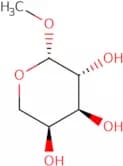
CAS:Methyl β-L-arabinopyranoside is a stereochemically pure monosaccharide that has been used to calibrate and quantify the conformational, stereochemical, and spectrometric methods. Methyl β-L-arabinopyranoside has a conformation that is restricted by the presence of an α-hydroxyl group at C2. The chloride ion can be used to monitor this conformation. The diameter of methyl β-L-arabinopyranoside can be measured with a micropipette and monitored using an aerosol detector. Methyl β-L-arabinopyranoside can also be quantified by mass spectrometry or spectrophotometry. The conformational, stereochemical, and spectrometric methods have been calibrated using methyl β-L-arabinopyranoside as a standard to determine their accuracy in measuring the size of other molecules.
Formula:C6H12O5Purity:Min. 95%Color and Shape:White Off-White PowderMolecular weight:164.16 g/mol