Antimicrobials
Antimicrobials are agents that destroy or inhibit the growth of microorganisms, including bacteria, viruses, fungi, and parasites. These compounds are essential in the prevention and treatment of infections, playing a crucial role in medicine, agriculture, and the food industry. At CymitQuimica, we offer an extensive range of high-quality, high-purity antimicrobials suitable for various scientific and industrial applications. Our catalog includes antibiotics, antifungals, antivirals, and disinfectants, all designed to meet the needs of research and development, as well as clinical and production applications. With our products, professionals can ensure the effectiveness and safety in infection control and public health protection.
Subcategories of "Antimicrobials"
- Antibiotics(4,110 products)
- Antifungals(835 products)
- Antiparasitics(704 products)
- Antivirals(762 products)
Found 2422 products of "Antimicrobials"
Sort by
Purity (%)
0
100
|
0
|
50
|
90
|
95
|
100
Alisporivir
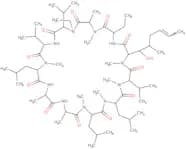
CAS:<p>Alisporivir is an investigational antiviral agent, which is a synthetic derivative of cyclosporine A. It originates from the structural modification of naturally occurring cyclosporines, specifically designed to retain potent antiviral activity while minimizing immunosuppressive effects. Its mode of action involves the inhibition of cyclophilin, an essential cellular protein that facilitates the replication of hepatitis C virus (HCV) by interacting with viral proteins. By binding to cyclophilin, alisporivir disrupts this interaction, effectively halting the viral replication process.</p>Formula:C63H113N11O12Purity:Min. 95%Molecular weight:1,216.6 g/molCefixime methyl ester
CAS:<p>Cefixime methyl ester is a chemical compound often used in the development of antibiotics, specifically as a semi-synthetic cephalosporin derivative. It is derived from Cephalosporium acremonium, a type of fungus, which serves as a source for the initial cephalosporin structure. The compound functions as a beta-lactam antibiotic by inhibiting bacterial cell wall synthesis. It achieves this through the acylation of penicillin-binding proteins, effectively halting the transpeptidation or cross-linking of the peptidoglycan layer, which is crucial for bacterial survival and division.</p>Formula:C17H17N5O7S2Purity:Min. 95%Molecular weight:467.50 g/molBasic violet 3 d6
CAS:<p>Basic Violet 3 is a synthetic dye, which is derived from coal tar sources with a mechanism of action involving the disruption of cellular components. This compound intercalates with nucleic acids, allowing it to bind to specific cellular structures. Its primary mode of action targets the chromosomal material, leading to colorimetric changes that enhance visualization.</p>Formula:C25H30ClN3Purity:Min. 95%Molecular weight:414 g/molUniconazole
CAS:<p>Uniconazole is a synthetic plant growth regulator, which is derived from triazole compounds. It acts as a potent inhibitor of gibberellin biosynthesis, specifically targeting enzymes involved in gibberellin production. By inhibiting gibberellins, uniconazole reduces internode elongation and alters growth patterns, resulting in shorter, more compact plants.</p>Formula:C15H18ClN3OPurity:Min. 95%Molecular weight:291.78 g/molMomfluorothrin
CAS:<p>Momfluorothrin is a synthetic pyrethroid insecticide, which is a man-made derivative based on the natural pyrethrins. It functions primarily as a neurotoxic agent, targeting the sodium channels in the nervous system of insects, leading to paralysis and eventual death. This specific mode of action involves delaying the closing of the sodium channels, resulting in prolonged nerve impulses.</p>Formula:C19H19F4NO3Purity:Min. 95%Molecular weight:385.4 g/molL-Carnitine fumarate
CAS:<p>L-Carnitine fumarate is a compound that functions as a dietary supplement, which is synthesized by combining L-carnitine, an amino acid derivative naturally found in the body, with fumaric acid. This product is primarily sourced from fermentation or chemical synthesis processes to produce L-carnitine, which is then reacted with fumaric acid to form the fumarate salt. This combination enhances the stability and bioavailability of L-carnitine.</p>Formula:C7H15NO3·C4H4O4Purity:Min. 95%Molecular weight:277.27 g/molNSC-60339
CAS:<p>NSC-60339 is a synthetic antineoplastic agent derived from laboratory synthesis known for its targeted inhibition of specific cancer cell pathways. The compound operates by interfering with crucial cellular processes such as DNA replication or protein synthesis, depending on its exact mode of action.</p>Formula:C26H23ClN6O2Purity:Min. 95%Molecular weight:487 g/molMagainin 1
CAS:<p>Magainin 1 is a peptide antibiotic, which is sourced from the skin secretions of the African clawed frog, *Xenopus laevis*. It operates through a membranolytic mode of action, whereby it integrates into microbial cell membranes, forming pores and causing cell lysis by disrupting membrane integrity. This mechanism is largely non-specific, making it effective against a broad spectrum of bacteria and fungi.</p>Formula:C112H177N29O28SPurity:Min. 95%Molecular weight:2,409.85 g/molTerrelulamide A
CAS:<p>Terrelulamide A is a bioactive compound, specifically a cyclic peptide, which is derived from marine cyanobacteria. The source of Terrelulamide A is primarily marine environments where these cyanobacteria undergo complex biosynthetic processes to produce such metabolites. This compound's mode of action involves the disruption of cellular processes by binding to specific molecular targets that are critical in cell cycle regulation. It exhibits cytotoxic activity, effectively inhibiting cancer cell proliferation through its interaction with those pathways.</p>Formula:C20H26N6O7Purity:Min. 95%Molecular weight:462.5 g/molAmidithion
CAS:<p>Amidithion is an insecticidal and acaricidal compound, which is a derivative of organophosphorus chemistry. This compound is chiefly synthesized through the complex chemical manipulation of phosphoryl groups, rendering it a potent inhibitor of enzymatic activity in target organisms.</p>Formula:C7H16NO4PS2Purity:Min. 95%Molecular weight:273.3 g/molAcivicin hydrochloride
CAS:<p>Acivicin hydrochloride is a synthetic compound that acts as a glutamine antagonist, sourced from microbial fermentation processes. It functions primarily through the inhibition of glutamine-utilizing enzymes, such as gamma-glutamyl transferase and carbamoyl phosphate synthetase, which play critical roles in nucleotide biosynthesis and other metabolic pathways. By disrupting these biochemical processes, Acivicin hydrochloride can hinder the proliferation of rapidly dividing cells, displaying potential antitumor properties.</p>Formula:C5H8Cl2N2O3Purity:Min. 95%Molecular weight:215.03 g/molPropiconazole
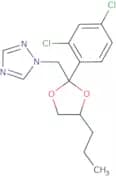
CAS:<p>Propiconazole is a triazole fungicide with action on fungal cell membranes by inhibiting ergosterol biosynthesis and is used for controlling fungal diseases in crops and turf.</p>Formula:C15H17Cl2N3O2Purity:Min. 95%Color and Shape:Clear LiquidMolecular weight:342.22 g/molCefdinir monohydrate
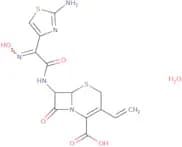
CAS:<p>Cefdinir monohydrate is a third-generation cephalosporin antibiotic, which is synthetically derived from cephalosporin C, a compound originally isolated from the fungus Acremonium. This antibiotic works by inhibiting bacterial cell wall synthesis through binding to penicillin-binding proteins (PBPs), which results in the interruption of peptidoglycan cross-linking. Consequently, this action leads to cell lysis and death of the bacterium.</p>Formula:C14H15N5O6S2Purity:Min. 95%Molecular weight:413.4 g/mol4-Epitetracycline hydrochloride
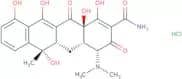
CAS:<p>4-Epitetracycline hydrochloride is a tetracycline antibiotic derivative, which is a secondary metabolite derived from bacterial sources, particularly Streptomyces species. It functions primarily by inhibiting protein synthesis in bacteria through binding to the 30S ribosomal subunit, preventing the attachment of aminoacyl-tRNA to the RNA-ribosome complex. This action hinders bacterial growth by interfering with vital processes necessary for bacterial survival and replication.</p>Formula:C22H25ClN2O8Purity:Min. 95%Color and Shape:PowderMolecular weight:480.9 g/molSulfadiazine-d4
CAS:<p>Sulfadiazine-d4 is an isotopically labeled antibiotic, which is a derivative of sulfadiazine containing four deuterium atoms. This compound is synthesized using advanced chemical techniques to replace hydrogen atoms with deuterium in the molecular structure. The mechanism of action involves inhibition of bacterial dihydropteroate synthase, an enzyme critical in the folate synthesis pathway. By preventing the production of folic acid, sulfadiazine-d4 effectively halts bacterial growth and replication.</p>Formula:C10H6D4N4O2SPurity:Min. 95%Molecular weight:254.3 g/molEnzaplatovir
CAS:<p>Enzaplatovir is a novel antiviral agent, which is a synthetic compound developed through advanced medicinal chemistry techniques. It functions as an inhibitor of RNA-dependent RNA polymerase, a critical enzyme in the replication cycle of various RNA viruses. By targeting this enzyme, Enzaplatovir effectively impedes viral RNA synthesis, thus disrupting viral replication.</p>Formula:C20H19N5O3Purity:Min. 95%Molecular weight:377.4 g/molAlthiomycin
CAS:<p>Althiomycin is a macrolide antibiotic, which is derived from Actinobacteria, specifically the genus Streptomyces. Its mode of action involves binding to the 50S subunit of the bacterial ribosome, thereby inhibiting protein synthesis. This mechanism effectively suppresses bacterial growth by interfering with the translation process, ultimately leading to pathogen elimination.</p>Formula:C16H17N5O6S2Purity:Min. 95%Molecular weight:439.50 g/molN,N′-1,2-Ethanediylbis[3-nitrobenzenesulfonamide]
CAS:<p>N,N′-1,2-Ethanediylbis[3-nitrobenzenesulfonamide] is a chemical compound, specifically a bis-sulfonamide derivative. It is synthesized through the reaction of sulfonamide derivatives with ethylenediamine, resulting in a unique structure characterized by its two nitrobenzenesulfonamide groups linked by an ethylene bridge. As a source, it is obtained through synthetic organic chemistry methods involving nitration and sulfonamidation processes.</p>Formula:C14H14N4O8S2Purity:Min. 95%Molecular weight:430.4 g/molPPA-904
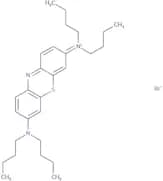
CAS:<p>PPA-904 is an organophosphate compound, which is a chemically synthesized product. It functions as an additive, often utilized in industrial applications due to its unique chemical properties. As an organophosphate, PPA-904 acts through phosphorylation processes, interacting with various substrates to alter their chemical and physical characteristics. This mechanism is utilized to enhance material properties such as stability, functionality, or resistance to environmental conditions.</p>Formula:C28H42BrN3SPurity:Min. 95%Molecular weight:532.6 g/mol3'-N-Desmethyl-3'-N-tosyl azithromycin
CAS:<p>3'-N-Desmethyl-3'-N-tosyl azithromycin is a semi-synthetic macrolide antibiotic analog, which is a derivative of azithromycin, a well-known member of the macrolide class of antibiotics. This compound is synthesized through chemical modifications of the parent molecule, azithromycin, to potentially enhance its pharmacokinetic and pharmacodynamic properties.</p>Formula:C44H76N2O14SPurity:Min. 95%Molecular weight:889.15 g/mol






![N,N′-1,2-Ethanediylbis[3-nitrobenzenesulfonamide]](/_next/image/?url=https%3A%2Fstatic.cymitquimica.com%2Fproducts%2F3D%2Fthumb-webp%2FAAA09662.webp&w=3840&q=75)