Nucleotides
Subcategories of "Nucleotides"
Found 2638 products of "Nucleotides"
2'-Deoxy-5-iodocytidine
CAS:Anti-viral agent; iodinated analog of deoxycytidineFormula:C9H12IN3O4Purity:Min. 98 Area-%Color and Shape:White Off-White PowderMolecular weight:353.12 g/mol5-Fluorouridine-5'-O-b-D-galactopyranoside
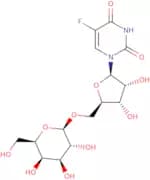
CAS:5-Fluorouridine-5'-O-b-D-galactopyranoside is a nucleoside that can be used as an activator to synthesize ribonucleosides and deoxyribonucleosides. This product is also an anticancer agent, as it inhibits cell proliferation by inactivating the enzyme DNA polymerase. It is highly purified, with a purity of 99%.Formula:C15H21FN2O11Purity:Min. 98 Area-%Color and Shape:Off-White PowderMolecular weight:424.33 g/mol2'-O-Methyl-2-thiouridine
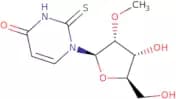
CAS:2'-O-Methyl-2-thiouridine is a modified nucleoside that is categorized as a mismatched nucleotide. It is found in RNA, where it replaces uridine and acts as a mismatch base. 2'-O-Methyl-2-thiouridine has been shown to stabilize duplex DNA against thermal denaturation by forming triplexes with complementary sequences. It also stabilizes dsDNA against hydrolysis by the enzyme ribonuclease H (RNase H) and has been used in the design of antisense therapeutics. Thermophilic bacteria use this molecule to synthesize their own thymine nucleotides, which are structurally similar to 2'-O-methyl-2-thiouridine. This modification prevents mismatches in their own dna and helps protect them from heat stress. The thermodynamic stability of this molecule has been calculated using an algorithm that takes into account the hybridization free energy, enthalpy change, entropyFormula:C10H14N2O5SPurity:Min. 95%Color and Shape:PowderMolecular weight:274.29 g/molTetrahydrouridine
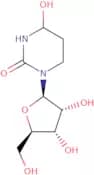
CAS:Tetrahydrouridine is a pyrimidine nucleoside that has been shown to have inhibitory properties in clinical pathology. Tetrahydrouridine is a natural product derived from the amino acid histidine and is found in the cells of many living organisms. It is believed that tetrahydrouridine may be useful as an adjuvant to radiation therapy, and it has been shown to reduce the toxicity of chemotherapy drugs, such as decitabine and Ara-C. Tetrahydrouridine inhibits enzymes involved in DNA methylation, which can lead to cancer cell death.br> Tetrahydrouridine also has inhibitory effects on enzymes that produce cytidine from uracil, which can help prevent the formation of cancerous cells.br> Tetrahydrouridine inhibits deaminase activity, which produces uracil from cytosine. This inhibition prevents the production of uracil-cytosineFormula:C9H16N2O6Purity:Min. 95%Color and Shape:White Off-White PowderMolecular weight:248.23 g/mol2'-O-Propargylguanosine
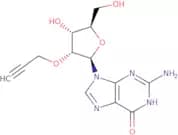
CAS:2'-O-Propargylguanosine is a monophosphate nucleoside that is synthesized from Ribonucleosides. It has been shown to have antiviral and anticancer properties. 2'-O-Propargylguanosine has shown to be an activator of the transcription factor NF-κB and to induce apoptosis in various cancer cell lines. This drug inhibits viral replication by inhibiting DNA polymerase, thereby preventing RNA synthesis.
Formula:C13H15N5O5Purity:Min. 95%Color and Shape:PowderMolecular weight:321.29 g/mol2',3',5'-Tri-O-acetyl-2-fluoroadenosine
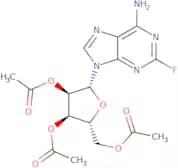
CAS:2',3',5'-Tri-O-acetyl-2-fluoroadenosine is nucleoside analog of adenosine for use in research. The addition of a fluorine to an adenosine can change adenosine's properties such as its hydrogen bonding ability and how it interacts with water and other biological molecules. It can also increase the stability of adenosine and increase its half-life in biological systems.
Formula:C16H18FN5O7Purity:Min. 95%Color and Shape:White To Off-White SolidMolecular weight:411.34 g/molN2-Isobutyrylguanosine
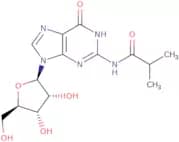
CAS:N2-Isobutyrylguanosine is a synthetic nucleoside analog. It is activated by the enzyme thymidine kinase and inhibits the synthesis of RNA and DNA, which leads to cell death. N2-Isobutyrylguanosine has been shown to be an effective inhibitor of epidermal growth factor receptor (EGFR) in mammalian cells. This drug has also been shown to inhibit insulin-like growth factor I and phosphorothioate monomers. N2-Isobutyrylguanosine inhibits the synthesis of fatty acids, leading to a decrease in lipid content in cells.Formula:C14H19N5O6Purity:Min. 95%Color and Shape:PowderMolecular weight:353.33 g/mol5-Hydroxyuridine
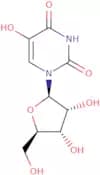
CAS:5-Hydroxyduridine is a nucleoside that is naturally found in the human body. It can be synthesized from uridine by oxidation of the 5-hydroxyl group to the corresponding aldehyde. It has been shown to have genotoxic effects in vitro and in prostate cancer cells. 5-Hydroxyduridine has also been shown to inhibit sugar transport, which may be due to its ability to form hydrogen bonds with glycosidic bonds. It has been reported that 5-hydroxyduridine causes acid formation and hydroxylation of cardiac lipids.Formula:C9H12N2O7Purity:Min. 96 Area-%Color and Shape:White Off-White PowderMolecular weight:260.2 g/mol7-Deaza-2',3'-dideoxyadenosine
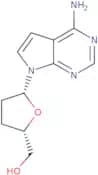
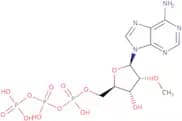
CAS:7-Deaza-2',3'-dideoxyadenosine (7DDAD) is a nucleoside analogue that has been used as an immunodeficiency agent. This drug inhibits the replication of the human immunodeficiency virus (HIV). 7DDAD is a prodrug that is converted to adenosine after it enters the cell, and this conversion prevents DNA synthesis. The effective dose of 7DDAD is 50 mg/kg in rats, but this dose may vary depending on the technique used. 7DDAD has been shown to be effective in vitro against HIV-1 and HIV-2 isolates, and it can also be used to treat cytomegalovirus infections. In addition, 7DDAD has been shown to inhibit the growth of various types of cancer cells in vitro.Formula:C11H14N4O2Purity:Min. 98 Area-%Color and Shape:PowderMolecular weight:234.26 g/mol2'-O-Methyladenosine-5'-triphosphate sodium salt - 100mM aqueous solution
CAS:2'-O-Methyladenosine-5'-triphosphate sodium salt is a novel nucleoside phosphoramidite. It is an activator and it can be used in the synthesis of DNA and RNA. The compound has antiviral properties and has been shown to inhibit DNA replication, protein synthesis, and RNA transcription. The compound also inhibits the growth of cancer cells by inducing apoptosis.Formula:C11H18N5O13P3·xNaPurity:Min. 95%Color and Shape:PowderMolecular weight:521.21 g/molThymidine-5'-diphosphate trisodium salt
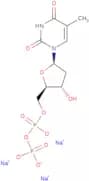
CAS:Thymidine-5'-diphosphate trisodium salt is a novel anticancer drug that is structurally modified to resemble thymidine. It has antiviral and antitumor effects and can be used as an antineoplastic agent. Thymidine-5'-diphosphate trisodium salt is a high quality, high purity ribonucleoside that can be used in the synthesis of deoxyribonucleosides and phosphoramidites. This drug has shown activity against various types of cancer cells and is being investigated for its potential use in the treatment of leukemia.
Formula:C10H13N2Na3O11P2Purity:Min. 95%Color and Shape:White PowderMolecular weight:468.13 g/mol3'-Deoxy-3'-fluoroadenosine
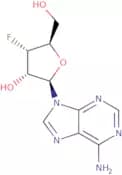
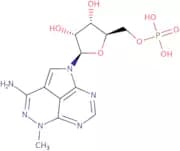
CAS:3'-Deoxy-3'-fluoroadenosine is a potent inhibitor of the phosphodiesterase enzyme, which is an important component of many different cellular processes. It has been shown to inhibit the activity of phosphodiesterase in cell culture and in serum alanine. 3'-Deoxy-3'-fluoroadenosine also inhibits the synthesis of uridine triphosphate, which is required for DNA replication and protein synthesis. The acid complex form has potent inhibition properties against viruses such as alphaviruses, and it also inhibits transport of nucleic acids into cells. 3'-Deoxy-3'-fluoroadenosine can act as an analog to adenosine and may be used to treat viral infections such as HIV or herpes simplex virus.Formula:C10H12FN5O3Purity:Min. 95%Color and Shape:White PowderMolecular weight:269.23 g/molTricyclic nucleoside phosphate
CAS:Akt activation inhibitor
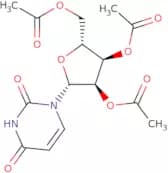
Formula:C13H17N6O7PPurity:Min. 95%Molecular weight:400.28 g/mol2',3',5'-Tri-O-acetyluridine
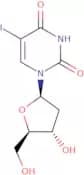
CAS:2',3',5'-Tri-O-acetyluridine is a uridine derivative with potential for use in organic synthesis such as the preparation of modified nucleosides, nucleotides, and RNA analogs.Formula:C15H18N2O9Purity:Min. 95%Color and Shape:White PowderMolecular weight:370.31 g/mol2'-Deoxy-5-iodouridine - EP
CAS:2'-Deoxy-5-iodouridine is a nucleoside analog that inhibits the replication of viruses and other DNA-containing organisms. 2'-Deoxy-5-iodouridine also has inhibitory properties on cell nuclei, which may be due to its ability to bind with DNA and prevent the synthesis of RNA or protein. 2'-Deoxy-5-iodouridine has been shown to inhibit the growth of human HL60 cells in vitro at an optimum concentration of 20 μM. It also inhibits the replication of murine sarcoma virus at an optimum concentration of 16 μM. 2'-Deoxy-5-iodouridine has significant cytotoxicity against solid tumours in mice, which may be due to its ability to inhibit hydrogen fluoride (HF) induced lipid peroxidation and reduce glutathione levels.Formula:C9H11IN2O5Purity:Min. 95%Color and Shape:PowderMolecular weight:354.1 g/mol2',3'-Dideoxy-5-iodocytidine
CAS:2',3'-Dideoxy-5-iodocytidine is a modified nucleoside analog based on cytidine, one of the four standard nucleosides found in DNA and RNA. It has been chemically altered to interfere with DNA or RNA synthesis, making it potentially useful as an antiviral or anticancer agent.
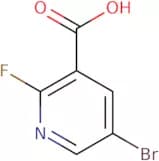
Formula:C9H12N3IO3Purity:Min. 95%Molecular weight:337.11 g/mol5-Bromo-2-fluoronicotinic acid
CAS:5-Bromo-2-fluoronicotinic acid is a crystalline compound with an orthorhombic crystal system. The crystal structure of 5-bromo-2-fluoronicotinic acid monohydrate was determined by X-ray diffraction and refined to 2.5 Å resolution. The space group was found to be P212121 and the unit cell dimensions are a = 9.716 Å, b = 10.867 Å, c = 12.242 Å and β = 106.9°. The molecular weight of 5-bromo-2-fluoronicotinic acid monohydrate was found to be 277.3 g/mol with an elemental analysis of C: 67% H: 7% F: 16%.Formula:C6H3BrFNO2Purity:Min. 95%Color and Shape:PowderMolecular weight:220 g/mol2',3'-O-Isopropylideneadenosine
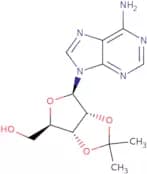
CAS:2',3'-O-Isopropylideneadenosine is a nucleoside that has a possible usage as an organic chemical synthesis intermediate
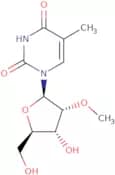
Formula:C13H17N5O4Purity:Min. 98 Area-%Color and Shape:White PowderMolecular weight:307.31 g/mol2'-O-Methyl-5-methyluridine
CAS:2'-O-Methyl-5-methyluridine is a nucleoside that is involved in the synthesis of RNA. It is a component of the 5-methyluridine (5MU) and 2'-O-methyl-5-hydroxymethyluridine (2'OMMU) families of nucleotides. This compound has been shown to be effective against organisms such as E. coli, S. typhimurium, and C. parapsilosis, which are amide sensitive. The amide group of 2'-O-methyl-5-methyluridine can be cleaved by reagents such as hydrazine or tris(2,4,6,-trimethlyphenyl)phosphonium bromide to form 5MU and 2'OMMU respectively. The modifications to the ribose ring are important for its activity and function in cells. The modification of the ribose ring is catalyzed by enzymes called
Formula:C11H16N2O6Purity:Min. 95%Color and Shape:PowderMolecular weight:272.25 g/mol1'-13CCytidine
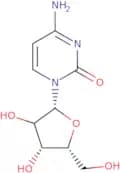
CAS:Cytidine is a nucleotide molecule formed through the attachment of cytosine to a ribose ring
Formula:CC8H13N3O5Purity:Min. 95%Molecular weight:244.21 g/mol