Nucleotides
Subcategories of "Nucleotides"
Found 2637 products of "Nucleotides"
Nicotinic acid-13C6 riboside
CAS:Please enquire for more information about Nicotinic acid-13C6 riboside including the price, delivery time and more detailed product information at the technical inquiry form on this page
Formula:C6C5H13NO6Purity:Min. 95%Molecular weight:260.17 g/mol8-(p-Chlorophenylthio)-cGMP
CAS:8-(p-Chlorophenylthio)-cGMP is a modified nucleoside that has anticancer activity. It inhibits DNA synthesis and the activation of protein kinases, which are enzymes that transmit signals from the cell surface to the nucleus. 8-(p-Chlorophenylthio)-cGMP can also inhibit viral replication by inhibiting the production of new virus particles and by inhibiting the action of reverse transcriptase, an enzyme that converts RNA into DNA.
Formula:C16H15ClN5O7PSPurity:Min. 95%Molecular weight:487.81 g/mol2',3',5'-Tri-O-acetylinosine
CAS:2′,3′,5′-Tri-O-acetylinosine is a protected form of the nucleoside inosine, with potential for use in the preparation of modified nucleotides and nucleoside analogs.
Formula:C16H18N4O8Purity:Min. 95%Color and Shape:White To Off-White SolidMolecular weight:394.34 g/molRef: 3D-NT06708
Discontinued product5′-O-DMT-LNA N-Bz adenosine
CAS:5′-O-DMT-LNA N-Bz adenosine is a novel nucleoside that has been modified with an aminooxy group. The compound is synthesized by the phosphoramidite method and it is designed for use in antiviral and anticancer research. 5′-O-DMT-LNA N-Bz adenosine can be used as a substrate for DNA polymerases and other enzymes to produce nucleic acid strands. This product is CAS No. 206055-74-5, monophosphate, Phosphoramidites, Synthetic, Deoxyribonucleosides, Anticancer, Ribonuclesides, High purity.
Formula:C39H35N5O7Purity:Min. 95%Molecular weight:685.73 g/molRef: 3D-ND182842
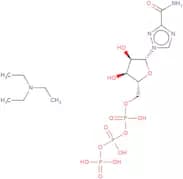
Discontinued productRibavirin 5'-triphosphate triethylammonium salt - 10 mM aqueous solution
CAS:Ribavirin triphosphate is the biologically active metabolite of antiviral nucleoside analog ribavirin. In cells, the prodrug ribavirin gets triphosphorylated and in it inhibits viral RNA polymerases, interfering with the synthesis of newly formed RNA.
Formula:C8H15N4O14P3•(C6H15N)xPurity:Min. 95 Area-%Color and Shape:Clear LiquidMolecular weight:789.732'-Deoxy-a-adenosine
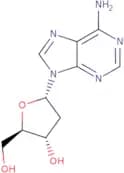
CAS:2'-Deoxy-a-adenosine is a nucleoside that contains an adenine base. It has been studied for its biological properties, including its reaction with solution and its use as an antimicrobial agent. 2'-Deoxy-a-adenosine has been shown to inhibit the growth of bowel disease in mice by binding to the adenosine A3 receptor on the surface of cells. This nucleoside also binds to nuclear DNA and may be used as a pharmacological agent, but more research is needed to determine whether it would be effective against cancer cells. 2'-Deoxy-a-adenosine may also be useful as a potential drug target for the treatment of cancer due to its ability to bind with dna duplexes, which are found in all cancer cells.
Formula:C10H13N5O3Purity:Min. 95%Color and Shape:White PowderMolecular weight:251.25 g/molRef: 3D-ND08541
Discontinued product2',3'-O-Isopropylideneinosine
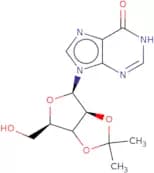
CAS:2',3'-O-Isopropylideneinosineis a nucleoside for use in research applications
Formula:C13H16N4O5Purity:Min. 95%Color and Shape:PowderMolecular weight:308.3 g/mol5-Methyl-L-uridine
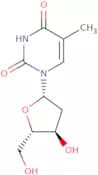
CAS:5-Methyl-L-uridine is an antiviral drug which belongs to a class of compounds called nucleoside analogues. It is used in the treatment of chronic hepatitis B and C, as well as for prevention of hepatitis A and B. 5-Methyl-L-uridine inhibits the virus by turning off the production of viral DNA and RNA, through interactions with the virus's polymerase chain reaction process. This drug also prevents protein synthesis in cells infected with viruses such as HIV, herpes simplex virus type 1, and influenza A virus. 5-Methyl-L-uridine is a prodrug that is converted to its active form, uridine monophosphate, by enzymes in the liver. The cytotoxic effects of 5-methyluridine on cancer cells have been shown to be due to inhibition of cellular DNA synthesis and repair pathways.
Formula:C10H14N2O6Purity:Min. 95%Color and Shape:White PowderMolecular weight:258.23 g/molAdenosine 5'-monophosphate sodium
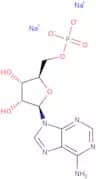
CAS:Adenosine 5'-monophosphate sodium is a nucleotide that is involved in the energy metabolism of cells. It has been shown to inhibit oxidative injury and to activate signal pathways in response to external stimuli, such as glucose deprivation. Adenosine 5'-monophosphate sodium can be synthesized from ATP by the enzyme adenosine kinase.
Formula:C10H13N5O7P·NaPurity:Min. 98 Area-%Color and Shape:White PowderMolecular weight:369.2 g/molRef: 3D-NA10369
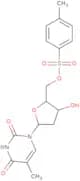
Discontinued product5'-O-Tosylthymidine
CAS:5'-O-Tosylthymidine is a bifunctional reagent that is used in the synthesis of DNA. It is a nucleophilic, inorganic compound that reacts with the electrophilic acrylonitrile group on 5'-hydroxythymidine to form a stable thiophosphate linkage. The reaction takes place stepwise and is catalyzed by an enzyme called DNA polymerase. This product has been used as an antimetabolite in medicine, mainly for treating leukemia.
Formula:C17H20N2O7SPurity:Min. 95%Molecular weight:396.42 g/molRef: 3D-NT10016
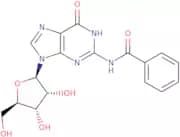
Discontinued productN2-Benzoylguanosine
CAS:N2-Benzoylguanosine is a nucleotide derivative that is formed by the acetylation of guanosine. It has been shown to act as a buffer in alkaline solutions and isomerizes to its n-oxide form when heated. N2-Benzoylguanosine reacts with peroxides such as hydrogen peroxide, glyoxal, and organic peroxides, forming hydroperoxide intermediates that can be converted into other products. The acidic hydrolysis of N2-benzoylguanosine yields the corresponding 6-benzoyladenosines. It has been shown to enhance the activity of uridine in inhibiting bacterial growth, while also acting as an inhibitor of viral RNA synthesis. This compound also reacts with nitrous acid to form an n6-benzoyladenosine derivative that inhibits the formation of RNA chains during transcription.
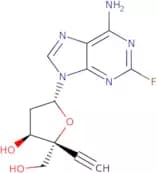
Formula:C17H17N5O6Purity:Min. 95%Color and Shape:White to beige solid.Molecular weight:387.35 g/mol2'-Deoxy-4'-ethynyl-2-fluoroadenosine
CAS:2'-Deoxy-4'-ethynyl-2-fluoroadenosine (EFdA) is an analog of adenosine. EFdA is a potent inhibitor of HIV replication, and has been shown to be effective against other viruses such as influenza virus, herpes simplex virus, and vesicular stomatitis virus. EFdA was the first nucleoside analog to show antiviral activity in tissue culture against these viruses. This drug also inhibits the synthesis of mitochondrial rRNA and reduces the formation of mitochondrial DNA in human cells by inhibiting mitochondrial DNA polymerase γ. EFdA also prevents the binding of monoclonal antibodies to human B lymphocytes, which may be due to its steric interactions with plasma RNA. This drug is metabolized by cytochrome P450 2C8 and 2C9 into a variety of metabolites that are excreted in urine as glucuronides or sulfates. EFdA has a long
Formula:C12H12FN5O3Purity:Min. 95%Molecular weight:293.25 g/molRef: 3D-ND45638
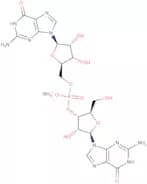
Discontinued productGuanylyl-3',5'-guanosine ammonium salt
CAS:Guanylyl-3',5'-guanosine ammonium salt is a novel antiviral agent that has high antiviral activity against influenza A virus. It is a guanine derivative which has been modified to include an aminopropyl group and an ammonium cation. This compound also acts as an activator for deoxyribonucleosides, nucleotides, and ribonucleosides. Guanylyl-3',5'-guanosine ammonium salt may be used in the manufacture of DNA, RNA, and phosphoramidites. This compound also has anticancer effects by inhibiting the proliferation of tumor cells and inducing apoptosis.
Formula:C20H25N10O12P·H3NPurity:Min. 95%Molecular weight:645.48 g/mol3′-Guanylic acid disodium
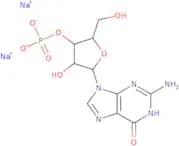
CAS:3′-Guanylic acid disodium is a nucleoside analog that inhibits viral replication and tumor growth. It is an antiviral agent that is active against herpes simplex virus type 1 and type 2, as well as cytomegalovirus. 3′-Guanylic acid disodium is also an anticancer agent that has shown promising results in animal models of glioma, lymphoma, lung cancer, and breast cancer. The molecule inhibits the synthesis of DNA by competitively inhibiting the action of ribonucleotide reductase. 3′-Guanylic acid disodium also inhibits protein synthesis by blocking the conversion of ribonucleotides to deoxyribonucleotides. This drug has been shown to have a high purity and quality with no detectable impurities or contaminants.
Formula:C10H14N5O8P•Na2Purity:Min. 95%Molecular weight:409.2 g/molRef: 3D-NG182606
Discontinued product2'-O-Methyluridine-5'-monophosphate triethylammonium
CAS:2'-O-Methyluridine-5'-monophosphate triethylammonium salt is a modified nucleoside analogue that is an antiviral agent. It inhibits viral replication by acting as an inhibitor of RNA synthesis and DNA polymerase, which are necessary for the virus to replicate. This compound also has anticancer activity and can be used as a chemotherapeutic agent. 2'-O-Methyluridine-5'-monophosphate triethylammonium salt is synthesized from uracil, phosphoramidite, and triethylamine. It has high purity and high quality with a CAS number of 67624-43-5.
Formula:C10H15N2O9P•(C6H15N)2Purity:Min. 95%Color and Shape:PowderMolecular weight:439.21 g/molRef: 3D-NM167710
Discontinued product2'-O-(2-Methoxyethyl)guanosine 5'-monophosphate
CAS:10umol is approx 5mg.2'-O-(2-Methoxyethyl)guanosine 5'-monophosphate is a novel nucleoside phosphorylated on the 5' position
Purity:Min. 95%2-Chloroadenosine 5'-monophosphate triethylamine salt
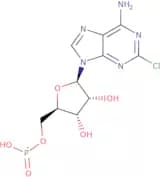
CAS:2-Chloroadenosine 5'-monophosphate triethylamine salt is a phosphoramidite that has anticancer and antiviral activities. It is synthesized by reacting 2-chloroadenosine with triethylamine. This product has a novel chemical structure and it can be used as an activator for the synthesis of modified DNA, RNA, and other nucleosides. It is also used in the manufacture of deoxyribonucleosides, ribonucleosides, and other nucleotides.
Formula:C10H13ClN5O7P·C12H30N2Purity:Min. 95%Molecular weight:584.05 g/molRef: 3D-NC10383
Discontinued product