Nucleosides
Found 3570 products of "Nucleosides"
N6-Benzoyl-5'-O-2'-deoxyadenosine
N6-Benzoyl-5'-O-2'-deoxyadenosine is a modified nucleoside that contains a benzoyl group. This nucleoside has been shown to be an antiviral and anticancer agent, and is also active against herpes simplex virus type 1 (HSV1). N6-Benzoyl-5'-O-2'-deoxyadenosine may be a potential therapeutic for the treatment of HSV1 infection. It is also believed to have anti-inflammatory properties. The synthesis of this compound can be achieved by reacting 5'-O-tetraisopropyldiphenylphosphoramidite with benzoyl chloride in the presence of triethylamine.
Formula:C36H31N5O4Purity:Min. 95%Molecular weight:597.66 g/mol2'-Deoxy-N2-isobutyryl-5'-O-levulinoyladenosine
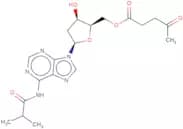
2'-Deoxy-N2-isobutyryl-5'-O-levulinoyladenosine is a modified nucleoside that has been shown to have anticancer and antiviral properties. It is synthesized as a phosphoramidite, and the synthesis of this compound has been patented internationally. This novel nucleoside is an activator for both DNA and RNA synthesis. The compound also has high purity, high quality, and is readily available to order from the supplier.
Formula:C19H25N5O6Purity:Min. 95%Molecular weight:419.44 g/mol2',3'-Dideoxy-6-thio-inosine
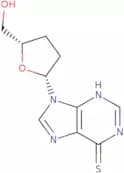
CAS:2',3'-Dideoxy-6-thio-inosine is a nucleoside analog that is used in vitro for the investigation of viral replication. 2',3'-Dideoxy-6-thio-inosine is a potent inhibitor of human immunodeficiency virus type 1 (HIV-1) infection, and has been shown to inhibit the synthesis of viral dna. The in vitro activity of this drug against HIV has been shown to be greater than 200 times more potent than zidovudine or didanosine. 2',3'-Dideoxy-6-thio-inosine also inhibits the growth of some cell lines, including those derived from infected T cells, indicating that it may have cytocidal effects.
Formula:C10H12N4O2SPurity:Min. 95%Molecular weight:252.29 g/mol6-Methylpurine-2'-deoxyriboside
CAS:6-Methylpurine-2'-deoxyriboside (6MPdR) is a nucleoside analog that inhibits viral polymerase activity. It is used in the treatment of bowel diseases, such as inflammatory bowel disease and hepatitis C. 6MPdR can be used to treat cancer by inhibiting cellular proliferation and inducing apoptosis. This drug has been shown to inhibit leishmania growth in cell culture. 6MPdR can be administered orally or intravenously, and is pegylated for greater stability in the blood stream.
Formula:C11H14N4O3Purity:Min. 95%Color and Shape:PowderMolecular weight:250.25 g/molRef: 3D-NM46495
Discontinued product3’-Azido-3’-deoxy-2-thiouridine
CAS:3’-Azido-3’-deoxy-2-thiouridine is an antiviral agent that is used to synthesize phosphoramidites for the preparation of modified oligonucleotides. 3’-Azido-3’-deoxy-2-thiouridine has been shown to inhibit cancer growth and induce apoptosis in cancer cells, suggesting that it may have anticancer properties. It is also a novel deoxyribonucleoside that can be used as a building block for the synthesis of ribonucleosides. 3’-Azido-3’-deoxy-2-thiouridine is a high quality product with high purity and excellent activator properties. This product has CAS No. 2305416–00–4 and can be used in pharmaceuticals, biotechnology, and other chemical applications.
Formula:C9H11N5O4SPurity:Min. 95%Molecular weight:285.28 g/mol6-Thioinosine 5'-monophosphate
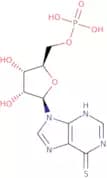
CAS:6-Thioinosine 5'-monophosphate (6TIMP) is a hydrogen bond donor that possesses inhibitory properties against protein synthesis. It has been shown to have an anti-inflammatory effect and can be used for the treatment of inflammatory bowel disease. 6TIMP is also able to inhibit the bcr-abl kinase, which is implicated in the development of renal cell cancer. 6TIMP can be administered intravenously or orally and penetrates tissues well. The rate at which it enters cells is dependent on the transport rate, which is determined by its acidity. 6TIMP has been shown to cause DNA damage, leading to apoptosis and cell death in carcinoma cell lines. The mechanism of action appears to involve inhibition of cellular protein synthesis, acid formation, and DNA damage.
Formula:C10H13N4O7PSPurity:Min. 95%Color and Shape:PowderMolecular weight:364.27 g/molRef: 3D-NT10843
Discontinued productDecitabine
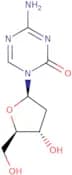
CAS:A synthetic cytosine analogue that incorporates into DNA and prevents DNA methylation via DNA (cytosine-5)-methyltransferase 1 (DNMT1) inhibition. Demonstrated potent anti-leukaemic effects attributed to cell cycle arrest and induction of apoptosis. Has anti-growth effects on solid tumor cell lines.
Formula:C8H12N4O4Purity:Min. 98 Area-%Color and Shape:White PowderMolecular weight:228.21 g/mol5-Aminouridine
CAS:5-Aminouridine is an analog of uridine that is used in the synthesis of RNA. It inhibits the synthesis of RNA by viruses, and it may also inhibit the synthesis of RNA by cells, including muscle cells. 5-Aminouridine has been shown to inhibit protein synthesis in muscle cells incubated with orotic acid. The drug may also interact with other drugs metabolized by UDP-glucose pyrophosphorylase, such as carbamazepine and phenytoin. This interaction may lead to decreased serum levels of these drugs following treatment with 5-aminouridine.
Formula:C9H13N3O6Purity:Min. 90 Area-%Color and Shape:PowderMolecular weight:259.22 g/molRef: 3D-NA163143
Discontinued product5-(3-Hydroxypropyn-1-yl)uridine
5-(3-Hydroxypropyn-1-yl)uridine is a modified nucleoside that can be used as an antiviral or anticancer drug. It is an activator of the enzyme ribonucleotide reductase, which converts ribonucleotides to deoxyribonucleotides. 5-(3-Hydroxypropyn-1-yl)uridine has been shown to inhibit the growth of various cancer cells in vitro and in vivo. This drug has also been shown to have antiviral activity against herpes simplex virus type 1 (HSV-1).
Purity:Min. 95%N-Pyrrolo-2'-deoxycytidine
CAS:N-Pyrrolo-2'-deoxycytidine is a nucleoside analog that is used in the laboratory as a template for DNA synthesis. It has been shown to be an effective inhibitor of human pathogens. N-Pyrrolo-2'-deoxycytidine binds to DNA and prevents replication by interfering with the binding of the enzyme polymerase to the template strand, which leads to denaturation of the complementary strand and blocking of DNA elongation. This drug has been shown to bind specifically to sequences that are unpaired in duplexes, such as single-stranded telomeres. N-Pyrrolo-2'-deoxycytidine can also be used as a fluorescence probe for detecting dsDNA duplexes.
Formula:C12H15N3O4Purity:Min. 98 Area-%Color and Shape:PowderMolecular weight:265.27 g/molRef: 3D-NP08698
Discontinued product4’-C-Methyl-2-thiouridine
CAS:4’-C-Methyl-2-thiouridine is an activator that has anticancer properties. It is a modified nucleoside with antiviral and antifungal activities, which has been shown to inhibit the growth of human tumor cells in vitro. 4’-C-methyl-2-thiouridine is able to inhibit viral replication in vitro and has been shown to be active against herpes simplex virus type 1 (HSV1) and herpes simplex virus type 2 (HSV2). Interestingly, this compound was found to have no effect on the intracellular levels of thymidine kinase or on cellular DNA synthesis.
Formula:C10H14N2O5SPurity:Min. 95%Molecular weight:274.29 g/molFmoc morpholino adenosine monomer
Fmoc-morpholino adenosine monomer is a synthetic nucleoside that is used in the synthesis of oligonucleotides for use as antiviral and anticancer agents. Fmoc-morpholino adenosine monomer has been synthesized by modifying the deoxyribonucleosides, which are then phosphoramidite derivatives of ribonucleosides. This novel chemical compound has shown high activity against DNA-dependent RNA polymerase, suggesting that it may be an effective antiviral agent.
Formula:C34H32ClN7O7PPurity:Min. 95%Color and Shape:PowderMolecular weight:717.09 g/mol1-(3'-Deoxy-3'-fluoro-b-D-xylofuranosyl)cytosine
1-(3'-Deoxy-3'-fluoro-b-D-xylofuranosyl)cytosine is a novel nucleoside that has been synthesized and characterized as a phosphoramidite monophosphate. It is a high purity, synthetic, DNA nucleoside that has shown antiviral and anticancer activities in vitro. 1-(3'-Deoxy-3'-fluoro-b-D-xylofuranosyl)cytosine is an activator of DNA polymerase δ and can be used as a modified nucleotide in nucleic acid synthesis. This compound has the CAS number 4384802-52-5.
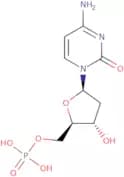
Purity:Min. 95%2'-Deoxycytidine-5'-monophosphate
CAS:2'-Deoxycytidine-5'-monophosphate (dCMP) is a nucleotide that is synthesized by the enzyme cytidine monophosphate synthetase. It has been shown to inhibit the activity of many enzymes, including those involved in DNA synthesis and repair. The incorporation of dCMP into DNA can be used as a probe for studying various biological processes, such as radiation damage and cellular physiology. In addition, it has been shown that dCMP inhibits the growth of human osteosarcoma cells. This drug is also used in combination preparations with other drugs, such as with 5-fluorouracil and doxorubicin, to treat cancer tumors.Formula:C9H14N3O7PPurity:Min. 99 Area-%Color and Shape:White PowderMolecular weight:307.2 g/molRef: 3D-ND02993
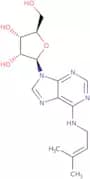
Discontinued product6-(3,3-Dimethylallylamino)-9-(b-D-ribofuranosyl)purine
CAS:6-(3,3-Dimethylallylamino)-9-(b-D-ribofuranosyl)purine is an energy metabolism agent that mimics cytokinin, a plant hormone. It has been shown to affect the angiogenic process and induce apoptosis in HL60 cells through the pro-apoptotic protein Bax. 6-(3,3-Dimethylallylamino)-9-(b-D-ribofuranosyl)purine has also been used as a model system to study the structure of dna, which is important for understanding how it replicates. 6-(3,3-Dimethylallylamino)-9-(b-D-ribofuranosyl)purine is structurally similar to adenosine and binds to the A3 receptor with high affinity. This drug is active as an analogue of adenosine and may be useful for treating diseases such as heart disease or diabetes.Formula:C15H21N5O4Purity:Min. 98 Area-%Color and Shape:White PowderMolecular weight:335.37 g/mol9-(3'-O-Methyl-b-D-xylofuranosyl)adenine
9-(3'-O-methyl-β-D-xylofuranosyl)adenine is a synthetic nucleoside that is an activator of viral DNA polymerase. 9-(3'-O-methyl-β-D-xylofuranosyl)adenine is a novel nucleoside that has been shown to be active against both DNA and RNA viruses. This compound also has anticancer activity. 9-(3'-O-methyl-β-D-xylofuranosyl)adenine is the phosphorylated form of adenine and has high purity and quality. The CAS number for this product is 53110-86-2.
Purity:Min. 95%Deoxyribonucleic acid, sodium salt, ex salmon testes
CAS:Deoxyribonucleic acid, sodium salt, ex salmon testes is a natural product that is produced by the electrochemical biosensor. It is used to study the interaction of DNA with carbanion and modified DNA. This product can be immobilized on a substrate to obtain a specific location for analysis. Deoxyribonucleic acid, sodium salt, ex salmon testes has been shown to be effective in catalyzing transfer reactions in aldehydes and nitroaldol reactions.
N6-Propargyladenosine-5'-triphosphate sodium salt
N6-Propargyladenosine-5'-triphosphate sodium salt is a phosphoramidite that is useful in the synthesis of oligodeoxyribonucleotides and DNA. This novel nucleotide has been shown to be an activator for mammalian cells and to inhibit tumor growth in mice. N6-Propargyladenosine-5'-triphosphate sodium salt is synthesized by reacting propargylamine with ATP, which produces a novel nucleotide with anti-cancer properties.
Formula:C13H18N5O13P3Purity:Min. 95%Molecular weight:545.23 g/molUDP- β- L- Arabinofuranose
CAS:UDP-β-L-Arabinofuranose is a research tool used in cell biology and pharmacology. It is an activator of ligand binding to receptor, and it binds with high affinity to the ion channels that regulate the flow of ions across the cell membrane. This compound is a ligand for the protein receptor and can be used as an inhibitor for peptide synthesis. UDP-β-L-Arabinofuranose is a high purity product with CAS No. 331001-44-6 and has been shown to inhibit protein interactions in life science experiments.
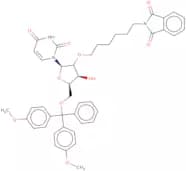
Formula:C14H22N2O16P2Purity:Min. 95%Molecular weight:536.28 g/mol5'-O-DMT-2'-O-hexylphthalimidouridine
5'-O-DMT-2'-O-hexylphthalimidouridine is a novel nucleoside analog with anticancer activity. It is a modified nucleoside that has been synthesized and purified in high purity. 5'-O-DMT-2'-O-hexylphthalimidouridine is an activator of DNA and RNA synthesis and has antiviral properties. It also inhibits the production of tumor necrosis factor alpha (TNFα) by human synovial cells. This compound binds to the RNA polymerase II enzyme, which prevents transcription of genetic material from DNA templates into messenger RNA. This leads to inhibition of protein synthesis and cell death by apoptosis.
Formula:C44H45N3O10Purity:Min. 95%Molecular weight:775.86 g/molRef: 3D-ND08415
Discontinued product