Nucleosides
Found 3569 products of "Nucleosides"
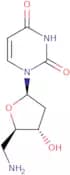
5'-Amino-2',5'-dideoxyuridine
CAS:5'-Amino-2',5'-dideoxyuridine (5-ADU) is a pyrimidine nucleoside that is structurally similar to thymidylate, which it inhibits. 5-ADU is used in the treatment of viral infections and cancers, as well as in the prevention of radiation injury. It has been shown to be an effective antiviral agent against herpes virus and some DNA viruses, such as adenovirus, vaccinia virus, and poliovirus. 5-ADU also enhances the effects of azauridine and other pyrimidine nucleosides in bacterial enzymes such as E. coli. 5-ADU has not been shown to be active against uninfected cells or tissues.Formula:C9H13N3O4Purity:Min. 95%Molecular weight:227.22 g/mol2-Methanesulfonyl-pyrimidine
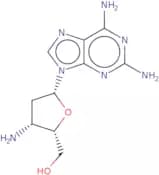
CAS:2-Methanesulfonyl-pyrimidine is a thiourea that is used as a catalyst in organic synthesis. It can be prepared by reacting phosphorus oxychloride with malonate and hydrochloric acid at temperatures of about 0°C to 150°C. The chloride anion is replaced by the sulfonyl chloride, which has high affinity for the 2-position of thiourea. This reaction leads to an intermediate that can be hydrolyzed with hydrochloric acid to produce 2-methanesulfonyl-pyrimidine. 2-Methanesulfonyl-pyrimidine is soluble in water and can be used as a catalyst in wastewater treatment processes, such as cyclic oxidation or oxychlorination reactions.Purity:Min. 95%2,6-Diamino-9-(3'-amino-2',3'-dideoxy-β-D-ribofuranosyl)purine
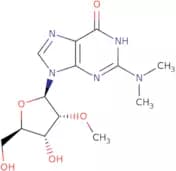
CAS:2,6-Diamino-9-(3'-amino-2',3'-dideoxy-b-D-ribofuranosyl)purine is an antiviral agent that inhibits the replication of the viral DNA by binding to the viral DNA and preventing its transcription into RNA. It has been shown to be active against herpes simplex virus type 1 (HSV-1) and human cytomegalovirus (HCMV). 2,6-Diamino-9-(3'-amino-2',3'-dideoxy-b-D-ribofuranosyl)purine is a modified nucleoside that can be used in various areas of research, including antiviral and anticancer activities.Formula:C10H15N7O2Purity:Min. 95%Molecular weight:265.28 g/molN,N-Dimethyl-2'-O-methylguanosine
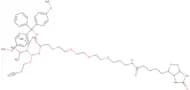
CAS:N,N-Dimethyl-2'-O-methylguanosine is a nucleoside that belongs to the category of nucleosides. It is a chemical structure that has been shown to have research value for the study of nucleic acids and their related diseases. This compound is also used in posttranscriptional mechanisms and phylogenetic studies. N,N-Dimethyl-2'-O-methylguanosine can be synthesized from uridine, ribonucleotide, or other nucleosides through various chemical reactions. It is also used as a structural component in some pharmaceuticals.Formula:C13H19N5O5Purity:Min. 95%Molecular weight:325.32 g/molBiotinTEG Phosphoramidite
CAS:BiotinTEG Phosphoramidite is a medicinal compound that acts as an inhibitor of cancer cell growth. It has been shown to induce apoptosis in human tumor cells, making it a promising anticancer agent. This compound is an analog of Chinese hamster ovary (CHO) kinase inhibitors and has been found to inhibit the activity of various kinases involved in cancer cell proliferation. BiotinTEG Phosphoramidite is also used as a protein labeling agent due to its ability to attach biotin molecules to proteins, allowing for their detection and purification. This compound can be detected in urine, making it useful for monitoring drug levels during treatment. Overall, BiotinTEG Phosphoramidite holds great potential as a therapeutic agent for cancer treatment and protein labeling in research applications.
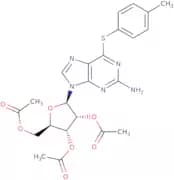
Formula:C52H76N5O11PSPurity:Min. 95%Molecular weight:1,010.2 g/mol2-Amino-6-(4-methylphenyl)thio-9-(2',3',5'-tri-O-acetyl-b-D-ribofuranosyl)purine
CAS:2-Amino-6-(4-methylphenyl)thio-9-(2',3',5'-tri-O-acetyl-b-D-ribofuranosyl)purine is a novel nucleoside phosphoramidite that has antiviral and anticancer activity. This compound is a modified nucleoside that inhibits viral replication by inhibiting the synthesis of viral DNA. 2-Amino-6-(4-methylphenyl)thio-9-(2',3',5'-tri-O-acetylbD ribofuranosyl)purine binds to the catalytic site of the enzyme ribonucleotide reductase, which is essential for the production of dNTPs. This chemical also has shown anticancer activity in cell culture against leukemia cells and breast cancer cells, although it was not active against colon cancer cells.Formula:C23H25N5O7SPurity:Min. 95%Molecular weight:515.54 g/molAdenosine-5'-carboxylic acid
CAS:Adenosine-5'-carboxylic acid is a pharmaceutical compound that is used as an anti-inflammatory agent. It is a synthetic, non-nucleoside adenine nucleotide analog that has been shown to have potent anti-inflammatory activity in vitro. Adenosine-5'-carboxylic acid inhibits the synthesis of prostaglandins and leukotrienes which are mediators of inflammation. It also inhibits the synthesis of protein kinase C, which plays a role in cell proliferation, differentiation and apoptosis. Adenosine-5'-carboxylic acid has also been found to inhibit the growth of glioma cells in tissue culture and human muscle cells in vivo. The mechanism for this effect may be due to its ability to inhibit DNA synthesis and induce apoptosis.Formula:C10H11N5O5Purity:Min. 95%Molecular weight:281.23 g/molN6-Benzoyl-3'-deoxy-5'-O-DMT-3'-fluoroadenosine
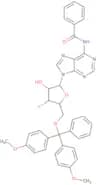
CAS:N6-Benzoyl-3'-deoxy-5'-O-DMT-3'-fluoroadenosine is an activator nucleoside that is used as a phosphoramidite in DNA synthesis. It is also used in antiviral and anticancer therapies. N6-Benzoyl-3'-deoxy-5'-O-DMT-3'-fluoroadenosine has been shown to have high purity and high quality, making it suitable for use in the pharmaceutical industry. This product is not active against bacterial or viral infections, but has proved to be effective in the treatment of leukemia, lymphoma and other cancers.Formula:C38H34FN5O6Purity:Min. 95%Molecular weight:675.71 g/mol5-Trimethylstannyl-1-(2-deoxy-2-fluoro-b-D-arabinofuranosyl)uracil
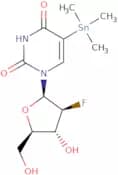
CAS:Ribonucleosides are a class of compounds that contain the nucleoside ribose and the phosphate group. Ribonuclesides are modified ribonucleosides that have been synthesized and modified to be more stable than standard ribonucleotide analogs. The compound 5-Trimethylstannyl-1-(2-deoxy-2-fluoro-b-D-arabinofuranosyl)uracil is a novel nucleoside that has been shown to have anticancer, antiviral, and antiinflammatory activities in vitro. It is also an activator for phosphoramidites, which are used to modify DNA or RNA molecules. This chemical is available at high purity and quality with CAS No. 213136-14-2.Formula:C12H19FN2O5SPurity:Min. 95%Molecular weight:408.98 g/molN6-Benzoyl-7'-OH-morpholino adenosine
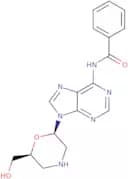
CAS:N6-Benzoyl-7'-OH-morpholino adenosine is a modified nucleoside with antiviral activity. It is being developed as an activator of ribonucleotide reductase and a potential anticancer agent. N6-Benzoyl-7'-OH-morpholino adenosine is synthesized by reacting benzoyl chloride with 7'-O-dimethoxytritylmorpholine. This reaction results in the formation of the desired product, which has been shown to be an activator of ribonucleotide reductase. The synthesis of this compound can be performed on a large scale, making it an attractive candidate for chemotherapeutic use.Formula:C17H18N6O3Purity:Min. 95%Color and Shape:SolidMolecular weight:354.36 g/mol5'-O-DMT-2'-fluoro-2'-deoxyinosine
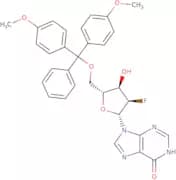
CAS:5'-O-DMT-2'-fluoro-2'-deoxyinosine is a novel nucleoside that has been modified with 2'-fluoro and 2'-deoxy substitutions. It is phosphoramidite, which can be activated by any of the standard methods to make DNA or RNA. 5'-O-DMT-2'-fluoro-2'-deoxyinosine is synthesized from DMT and fluoroacetyl chloride in the presence of triethylamine. This nucleoside has antiviral activity against HIV and influenza A virus, as well as anticancer effects.Formula:C31H29FN4O6Purity:Min. 95%Molecular weight:572.58 g/mol2,5-Dioxo-3-sulfo-1-pyrrolidinyl 6-[[5-(hexahydro-2-oxo-1H-thieno[3,4-d]imidazol-4-yl)-1-oxopentyl]amino]hexanoate sodium salt
CAS:2'-Deoxy-5'-O-DMT-N6-methyl-8-oxoadenosine 3'-CE phosphoramidite is a nucleotide analog that is used for the treatment of cancer. It inhibits sugar transport, which leads to tumor cell lysis. 2'-Deoxy-5'-O-DMT-N6-methyl-8-oxoadenosine 3'-CE phosphoramidite binds to glut1 and toll-like receptor 4 in the cell membrane, inhibiting the activation of these cells. This drug has been shown to have an antibody response in myeloma cells and basic fibroblast cell lines.Formula:C20H30N4O9S2•NaPurity:Min. 95%Molecular weight:557.60 g/molN6-Benzoyl-9-(2'-deoxy-5'-O-DMT-2'-fluoro-b-D-arabinofuranosyl)adenine 3'-O-succinate triethylammonium salt
N6-Benzoyl-9-(2'-deoxy-5'-O-DMT-2'-fluoro-b-D-arabinofuranosyl)adenine 3'-O-succinate triethylammonium salt is a novel antiviral nucleotide. This drug has been shown to be an activator of DNA synthesis and to inhibit the growth of viruses such as influenza A, herpes simplex virus type 1, and HIV type 1. N6-Benzoyl-9-(2'-deoxy-5'-O-DMT-2'-fluoro-b-D arabinofuranosyl)adenine 3'-O succinate triethylammonium salt is synthesized by the reaction of 6-[(3,4,5,6 -tetrahydrobenzo[1,2]dioxaphosphinanyl)methyl]aminopurine (N6BA), 2',5' -dFormula:C42H38FN5O9·C6H16NPurity:Min. 95%Molecular weight:878 g/molDiethyl N-(tert-Butoxycarbonyl)phosphoramidate
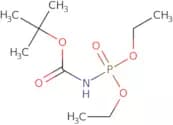
CAS:Diethyl N-(tert-Butoxycarbonyl)phosphoramidate is a chemical compound that is used in coupling reactions. It has a magnetic resonance and can be used to detect the presence of certain elements. Diethyl N-(tert-Butoxycarbonyl)phosphoramidate shifts at 12.2 ppm, which is higher than the normal chemical shift for an ester of this type. The magnetic resonance data for Covid-19 pandemic, Covid-19, and 3D-19 are all constant with Covid-19 pandemic being the most intense. Covid-19 pandemic has a structural formula of C8H16O4N2S, which is different from Covid-19 and 3D-19, which have structural formulas of C8H14O4N2S. The three compounds have similar chemical shifts with covid-19 having a slightly higher frequency than covid-19 pandemic
Formula:C9H20NO5PPurity:Min. 95%Molecular weight:253.23 g/molN4-Acetyl-2'-deoxy-5'-O-DMT-cytidine 3'-Me phosphonamidite
N4-Acetyl-2'-deoxy-5'-O-DMT-cytidine 3'-Me phosphonamidite is a monophosphate nucleoside that is synthetically modified. It has anticancer activity and can be used to treat viral infections. N4-Acetyl-2'-deoxy-5'-O-DMT-cytidine 3'-Me phosphonamidite is also a novel nucleoside that exhibits antiviral and antitumor properties. This compound can be used as an intermediate in the synthesis of DNA, ribonucleosides, and deoxyribonucleosides.Formula:C39H49N4O7PPurity:Min. 95%Molecular weight:716.8 g/moldATP - 100 mmol solution
CAS:aATP is useful in molecular biology applications including PCR/qPCR, reverse transcription, DNA labelling and DNA sequencing.Formula:C10H16N5O12P3Purity:Min. 95%Molecular weight:491.18 g/mol2'-Deoxy-N2-isopropylguanosine
CAS:2'-Deoxy-N2-isopropylguanosine is a nucleoside that is synthesized from 2'-deoxy-N6-methyladenosine and isopropyl alcohol. It has antiviral and anticancer properties. The antiproliferative effects of this drug are mediated by the inhibition of DNA synthesis in cells. This compound also inhibits the activation of the transcriptional factor NF-κB, which regulates inflammatory responses in the body.Formula:C13H19N5O4Purity:Min. 95%Molecular weight:309.33 g/mol1-(b-D-Ribofuranosyl)-5-nitropyridine-2-one
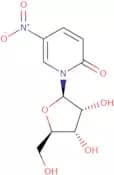
CAS:1-(b-D-Ribofuranosyl)-5-nitropyridine-2-one is a nucleoside that has been modified to have anticancer properties. The drug is an activator of the enzyme ribonucleotide reductase, which is responsible for making deoxyribonucleotides from ribonuclesides. 1-(b-D-Ribofuranosyl)-5-nitropyridine-2-one inhibits viral replication by inhibiting the activity of DNA polymerase and preventing RNA synthesis. This drug also inhibits human immunodeficiency virus type 1 (HIV) reverse transcriptase and is used as an antiviral agent.Formula:C10H12N2O7Purity:Min. 95%Molecular weight:272.21 g/molEthyl 2-chloro-4-methylpyrimidine-5-carboxylate
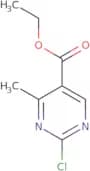
CAS:Ethyl 2-chloro-4-methylpyrimidine-5-carboxylate is an antiviral drug that inhibits the replication of RNA viruses. It binds to the active site of the enzyme responsible for viral RNA synthesis. Ethyl 2-chloro-4-methylpyrimidine-5-carboxylate has been shown to inhibit the growth of Mycobacterium tuberculosis in cell cultures. This drug also has cytostatic activity and can be used to treat tumors in cell culture.Formula:C8H9ClN2O2Purity:Min. 95%Molecular weight:200.62 g/mol2'-Deoxy-2'-fluoroadenosine-5'-triphosphate
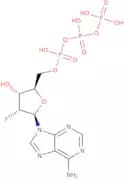
CAS:2'-Deoxy-2'-fluoroadenosine-5'-triphosphate is an analog of adenosine triphosphate (ATP). It inhibits the synthesis of RNA by binding to the ribonucleotide reductase enzyme. This inhibition leads to the inhibition of DNA synthesis, which in turn prevents cell division and/or causes cell death. The inhibitory effect of 2'-deoxy-2'-fluoroadenosine-5'-triphosphate on protein and DNA synthesis has been shown in vivo and in vitro using cell culture techniques. This compound inhibits topoisomerase II, a key enzyme in DNA replication, at high concentrations.
Formula:C10H15FNO12P3Purity:Min. 95%Molecular weight:509.18 g/mol


![2,5-Dioxo-3-sulfo-1-pyrrolidinyl 6-[[5-(hexahydro-2-oxo-1H-thieno[3,4-d]imidazol-4-yl)-1-oxopentyl…](/_next/image/?url=https%3A%2Fstatic.cymitquimica.com%2Fproducts%2F3D%2Fthumb-webp%2FPD08913.webp&w=3840&q=75)