Nucleosides
Nucleosides are fundamental building blocks of nucleic acids, composed of a nitrogenous base attached to a sugar molecule. In this section, you can find a wide variety of nucleosides essential for research in molecular biology, biochemistry, and pharmacology. These compounds play crucial roles in the synthesis of DNA and RNA, and are also vital in various metabolic processes. Nucleosides are used in studying genetic material, developing antiviral and anticancer therapies, and understanding cellular mechanisms. At CymitQuimica, we provide high-quality nucleosides to support your research and development needs, ensuring purity and reliability for your experimental applications.
Found 3567 products of "Nucleosides"
Sort by
Purity (%)
0
100
|
0
|
50
|
90
|
95
|
100
Clofarabine 5'-monophosphate triethylammonium salt
CAS:<p>Clofarabine is an anti-cancer drug that belongs to the class of diphosphate, Synthetic, Activator, Phosphoramidites, Deoxyribonucleosides. It is a modified nucleoside with antiviral and anticancer activity. Clofarabine 5'-monophosphate triethylammonium salt (CPF) has been shown to inhibit DNA synthesis by blocking the incorporation of deoxyribonucleotides into DNA. CPF binds to DNA at the 3' position of the deoxyribonucleotide chain, which prevents its extension and leads to inhibition of DNA replication. CPF also inhibits viral DNA synthesis through inhibition of viral DNA polymerase or viral RNA polymerase in vitro. Clofarabine is not active against bacteriophage T4 or bacterial RNA polymerase.</p>Purity:Min. 95%Stavudine 5'-triphosphate triethyammonium salt
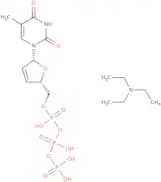
CAS:<p>Stavudine 5'-triphosphate triethyammonium salt is a novel, modified nucleoside that has antiviral and anticancer properties. It is synthesized as a phosphoramidite and used in the synthesis of ribonucleotides, which are incorporated into RNA. Stavudine 5'-triphosphate triethyammonium salt inhibits viral DNA replication by inhibiting the activity of reverse transcriptase, an enzyme that copies the DNA sequence to create a complementary RNA sequence. In vitro studies have shown that stavudine 5'-triphosphate triethyammonium salt inhibits cell proliferation in human cancer cells.</p>Purity:Min. 95%2,2'-Anhydrocytidine
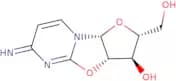
CAS:<p>2,2'-Anhydrocytidine is a cytosine analogue that has been shown to have anticancer activity against solid tumours in mice. The mechanism of action of 2,2'-Anhydrocytidine is not fully understood, but it may be due to its ability to bind to fatty acids and tubule cells in the liver. This compound also induces the production of epidermal growth factor (EGF) and has been shown to inhibit the phase transition temperature of nuclear DNA. It can be used as a model system for hydrogen bonding interactions and chemical stability. 2,2'-Anhydrocytidine can also be used for tissue culture experiments or as a reaction solution in vivo.</p>Formula:C9H11N3O4Purity:Min. 95%Color and Shape:SolidMolecular weight:225.2 g/mol6-Thioguanosine-5'-O-diphosphate sodium salt - 10mM aqueous solution
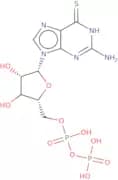
CAS:<p>6-Thioguanosine-5'-O-diphosphate sodium salt is a nucleotide derivative of guanosine that binds to the regulatory site of ATP synthase in the chloroplast. It is an allosteric inhibitor that has been shown to inhibit the synthesis of proteins and chlorophyll, as well as ATP synthesis in plastids of plants. 6-Thioguanosine-5'-O-diphosphate sodium salt has been shown to be effective at inhibiting protein synthesis in mammalian cells, which may be due to its ability to bind to the metabotropic glutamate receptor. The molecule was also found to bind with high affinity to a ternary complex that includes glutamine, glutamate, and ammonia.</p>Formula:C10H15N5O10P2SxNaPurity:Min. 95%Color and Shape:PowderMolecular weight:459.27 g/mol2',3',5'-Tri-O-acetyl-2N,2N-dimethylguanosine
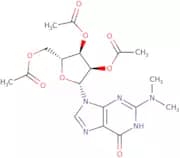
CAS:<p>2',3',5'-Tri-O-acetyl-2N,2N-dimethylguanosine (TAMG) is a novel nucleoside that is synthesized from 2',3',5'-tri-O-acetyl-1,3,5-trioxohexanecarboxylic acid. TAMG has been shown to inhibit HIV and Hepatitis B virus replication by inhibiting the synthesis of viral DNA and RNA. The antiviral properties of TAMG are due to its incorporation into the growing DNA chain and blocking the polymerization process. TAMG also has anticancer activity and can be used as a chemotherapeutic agent against various types of cancer cells.</p>Formula:C18H23N5O8Purity:Min. 95%Molecular weight:437.4 g/mol2-Aminopyrimidine-5-boronic acid
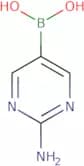
CAS:<p>2-Aminopyrimidine-5-boronic acid is a synthetic compound that has been shown to inhibit the activity of cellulase enzymes in vitro. It also has neuroprotective effects and potent inhibition against cancer cells. 2-Aminopyrimidine-5-boronic acid's mechanism of action is reversible covalent, meaning that it reacts with DNA by forming an N2-(2'-aminopyrimidine) adduct with guanine at position 6 in the purine ring. This reaction inhibits DNA synthesis, leading to cell death. 2-Aminopyrimidine-5-boronic acid is not currently being used as a cancer therapy, but it is being researched for its potential use in cancer treatments.</p>Formula:C4H6BN3O2Purity:Min. 95%Molecular weight:138.92 g/mol7-(Aminomethyl)-7-deazaguanosine
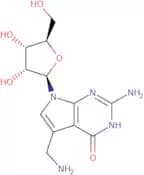
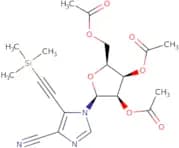
CAS:<p>7-Aminomethyl-7-deazaguanosine is a nucleoside that is classified as a purine. It can be synthesized from 7-amino-7-deazaguanosine and sodium periodate. The chemical reactions involved in the synthesis are oxidation of the amine group on the 7-amino group to form an iminium ion and subsequent nucleophilic attack by the hydroxyl group on the N9 position of the purine ring to form an amino alcohol. This nucleoside has been shown to bind to ribosomes and inhibit protein synthesis, which suggests that it may have potential for use as an antibiotic or anticancer agent. 7-Aminomethyl-7-deazaguanosine has also been shown to cause epigenetic changes such as DNA methylation, histone modification, and alterations in chromatin structure.</p>Formula:C12H17N5O5Purity:Min. 95%Molecular weight:311.29 g/mol5-(2-(Trimethylsilyl)-1-ethynyl)-1-(2',3',5'-tri-O-acetyl-b-D-ribofuranosyl)imidazo-4-carbonitrile
CAS:<p>Ribonucleosides are a class of nucleoside analogues that have been used as antiviral and anticancer agents. Ribonucleosides are synthesized in a two-step process. The first step is the conversion of an appropriate ribose or deoxyribose to the corresponding monophosphate. The second step is the coupling of the monophosphate with an appropriate nucleotide. 5-(2-(Trimethylsilyl)-1-ethynyl)-1-(2',3',5'-tri-O-acetyl-b-D-ribofuranosyl)imidazo-4-carbonitrile is a novel nucleoside analogue, which has been shown to be active against cancer cells and to inhibit viral replication by interacting with DNA polymerase and other enzymes involved in DNA synthesis.</p>Purity:Min. 95%5'-O-DMT-2'-ethylfluoro-5-methyluridine
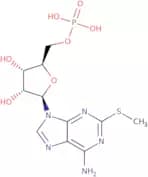
<p>5'-O-DMT-2'-ethylfluoro-5-methyluridine is an activated nucleotide that is used as a synthetic, nonnatural substrate for DNA polymerases. It has been shown to have anticancer and antiviral activities. 5'-O-DMT-2'-ethylfluoro-5-methyluridine is highly pure and of high quality, which makes it suitable for use in research or other applications requiring a high level of purity.</p>Purity:Min. 95%2-Methylthioadenosine 5-monophosphate
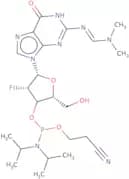
CAS:<p>2-Methylthioadenosine 5-monophosphate (2MTA) is an intermediate in purine metabolism that can be synthesized from adenosine monophosphate and methyl mercaptan. 2MTA inhibits the platelet aggregation by inhibiting the function of the P2Y12 receptor, which is a member of the G protein-coupled receptor family. It has been shown to inhibit tumor growth and tumor vasculature, as well as to induce apoptosis in cancer cells. 2MTA also has antiplatelet activity, which may be due to its ability to inhibit cyclooxygenase-1 (COX-1) and cyclooxygenase-2 (COX-2).</p>Formula:C11H16N5O7PSPurity:Min. 95%Molecular weight:393.31 g/mol2'-Deoxy-N2-DMF-5'-DMT-2'-fluoroguanosine 3'-CE phosphoramidite
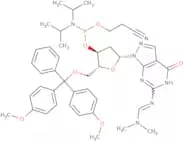
<p>2'-Deoxy-N2-DMF-5'-DMT-2'-fluoroguanosine 3'-CE phosphoramidite is a nucleoside analog that is structurally similar to the natural substrate of DNA polymerase. It can be used in the synthesis of oligonucleotides and as a reagent for the synthesis of modified DNA. The phosphoramidite has antiviral activity and has been shown to have anticancer effects in animal models. It is also used as an activator for deoxyribonucleotide activation, which increases the efficiency of DNA synthesis.</p>Formula:C43H52FN8O7PPurity:Min. 95 Area-%Color and Shape:PowderMolecular weight:842.89 g/mol5-[4-(4,4,5,5-tetramethyl-[1,3,2]dioxaborolan-2-yl)-benzylidene]-pyrimidine-2,4,6-trione
<p>Ribonuclease is an enzyme that cleaves the phosphodiester backbone of ribonucleotide to produce a 5'-phosphate and a 2'-deoxyribonucleoside. Ribonuclease is an activator that activates the synthesis of ribonucleotides, deoxyribonesucleotides and nucleosides. Ribonuclease has antiviral properties which may be due to its ability to inhibit DNA polymerase by catalyzing the hydrolysis of the 2'-deoxyribose-5'-phosphate bond in DNA. Ribonuclease has also been shown to have anticancer activity, which may be due to its ability to inhibit protein synthesis.</p>Purity:Min. 95%8-Aza-7-deaza-2'-deoxy-N2-DMF-5'-O-DMT-guanosine 3'-CE phosphoramidite
CAS:<p>8-Aza-7-deaza-2'-deoxy-N2-DMF-5'-O-DMT-guanosine 3'-CE phosphoramidite is a novel monophosphate derivative of 2' deoxyN2,8-diaminofluorene 5'-O-(4,4′-dimethoxytrityl) guanosine. It can be used as an activator in DNA synthesis or as a precursor for the synthesis of other modified purines and pyrimidines. This compound has been shown to have anticancer activity in mice. It also has antiviral effects against HIV and HSV1. 8-Aza-7-deaza-2'-deoxyN2,8-diaminofluorene 5'-O-(4,4′dimethoxytrityl) guanosine 3′ CE phosphoramidite is soluble in methanol and ethanol and</p>Formula:C43H53N8O7PPurity:Min. 95%Color and Shape:PowderMolecular weight:824.9 g/mol3',5'-Bis-o-(t-butyldimethylsilyl)-O4-(2,4,6-triisopropylphenylsulfonyl)thymidine
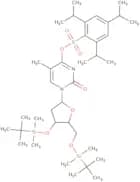
CAS:<p>3',5'-Bis-o-(t-butyldimethylsilyl)-O4-(2,4,6-triisopropylphenylsulfonyl)thymidine (SQ22536) is a modified nucleoside with anticancer activity. It is a deoxyribonucleoside and phosphoramidate analog of thymidine. SQ22536 can be used in the synthesis of DNA or RNA and as an antiviral agent.<br>It has been shown to inhibit the replication of HIV-1 in vitro by inhibiting HIV reverse transcriptase and DNA polymerase.</p>Formula:C37H64N2O7SSi2Purity:Min. 95%Molecular weight:737.1 g/molCytidyl-3'-5'-adenosine ammonium salt
<p>Cytidyl-3'-5'-adenosine ammonium salt is a novel synthetic monophosphate nucleoside with antiviral and anticancer properties. It is synthesized from adenosine and cytidine, which are natural nucleosides. Cytidyl-3'-5'-adenosine ammonium salt is a high purity, high quality product that has been modified to target the ribonucleotide reductase enzyme. This enzyme controls the production of DNA in the cell, preventing it from reproducing. This product can be used as an activator for other chemotherapeutic drugs or as an anticancer drug itself.</p>Purity:Min. 95%5-Fluorouridine
CAS:<p>5-Fluorouridine is an anticancer drug that belongs to the group of modified nucleosides. It is a synthetic nucleoside analogue that inhibits viral and DNA synthesis and can be used as antiviral agents. 5-Fluorouridine has also been shown to inhibit RNA synthesis in vitro. This compound is converted to uracil by deoxyribonucleotide reductase, which results in the formation of 5-fluoro-2'-deoxyuridine monophosphate (5FdUMP) and 5-fluoro-2'-deoxyuridine diphosphate (5FdUDP). The latter has been shown to inhibit DNA synthesis in vitro.</p>Formula:C9H11FN2O6Purity:Min. 95%Molecular weight:262.19 g/mol5'-O-Acetyl-2',3'-O-isopropylideneadenosine
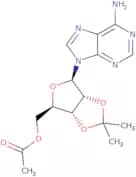
CAS:<p>5'-O-Acetyl-2',3'-O-isopropylideneadenosine is an anti-leishmanial agent that is synthesized from 2,3-O-isopropylideneadenosine by acetylating the 5' hydroxyl group. It was found to be more potent than the parent compound and other related compounds in inhibiting Leishmania amazonensis promastigotes. The proposed mechanism of action of 5'-O-acetyl-2',3'-O-isopropylideneadenosine involves hydrogen bonding with the guanosine moiety of DNA and inhibition of RNA synthesis. This drug also has an effect on carbonyl oxygens and resonances, which are observed in the nmr spectra. The synthetic scheme for this drug starts with uridine, which is converted to cytidine by reacting it with sodium cyanide in aqueous solution at 0°C. Cytidine</p>Formula:C15H19N5O5Purity:Min. 95%Color and Shape:PowderMolecular weight:349.34 g/mol4,5-Dimethoxy-2-nitrobenzyl adenosine 3',5'-cyclic monophosphate
<p>4,5-Dimethoxy-2-nitrobenzyl adenosine 3',5'-cyclic monophosphate is a synthetic nucleotide that can be activated to form an antiviral and anticancer agent. This compound has been shown to inhibit the proliferation of leukemia cells in culture. It also inhibits the synthesis of DNA and RNA, leading to cell death by inhibiting the production of proteins vital for cell division. 4,5-Dimethoxy-2-nitrobenzyl adenosine 3',5'-cyclic monophosphate is a novel nucleoside with high purity and CAS number: 57314-27-1.</p>Formula:C19H21N6O10PPurity:Min. 95%Molecular weight:524.38 g/molN4-Anisoyl-2'-deoxycytidine
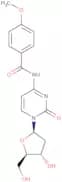
CAS:<p>N4-Anisoyl-2'-deoxycytidine is a nucleoside that contains a long chain of four carbon atoms. It is the cyclic form of N4-anisoyl-2'-deoxyadenosine. This compound has been shown to be synthesized in yields of up to 71% using acid anhydrides and diamino compounds. N4-Anisoyl-2'-deoxycytidine is a bifunctional reagent that can be used as a starting material for the synthesis of oligodeoxyribonucleotides. The compound has also been shown to function as an effective inhibitor of DNA synthesis, which may lead to anti-cancer effects.</p>Formula:C17H19N3O6Purity:Min. 95%Color and Shape:PowderMolecular weight:361.35 g/molN4-Acetyl-5'-O-DMT-cytidine 3'-succinyl CPG 1000 Å (RNA)
<p>N4-Acetyl-5'-O-DMT-cytidine 3'-succinyl CPG 1000 Å (RNA) is a novel, high quality, high purity, synthetic nucleoside analogue. It has antiviral and anticancer properties.</p>Purity:Min. 95%



![5-[4-(4,4,5,5-tetramethyl-[1,3,2]dioxaborolan-2-yl)-benzylidene]-pyrimidine-2,4,6-trione](/_next/image/?url=https%3A%2Fstatic.cymitquimica.com%2Fproducts%2F3D%2Fthumb-webp%2FNT44284.webp&w=3840&q=75)