Others
Found 6307 products of "Others"
Phosphoric acid, mono(4-nitrophenyl) ester
CAS:Phosphoric acid, mono(4-nitrophenyl) ester is an inhibitor that binds to the human serum albumin (HSA), thereby preventing it from binding to the transcriptional regulatory protein. This leads to a decrease in the activity of this protein and consequently less inhibition of gene expression. The structural analysis of this inhibitor has shown that it forms hydrogen bonding interactions with basic proteins, while its reactivity is mainly dependent on Michaelis–Menten kinetics. The inhibitor also inhibits enzyme activities by binding to their active sites, reducing the enzyme's ability to catalyze reactions.Formula:C6H6NO6PMolecular weight:219.09 g/molRef: 3D-P-6460
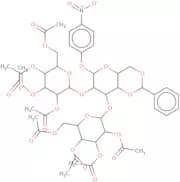
-Unit-kgkgTo inquire1kgTo inquire50gTo inquire100gTo inquire250gTo inquire500gTo inquire4-Nitrophenyl 2,3-di-O-(2,3,4,6-tetra-O-acetyl-b-D-glucopyranosyl)-4,6-benzylidene-b-D-glucopyranoside
4-Nitrophenyl 2,3-di-O-(2,3,4,6-tetra-O-acetyl-b-D-glucopyranosyl)-4,6-benzylidene-b-D-glucopyranoside is a high purity, high quality 4nitrophenol derivative that is used as a food testing substrate. It is also used for the detection of fluorescence in environmental testing. This product can be conjugated with ligands for use in diagnostic assays.Purity:Min. 95%Molecular weight:1,049.93 g/molOctyl 4-nitrophenyl hexyl phosphonate
CAS:Octyl 4-nitrophenyl hexyl phosphonate is a lipase suicide inhibitor that is a chromogenic substrate for lipases which upon enzymatic action, binds irreversibly to the lipase and inactivates it. The substrate can be used for the determination of active sites in lipases, especially in lipases preferring hydrophobic leaving groups.Purity:Min. 95%Molecular weight:399.462-Chloro-4-nitrophenyl a-D-fucopyranoside
CAS:2-Chloro-4-nitrophenyl a-D-fucopyranoside (CNPF) is a chromogenic enzyme substrate used primarily to detect fucosidase activity. CNPF is cleaved by the enzyme, which results in the release of a colored product that can be measured spectrophotometrically. Fucosidases are important enzymes that catalyze the hydrolysis of fucose-containing oligosaccharides, and CNPF is a commonly used substrate for the detection and quantification of these enzymes in various research studies.
Purity:Min. 95%Molecular weight:319.69 g/mol4-Nitrophenyl 2-O-(a-L-fucopyranosyl)-a-D-galactopyranoside
CAS:4-Nitrophenyl 2-O-(a-L-fucopyranosyl)-a-D-galactopyranoside is a chromogenic pNP enzyme substrate consisting of a fucose and galactose moieties. Upon enzymatic hydrolysis by specific fucosidases or galactosidases, it releases the highly chromogenic molecule 4-nitrophenol, which exhibits a distinct yellow color that can be monitored spectrophotometrically. This substrate is frequently used to study enzyme specificity, kinetics, and inhibition, and it plays a critical role in the investigation of carbohydrate active enzymes (CAZymes), the screening of enzyme inhibitors, and the development of novel analytical methods for the detection and quantitation of enzyme activities.Purity:Min. 95%Molecular weight:447.39 g/mol4-Nitrophenyl b-D-cellobioside heptacetate
CAS:4-Nitrophenyl b-D-cellobioside heptacetate is a fluorogenic substrate that is used in food testing and environmental testing. The product is an enzyme substrate that can be used as a conjugate to produce chemiluminescence or bioluminescence. 4-Nitrophenyl b-D-cellobioside heptacetate has CAS number 69948-03-4 and is of high purity and quality. It has been shown to have good fluorescence properties, which makes it ideal for use in fluorescence microscopy applications.Purity:Min. 95%Molecular weight:757.65 g/molAldol® 515 β-D-xylopyranoside, Biosynth Patent: EP 2427431 and US 8940909
CAS:Aldol® 515 beta-D-xylopyranoside is a chromogenic substrate that is used in food testing. It is an alternative to the more common glucose and sucrose, which are not suitable for some types of assays. Aldol® 515 beta-D-xylopyranoside is also used in diagnostics as a ligand for fluorescent antibody staining and chemiluminescence assays. It has been shown to increase the sensitivity of these tests by up to 10 times. The substrate has been tested extensively and is safe for use with a wide range of bacteria including E. coli, S. typhimurium, M. tuberculosis, and C. albicans at concentrations up to 100 mM without any inhibitory effects on growth or viability.
END>.Formula:C28H34N2O6Purity:Min. 95.0 Area-%Molecular weight:494.59 g/molOstazin brilliant red H-3B hydroxyethylcellulose
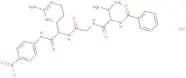
Ostazin brilliant red H-3B hydroxyethylcellulose is a chromogenic enzyme substrate that produces a bright red color upon reaction with specific enzymes. This substrate is particularly useful for the detection and visualization of enzyme activity in histochemical and cytochemical staining techniques. The vibrant red color produced by the reaction allows for easy observation and analysis of enzyme distribution and localization in cells and tissues. Ostazin brilliant red H-3B hydroxyethylcellulose is often used in combination with other substrates to study the presence and activity of multiple enzymes simultaneously, providing valuable insights into the complex interactions and functions of enzymes in biological systems.Purity:Min. 95%N-Benzoyl-Val-Gly-Arg p-nitroanilide hydrochloride
CAS:N-Benzoyl-Val-Gly-Arg p-nitroanilide hydrochloride is a fluorogenic substrate that can be used for the detection of β-glucuronidase. It has been shown to have high purity and quality, which makes it an excellent choice for use in food testing and staining.
Formula:C26H34N8O6•HClPurity:Min. 95%Molecular weight:591.06 g/mol4-Nitrophenyl b-D-celloheptaoside
CAS:Chromogenic substrate targeting cellulasePurity:Min. 95%Molecular weight:1,274.09 g/mol4-Nitrophenyl 2-acetamido-3-azido-2,3-dideoxy-b-D-galactopyranoside
4-Nitrophenyl 2-acetamido-3-azido-2,3-dideoxy-b-D-galactopyranoside is a fluorogenic substrate for beta-galactosidase. It has been used in the detection of beta-galactosidase activity in culture media, and for the detection of beta-galactosidase activity in environmental samples. 4NPAG can be conjugated to a variety of molecules, including antibodies, proteins, nucleotides, and oligonucleotides. 4NPAG can be used as an enzyme substrate for both chromogenic and fluoroquinolone substrates.Purity:Min. 95%4-Nitrophenyl 2-azido-2-deoxy-a-D-galactopyranoside
CAS:4-Nitrophenyl 2-azido-2-deoxy-a-D-galactopyranoside is a superior chromogenic substrate for the precise determination of alpha-D-galactosidase enzyme activity. This substrate features a unique 2-azido moiety providing enhanced sensitivity and specificity in biochemical assays. Upon enzymatic cleavage, it releases the highly fluorescent compound 4-nitrophenol, which simplifies quantification and tracking of enzyme activity in applications such as drug discovery, genetic studies, and enzyme inhibition assays.Purity:Min. 95%Color and Shape:White PowderMolecular weight:326.26 g/mol2-Methyl-4-nitrophenyl b-D-galactopyranoside
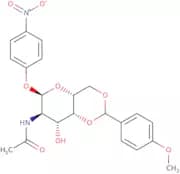
2-Methyl-4-nitrophenyl b-D-galactopyranoside is a chemiluminescent substrate that is used in various applications. It is a ligand that binds to the enzyme beta-galactosidase and is used in diagnostics for detecting the presence of the enzyme. 2-Methyl-4-nitrophenyl b-D-galactopyranoside has been shown to be an appropriate substrate for chemiluminescence reactions, such as those used in diagnostic or research applications. The product also has been tested for potential toxicity and found not to be toxic at concentrations up to 100mg/mL. This product can be used in a variety of applications, including food testing, bacterial culture media, and environmental testing.Purity:Min. 95%Molecular weight:315.28 g/mol4-Nitrophenyl 2-acetamido-2-deoxy-4,6-O-p-methoxybenzylidene-a-D-galactopyranoside
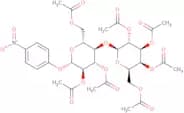
CAS:4-Nitrophenyl 2-acetamido-2-deoxy-4,6-O-p-methoxybenzylidene-a-D-galactopyranoside is a chromogenic substrate designed for the detection and quantification of enzyme activity. This methoxybenzylidene-protected compound is specifically designed to be cleaved by enzymes, releasing a yellow 4-nitrophenol product that can be easily measured spectrophotometrically. This allows for accurate and sensitive analysis of enzyme kinetics, inhibition studies, and substrate specificity determination in various applications.Purity:Min. 95%Molecular weight:460.43 g/mol4-Nitrophenyl hepta-O-acetyl-b-lactoside
CAS:4-Nitrophenyl hepta-O-acetyl-b-lactoside is a high-quality chromogenic pNP enzyme substrate that exhibits excellent sensitivity and specificity in enzyme assays. This synthetic compound is designed to react with β-galactosidase enzymes, generating a yellow product (4-nitrophenol) upon cleavage. The resulting color change allows for quantitative measurement of enzyme activity, providing valuable insights in various research applications including enzyme kinetics, screening of inhibitors, drug discovery, and molecular diagnostics. Our product ensures consistent results with minimal interference, making it a reliable choice for a wide range of biochemical applications.Purity:Min. 95%Molecular weight:757.65 g/mol2-Nitrophenyl 6-O-trityl-b-D-galactopyranoside
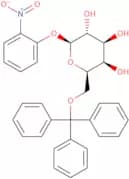
CAS:2-Nitrophenyl 6-O-trityl-b-D-galactopyranoside is a chromogenic enzyme substrate used in assays to detect galactosidase activity. It is a derivative of galactose that can be hydrolyzed by galactosidase to release the yellow-colored 2-nitrophenyl group, which can be detected spectrophotometrically. The trityl group helps to stabilize the molecule and prevent undesired hydrolysis during storage. This substrate is commonly used in the study of carbohydrate metabolism and in the detection of galactosidase activity in microorganisms.Purity:Min. 95%Molecular weight:543.56 g/mol5-Bromo-4-chloro-3-indolyl 2-acetamido-2-deoxy-a-D-glucopyranoside
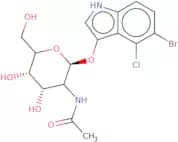
5-Bromo-4-chloro-3-indolyl 2-acetamido-2-deoxy-a-D-glucopyranoside is a fluorogenic substrate that reacts with horseradish peroxidase to produce light. It is used in the detection of β-galactosidase activity in food testing, staining, and environmental testing. This product is also used as a chromogenic substrate for the determination of β-galactosidase activity in immunological assays. 5BICAPG is a conjugate that can be used as a diagnostic ligand for the detection of β -galactosidase enzyme activity. This product has been shown to react with horseradish peroxidase and produce chemiluminescence or bioluminescence when exposed to oxygen. 5BICAPG has also been found to be an excellent enzyme substrate for various enzymes including alkaline phosphataseFormula:C16H18BrClN2O6Purity:Min. 95%Molecular weight:449.68 g/mol2-(5'-Chloro-2'-hydroxyphenyl)-6-chloro-4(3H)-quinazolinonyl a-D-N-acetylgalactosamine
2-(5'-Chloro-2'-hydroxyphenyl)-6-chloro-4(3H)-quinazolinonyl a-D-N-acetylgalactosamine is an inhibitor of bacterial cell wall synthesis. It has been shown to inhibit the enzymatic activity of beta-lactamase, which is an enzyme that breaks down beta-lactam antibiotics. 2-(5'-Chloro-2'-hydroxyphenyl)-6-chloro-4(3H)-quinazolinonyl a-D-N-acetylgalactosamine can be used for the treatment of infections caused by bacteria such as methicillin resistant Staphylococcus aureus. This compound has been shown to have low toxicity and does not cause any significant side effects in animals.Purity:Min. 95%Molecular weight:510.32 g/mol4-Nitrophenyl 4,6-cyclohexylidene-b-D-mannopyranoside
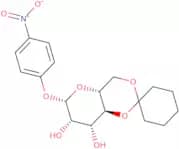
CAS:4-Nitrophenyl 4,6-cyclohexylidene-b-D-mannopyranoside is a fluorogenic substrate that can be used for the detection of β-glucosidase activity. It is a high purity product with a ligand that binds specifically to β-glucosidase. 4NPPM is an enzyme substrate that can be used in diagnostics for the detection of β-glucosidase activity and conjugate for chemiluminescence and bioluminescence. This product has been shown to react with glucose in the presence of hydrogen peroxide and luminol, emitting light when excited by ultraviolet light at 365 nm. 4NPPM also reacts with glucose oxidase to produce hydrogen peroxide, which then reacts with luminol, producing light. The CAS number for this compound is 102717-16-8.Purity:Min. 95%Molecular weight:381.38 g/mol4-Nitrophenyl 2,3-di-O-(b-D-glucopyranosyl)-b-D-glucopyranoside
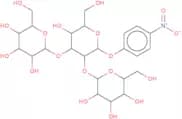
4-Nitrophenyl 2,3-di-O-(b-D-glucopyranosyl)-b-D-glucopyranoside is a chromogenic substrate that can be used to detect the presence of β-glucuronidase in human and animal tissue. The compound is also a fluoroquinolone substrate for the detection of β-lactamase activity. 4NPBG is used in diagnostics as well as food testing, due to its ability to detect bacteria in both food and water samples. 4NPBG is a chemiluminescent substrate that emits light upon hydrolysis by β-glucuronidase or β-lactamase. The compound has been shown to be an excellent ligand for binding to protein A or protein G and can be used for immunoassays such as ELISA or Western blotting.Purity:Min. 95%Molecular weight:625.53 g/mol