Others
Found 6295 products of "Others"
3,4-Cyclohexenoesculetine-N-acetyl-glucosamine
Please enquire for more information about 3,4-Cyclohexenoesculetine-N-acetyl-glucosamine including the price, delivery time and more detailed product information at the technical inquiry form on this page
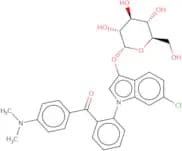
Purity:Min. 95%Aldol® 518 alpha-D-glucopyranoside, Biosynth Patent: EP 2427431 and US 8940909
CAS:Aldol® 518 alpha-D-glucopyranoside is a fluorogenic enzyme substrate used for detection of alpha-D-glucosidase activity. The colorless enzyme substrate is cleaved by alpha-D-glucosidase, generating red fluorescent signal and in some conditions, an orange colour in the visible spectrum can get formed, staining bacterial colonies in faint orange coloration. Aldol® 518 alpha-D-glucopyranoside can be used under aerobic and anaerobic conditions.
Formula:C29H29ClN2O7Purity:Min. 95%Color and Shape:PowderMolecular weight:553 g/molNitrocefin
CAS:Chromogenic cephalosporin substrate for the detection of beta-lactamase activity
Formula:C21H16N4O8S2Purity:Min. 90 Area-%Color and Shape:Yellow Orange PowderMolecular weight:516.51 g/molRef: 3D-EN46644
Discontinued productAldol® 518 beta-D-glucuronic acid, Biosynth Patent: EP 2427431 and US 8940909
CAS:Aldol® 518 beta-D-glucuronic acid is a chromogenic and fluorogenic enzyme substrate used for detection of beta-glucuronidase activity, yielding red colour and red fluorescence. Living cells of Escherichia coli can be reliably detected with Aldol® 518 beta-D-glucuronic acid-containing media. Aldol® 518 beta-D-glucuronic acid can be also used in GUS reporter assays, e.g. in plant biotechnology. Aldol® 518 beta-D-glucuronic acid is suitable for use in liquid and solid media, under aerobic as well as anaerobic conditions.Formula:C29H27ClN2O8Purity:Min. 95 Area-%Molecular weight:566.99 g/molNaphthol AS-TR phosphate
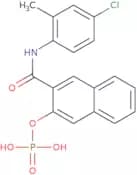
CAS:Modified naphtol AS substrate used in histochemical and cytochemical staining
Formula:C18H15ClNO5PPurity:Min. 95%Color and Shape:Off-White PowderMolecular weight:391.74 g/mol5-Bromo-4-chloro-3-indolyl a-L-rhamnoside
5-Bromo-4-chloro-3-indolyl a-L-rhamnoside is a chromogenic substrate used to detect the specific enzymatic activity of alpha-L-rhamnosidase. After cleavage, 5-bromo-4-chloro-indoxyl is released, resulting in a blue to blue-green color change in bacterial colonies or media. 5-Bromo-4-chloro-3-indolyl a-L-rhamnoside is used in bacterial rhamnose metabolism studies (e.g. E. coli).
Formula:C14H15BrClNO5Purity:Min. 95%Color and Shape:SolidMolecular weight:392.63 g/molRef: 3D-EB170531
Discontinued product5-Bromo-6-chloro-3-indoxyl choline phosphate
CAS:Please enquire for more information about 5-Bromo-6-chloro-3-indoxyl choline phosphate including the price, delivery time and more detailed product information at the technical inquiry form on this page
Formula:C13H17BrClN2O4PPurity:Min. 99 Area-%Molecular weight:411.63 g/molRef: 3D-B-7118
Discontinued product4-Nitrophenyl 2-O-trans-feruloyl-a-L-arabinofuranoside
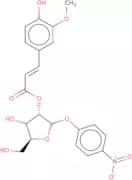
CAS:4-Nitrophenyl 2-O-trans-feruloyl-alpha-L-arabinofuranoside is a chromogenic substrate for alpha-L-arabinofuranosidase. Upon hydrolysis, para-nitrophenol is released yielding a yellowish colour. 4-Nitrophenyl 2-O-trans-feruloyl-alpha-L-arabinofuranoside is used in different applications such as the Plant biomass analysis, bacterial arabinan degradation assays
Formula:C21H21NO10Purity:Min. 95%Color and Shape:PowderMolecular weight:447.39 g/molRef: 3D-EN16252
Discontinued productNaphthol AS-D
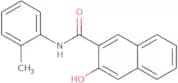
CAS:Naphthol AS-D is a diagnostic chemical for phosphatase enzymes and is used to stain cells, tissues, and body fluids for diagnosis. The chemical reacts with the amino groups of proteins in cells and produces a brown color. Naphthol AS-D is not toxic to living cells in concentrations below 5%. It stains basophilic leukemia cells as well as brain cells. This chemical can be used to diagnose cutaneous lesions, such as psoriasis or melanoma, which are difficult to diagnose by standard methods. present in these lesions and produce a brown color.
Formula:C18H15NO2Purity:Min. 95%Color and Shape:PowderMolecular weight:277.32 g/mol5-Bromo-6-chloro-3-indoxyl phosphate, p-toluidine salt
CAS:Substrate for visualizing alkaline phosphatase activity. Produces a magenta colored insoluble end product that is detected visually, when used together with Nitroblue tetrazolium. The substrate system is versatile and functions in a variety of applications, including Northern, Southern, and Western blotting, in situ hybridization, ELISAs and immunohistochemistry. DMF soluble.Formula:C15H15BrClN2O4PPurity:Min. 98.0 Area-%Molecular weight:433.63 g/mol4-Nitrophenyl decanoate
CAS:4-Nitrophenyl decanoate is a chromogenic substrate for lipase. Upon hydrolysis, para-nitrophenol is released yielding a yellowish colour. 4-Nitrophenyl decanoate is used in different applications such as the Pancreatic insufficiency diagnosis, lipid metabolism studies
Formula:C16H23NO4Purity:Min. 97 Area-%Color and Shape:PowderMolecular weight:293.36 g/molAldol® 467 beta-D-galactopyranoside, Biosynth Patent: EP 2427431 and US 8940909
CAS:Aldol® 467 beta-D-galactopyranoside is a chromogenic and fluorogenic enzyme substrate used for detection of beta-galactosidase activity. The colorless product is cleaved by lactose-utilizing bacteria grown in liquid or solid media, yielding yellow coloration and green fluorescence. Aldol® 467 beta-D-galactopyranoside can also be used in beta-galactosidase gene reporter assays or immunoassay applications (ELISA). Aldol® 467 beta-D-galactopyranoside can be used under aerobic and anaerobic conditions.
Formula:C29H28ClNO9Purity:Min. 95%Color and Shape:PowderMolecular weight:570 g/mol5-Bromo-3-indoxyl choline phosphate
Please enquire for more information about 5-Bromo-3-indoxyl choline phosphate including the price, delivery time and more detailed product information at the technical inquiry form on this page
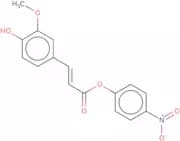
Formula:C13H18BrN2O4PMolecular weight:377.18 g/mol4-Nitrophenyl trans-ferulate
CAS:Substrate for feruloyl esterases
Formula:C16H13NO6Purity:Min. 98 Area-%Color and Shape:PowderMolecular weight:315.28 g/molAldol® 495 acetate, Biosynth Patent: EP 2427431 and US 8940909
CAS:Controlled ProductAldol 495 acetate is a chromogenic substrate that contains the chemical compound Aldol. It is used in food testing, diagnostics, and environmental testing. Aldol 495 acetate can be used as a ligand to detect the presence of enzymes or bacteria in culture media and diagnostics. This product has been shown to have a high purity and quality.
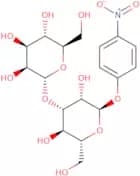
Formula:C22H17ClN2O3Purity:Min. 95.0 Area-%Molecular weight:392.83 g/mol4-Nitrophenyl 3-O-(a-D-mannopyranosyl)-a-D-mannopyranoside
CAS:Chromogenic substrate for α-glucanase
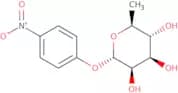
Formula:C18H25NO13Purity:Min. 97 Area-%Color and Shape:White PowderMolecular weight:463.39 g/mol4-Nitrophenyl α-L-rhamnopyranoside
CAS:Chromogenic substrate for alpha-L-rhamnosidase
Formula:C12H15NO7Purity:Min. 99 Area-%Color and Shape:White Slightly Yellow PowderMolecular weight:285.25 g/mol4-Chloro-1-naphthol
CAS:4-Chloro-1-naphthol is a chemical compound that has been used in clinical pathology to identify human immunoglobulin. It is also used as a potential biomarker for the diagnosis of Alzheimer's disease. 4-Chloro-1-naphthol binds to the amyloid fibrils and has anti-angiogenic effects in the hippocampus, which may be due to its ability to inhibit the formation of new blood vessels. This chemical compound can be used as a substrate molecule for electrochemical impedance spectroscopy and is used in wastewater treatment.
Formula:C10H7ClOPurity:Min. 97.0 Area-%Molecular weight:178.62 g/molAlizarin-2-β-D-galactopyranoside
CAS:Chromogenic substrate targeting beta- galactosidase and whose color is dependent on the metal chelating.Alizarin-2-beta-D-galactopyranoside is a chromogenic substrate for enzymes based on alizarin and has been reported for the detection of bacterial beta-galactosidase by researchers at the University of Northumbria and the Freeman Hospital, Newcastle upon Tyne in the UK (James, 2000).
Formula:C20H18O9Purity:Min. 98.0 Area-%Molecular weight:402.36 g/mol