Carbohydrates and glycoconjugates
Found 5047 products of "Carbohydrates and glycoconjugates"
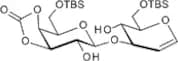
3',4'-O-Carbonyl-6,6'-di-O-tert-butyldimethylsilyl lactal
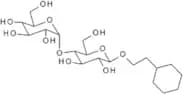
CAS:3',4'-O-Carbonyl-6,6'-di-O-tert-butyldimethylsilyl lactal is a fluorinated carbohydrate that can be used as a building block for the synthesis of oligosaccharides. It is an important sugar in glycosylation, click chemistry and methylations. This compound has been shown to have high purity and is available for custom synthesis.Formula:C25H46O10Si2Purity:Min. 95%Molecular weight:562.8 g/mol2-Cyclohexylethyl-4-O-(a-D-glucopyranosyl)-b-D-glucopyranoside
CAS:Oroxylum indicum is a plant that belongs to the family Bignoniaceae. It has been used in traditional medicine for the treatment of cancer and has been shown to possess anti-inflammatory properties. The sequenced genome of Oroxylum indicum has provided a model system for understanding the molecular mechanisms underlying tumorigenesis. This plant contains a number of monoclonal antibodies, including one that is active against mouse monoclonal antibodies and inhibits tumor xenografts. The extract of this plant also inhibits influenza virus and polymerase chain reactions, which are important steps in protein synthesis. Oroxylum indicum may have therapeutic potential as an anti-cancer drug because it can inhibit solid tumours by interfering with protein synthesis.Formula:C20H36O11Purity:Min. 95%Color and Shape:PowderMolecular weight:452.49 g/molBlood group A type 3/4 tetrasaccharide
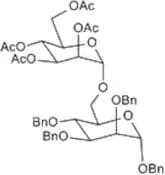
Gala1-3(Fuca1-2)Galb1-3GalNAcFormula:C28H48N2O20Purity:Min. 95%Molecular weight:732.68 g/mol6-O-(2,3,4,6-Tetra-O-acetyl-a-D-mannopyranosyl)-1,2,3,4-tetra-O-benzyl-a-D-mannopyranoside
6-O-(2,3,4,6-Tetra-O-acetyl-a-D-mannopyranosyl)-1,2,3,4-tetra-O-benzyl-a-D-mannopyranoside is an oligosaccharide with a complex carbohydrate structure. This chemical is a custom synthesis and it has high purity. 6-O-(2,3,4,6-Tetra-O-acetyl-a-D-mannopyranosyl)-1,2,3,4-- tetra--O--benzyl--A--mannopyranoside is used as an intermediate for the production of other compounds. The CAS number for this compound isFormula:C48H54O15Purity:Min. 95%Molecular weight:870.93 g/molMethyl 3-O-(2-acetamido-2-deoxy-a-D-galactopyranosyl)-a-D-galactopyranoside
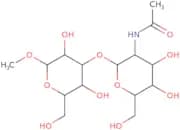
CAS:Methyl 3-O-(2-acetamido-2-deoxy-a-D-galactopyranosyl)-a-D-galactopyranoside is a synthetic carbohydrate. It is a biochemically active compound that can be used as an intermediate in the synthesis of oligosaccharides and monosaccharides, as well as other natural products. Methyl 3-O-(2-acetamido-2-deoxy-a-D-galactopyranosyl)-a-D-galactopyranoside has been studied for its potential use in cancer treatments, antiaging, and diabetes treatments.Formula:C15H27NO11Purity:Min. 95%Color and Shape:PowderMolecular weight:397.38 g/molHyaluronate rhodamine - Molecular Weight - 1000kDa
Hyaluronate Rhodamine (HR) is a high purity, custom synthesis sugar that has been modified with Click chemistry. HR is a complex carbohydrate that consists of saccharides and oligosaccharides. HR has been synthesized using glycosylation and methylation reactions. Hyaluronate Rhodamine's CAS number is 1059-14-5.Purity:Min. 95%a1-3,a1-6-Mannotriose-BSA
a1-3,a1-6-Mannotriose-BSA is a carbohydrate that is synthesized by the modification of maltotriose with a fluorinated alcohol. It is an oligosaccharide made up of three glucose units linked together in a 1,3 configuration and one glucose unit linked together in a 1,6 configuration. The molecular weight of this carbohydrate is 793 Daltons. This product has been shown to be high purity and custom synthesis for use in research.Purity:Min. 95%Color and Shape:PowderNGA2 Glycan, 2-AB labelled
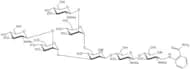
NGA2 Glycan, 2-AB labelled is a complex carbohydrate that is custom synthesized for research purposes. It is a high purity, high quality product that has been fluorinated and glycosylated. NGA2 Glycan, 2-AB labelled is used in the synthesis of oligosaccharides and polysaccharides. This product can be used for glycosylation, methylation and click modification.
Purity:Min. 95%Digalacturonic acid
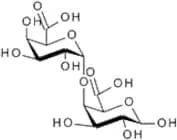
CAS:Digalacturonic acid (DGA) (α-1,4 galacturonobiose), is derived from pectin or pectic acid, by enzymatic or partial acid hydrolysis. It is used in the co-crystallization of enzymes such as proteinase K. It is also used in galacturonic acid metabolism research as a substrate to identify, differentiate, and characterized endo- and exopolygalacturonase(s), and gluconase(s).Formula:C12H18O13Purity:Min. 95%Color and Shape:White PowderMolecular weight:370.26 g/molHyaluronate rhodamine - Molecular Weight - 500kDa
Hyaluronate is a naturally occurring glycosaminoglycan (GAG) found in the extracellular matrix of animal tissues. It is a linear polymer composed of alternating units of N-acetylglucosamine and glucuronic acid. The molecular weight of hyaluronate ranges from 10,000 Da to 1,000,000 Da. Hyaluronate has been modified by fluorination, methylation, and click modification reactions. These modifications affect the physical properties of hyaluronate, including its reactivity with other molecules. Click modification reactions are often used to link two different molecules together. This may include linking an oligosaccharide or saccharide to the hydroxyl groups on the glucuronic acid residues in hyaluronate.Purity:Min. 95%3'-Sialyllacto-N-biose
3'-Sialyllacto-N-biose is a regiospecific, biochemically defined carbohydrate. It is a component of the glycan chains that are present on the surface of cell membranes. Lacto-n-biose has been shown to have inhibitory activity against the growth of Mycobacterium tuberculosis and Mycobacterium avium complex bacteria.Purity:Min. 95%Color and Shape:PowderSulpho Lewisx Na
Sulpho Lewisx Na is a high purity, custom synthesized sugar that has been modified using a click chemistry reaction. It has been fluorinated and glycosylated to produce a complex carbohydrate. Sulpho Lewisx Na is a synthetic oligosaccharide produced with the intention of mimicking the structure of Lewisx in order to study its properties. The CAS number for this compound is 2641-19-2 and it can be found under the name Oligosaccharide, Monosaccharide, saccharide, Carbohydrate on Pubchem CID 1039264.Formula:C20H34NNaO18SPurity:Min. 95%Molecular weight:631.54 g/mol2,3,4-Tri-O-acetyl-6-O-(2,3,4,6-tetra-O-acetyl-b-D-glucopyranosyl)-D-glucopyranose
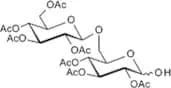
CAS:2,3,4-Tri-O-acetyl-6-O-(2,3,4,6-tetra-O-acetyl-b-D-glucopyranosyl)-D-glucopyranose is a synthetic sugar. It is a monosaccharide that is synthesized from 2,3,4,6 tetraacetyl b D glucopyranosyl b D glucose and triethylene glycol. This compound can be used in the synthesis of polysaccharides or complex carbohydrates.Formula:C26H36O18Purity:Min. 95%Molecular weight:636.55 g/molLipid A (E. Coli) triethylammonium salt
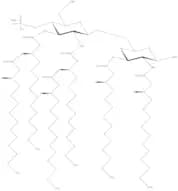
CAS:The Lipid A moiety of lipopolysaccharide forms the outer monolayer of the outer membrane in most Gram-negative bacteria. Escherichia coli lipid A is synthesized on the cytoplasmic side of the inner membrane by a conserved pathway of nine constitutive enzymes. Following attachment of the core oligosaccharide, nascent core-lipid A is flipped to the outer surface of the inner membrane by the ABC transporter MsbA, where the O-antigen polymer is attached. These complex glycoforms protect bacteria from antibiotics and complement-mediated lysis. The core and O-antigen domains are required for virulence and consequently are present in most clinical and environmental isolates (Raetz, 2007).Formula:C94H178N2O25P2Purity:Min. 95%Molecular weight:1,798.37 g/molNGA4F N-Glycan
CAS:NGA4F N-Glycan is a modification of the N-glycan structure. It is an oligosaccharide composed of a single monosaccharide, methylated and glycosylated to form a polysaccharide with sugar groups on every other carbon. This product can be custom synthesized by our chemists at your request.Formula:C72H120N6O50Purity:Min. 95%Molecular weight:1,869.73 g/mol8-Ethoxycarbonylheptyl N,N'-di-O-acetyl-b-chitobioside
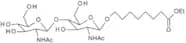
8-Ethoxycarbonylheptyl N,N'-di-O-acetyl-b-chitobioside is a custom synthesis of an oligosaccharide. It is a complex carbohydrate that is composed of saccharides and has a CAS number. 8-Ethoxycarbonylheptyl N,N'-di-O-acetyl-b-chitobioside is modified with methylation, glycosylation and click modification. This product is also fluorinated. 8-Ethoxycarbonylheptyl N,N'-di-O-acetyl-b-chitobioside has high purity and can be used as a sugar in the synthesis of other compounds.Formula:C26H46N2O13Purity:Min. 95%Molecular weight:594.65 g/molLewis Y tetrasaccharide-APE-HSA
Lewis Y tetrasaccharide-APE-HSA is a synthetic, high purity glycosylated oligosaccharide. It is composed of a Lewis Y tetrasaccharide linked to an APE peptide and HSA. The Lewis Y tetrasaccharide has been custom synthesized with click modification and fluorination. The APE peptide has been modified with glycosylation and methylation. The HSA has been modified with glycosylation, methylation, and acetylation. The oligosaccharide was synthesized using the solid phase method on a CEM Liberty Star Column. This glycoconjugate is CAS No., which can be found at Pubchem CID: 10609300.
Purity:Min. 95%Methyl a-D-laminarabioside heptaacetate
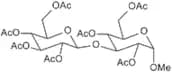
CAS:Methyl a-D-Lamarabioside heptaacetate is a synthetic, fluorinated monosaccharide derived from the natural compound D-Lamarabioside. It is used as a building block for the synthesis of novel oligosaccharides and glycosylated proteins. This product also has applications in medical research and development, such as for the design of new drugs and vaccines, as well as in biotechnology and chemical engineering. Methyl a-D-laminarabioside heptaacetate is soluble in water with a melting point of 230°C. It can be used to modify proteins with high purity by introducing glycosylation sites. This product is also useful for click chemistry reactions.Formula:C27H38O18Purity:Min. 95%Molecular weight:650.58 g/molMaltododecaose
CAS:α-1,4-glucododecasaccharide derived from starch by hydrolysis and chromatographyFormula:C72H122O61Purity:Min. 95%Color and Shape:Clear Liquid PowderMolecular weight:1,962 g/mol2-Acetamido-4-O-(2-acetamido-2-deoxy-a-D-glucopyranosyl)-2-deoxy-D-galactopyranose
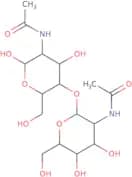
CAS:2-Acetamido-4-O-(2-acetamido-2-deoxy-a-D-glucopyranosyl)-2-deoxy-D-galactopyranose is a Custom synthesis of an oligosaccharide that is synthesized by the modification of natural sugars. This product has been fluorinated, methylated and modified with click chemistry. It is saccharide consisting of two monosaccharides, which are 2 acetamido 4 O-(2 acetamido 2 deoxy a D glucopyranosyl)-2 deoxy D galactopyranose and 2 deoxy D galactose. The molecular weight of this compound is 528.5 g/mol.
Formula:C16H28N2O11Purity:Min. 95%Molecular weight:424.4 g/mol