Free Radicals and Oxidant/Reducing Agents
Free radicals are molecules with unpaired electrons that can damage cellular structures, affecting the stability of active pharmaceutical ingredients (APIs). These radicals are important in API formulation, as their presence can influence the stability and efficacy of the drug. Oxidising agents are substances that facilitate the loss of electrons, which can be useful in the production of certain APIs but may also trigger unwanted reactions if not properly controlled. Reducing agents, on the other hand, can stabilise some active compounds by preventing oxidation. The control of free radicals and the management of oxidising and reducing agents are essential in the development of APIs with a prolonged shelf life and efficient therapeutic activity.
Found 212 products of "Free Radicals and Oxidant/Reducing Agents"
Sort by
Purity (%)
0
100
|
0
|
50
|
90
|
95
|
100
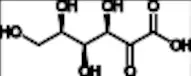
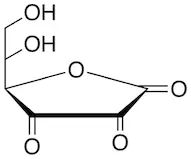
L-threo-Hex-2-enaric acid 1,4-Lactone
CAS:Formula:C6H6O7Color and Shape:Off-WhiteMolecular weight:190.11Oxalic Acid
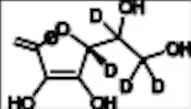
CAS:<p>Applications An impurity of oxaliplatin which is a coordination complex that is used in cancer chemotherapy.A reducing agent and its conjugate base, known as oxalate (C2O42−), is a useful chelating agent for metal cations.<br>References Wheate, N., et al.: Dalton Trans., 39, 8113 (2010),<br></p>Formula:C2H2O4Color and Shape:White To Off-WhiteMolecular weight:90.03D(-)-Isoascorbic Acid (Erythorbic Acid)
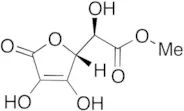
CAS:<p>Stability Moisture Sensitive<br>Applications Erythorbic Acid is used as a food additive as an antimicrobial and antioxidative agent.<br>References Sakagami, H. et al.: Anticanc. Res., 17, 221 (1997); Brahma, B. et al. J. Neurochem., 74, 1263 (2000);<br></p>Formula:C6H8O6Color and Shape:WhiteMolecular weight:176.12L-threo-Hex-2-enaric acid 1,4-Lactone 6-Methyl Ester
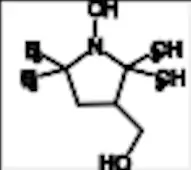
CAS:Formula:C7H8O7Color and Shape:NeatMolecular weight:204.13(1-Oxyl-2,2,5,5-tetramethyl-δ-3-pyrroline-3-methyl) Methanethiosulfonate
CAS:<p>Stability Light Sensitive<br>Applications A highly reactive thiol-specific spin-label. A specific conformational probe of thiol site structure by virtue of its minimal rotational freedom and distance from the covalent disulfide linkage to the macromolecule under study.<br>References Huang, H., et al.: Biochem., 47, 12380 (2008), Antoniou, C., et al.: Anal. Biochem., 376, 160 (2008), Padmavathi, P., et al.: J. Mol. Biol., 378, 204 (2008),<br></p>Formula:C10H18NO3S2Color and Shape:NeatMolecular weight:264.38S-(2-Hydroxyethyl)glutathione
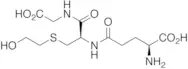
CAS:Controlled Product<p>Stability Very Hygroscopic<br>Applications A glutathione derivative as inhibitor of glutathione S-transferase.<br>References Dirr, H., et al.: Eur. J. Biochem., 196, 693 (1991), Oakley, A., et al.: J. Mol. Biol., 274, 84 (1997), Alcaro, S., et al.: Bioorg. Med. Chem., 13, 3371 (2005),<br></p>Formula:C12H21N3O7SColor and Shape:NeatMolecular weight:351.38Potassium Dichromate
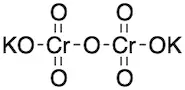
CAS:Controlled Product<p>Applications Potassium Dichromate is toxic if ingested, however has been used in tracing methods. Also, is used in treating patients suffering from COPD and related tracheal secretions.<br> Not a dangerous good if item is equal to or less than 1g/ml and there is less than 100g/ml in the package<br>References Frass, M. et al.: Chest., 127, 936 (2005); Mascorro, J. et al.: Stain. Technol., 50, 391 (1975);<br></p>Formula:Cr2O7·2KColor and Shape:NeatMolecular weight:294.18L-Gulono-1,4-lactone
CAS:Controlled Product<p>Applications L-Gulono-1,4-lactone is a precursor in the biosynthesis of ascorbic acid, one of the many forms of Vitamin C.<br>References Wolucka, B. et al.: J. Biol. Chem., 278, 47483 (2003); Heller, R. et al.: J. Biol Chem., 274, 8254 (1999);<br></p>Formula:C6H10O6Color and Shape:White To Off-WhiteMolecular weight:178.142-Phospho-L-ascorbic Acid Trisodium Salt
CAS:Controlled Product<p>Applications 2-Phospho-L-ascorbic Acid Trisodium Salt is a long-lasting vitamin C derivative used in studies of gene repression. Maximizes the benefical properties of vitamins C for personal care and a main active ingredient in medicated cosmetics for whitening. Also, it is substrate in the chromoamperometric method to detect tungsten in water.<br>References Fuchihata, M.: Frag. J., 43, 64-68 (2015); Alvarado-Gamez, A. L., et al.: Sens., 15, 2232-2243 (2015);<br></p>Formula:C6H6Na3O9PColor and Shape:NeatMolecular weight:322.05L-Dehydro Ascorbic Acid (>90%)
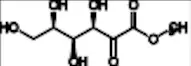
CAS:Controlled Product<p>Applications The reversibly oxidized form of ascorbic acid.<br>References Moubasher, et al.: J. Biol. Chem., 176, 633 (1948), Sy, K., et al.: J. Food Prot., 68, 1176 (2005), Llorach, R., et al.: Food Chem., 2008, 108, 1028 (2008),<br></p>Formula:C6H6O6Color and Shape:NeatMolecular weight:174.11Ref: 4Z-H-086001
Discontinued productRef: 4Z-E-5310
Discontinued productRef: 4Z-M-203002
Discontinued productRef: 4Z-E-5349
Discontinued productRef: 4Z-E-5347
Discontinued productRef: 4Z-E-5354
Discontinued productRef: 4Z-E-5352
Discontinued productRef: 4Z-E-5348
Discontinued productRef: 4Z-E-5350
Discontinued productRef: 4Z-E-5353
Discontinued product