APIs for research and impurities
Subcategories of "APIs for research and impurities"
- Aminoacids and derivatives(12,319 products)
- Anthraquinones and derivatives(402 products)
- Benzimidazole and Imidazole Derivatives(10,389 products)
- Benzodiazepine Derivatives(326 products)
- Carbohydrates and glycoconjugates(5,046 products)
- Esters and Derivatives(42,242 products)
- Fatty Acids and Lypidic Derivatives(32,371 products)
- Flavonoids and Polyphenols(17,073 products)
- Free Radicals and Oxidant/Reducing Agents(211 products)
- Ketones and derivatives(2,398 products)
- Natural and semi-synthetic antibiotics(6,321 products)
- Nitriles and Cyano Derivatives(3,068 products)
- Nitrosamines and Derivatives(55 products)
- Nucleosides and Nucleotides(3,441 products)
- Organic Phosphates and Phosphonates(1,193 products)
- Organic Sulphonates and Sulphates(10,418 products)
- Organometallics(4,417 products)
- Others(6,270 products)
- Peptides and Proteins(3,132 products)
- Polymers and Derivatives(99 products)
- Purines and Pyrimidine Derivatives(8,895 products)
- Quinazoline and Quinoline Derivatives(65,667 products)
- Quinones and Derivatives(24,338 products)
- Salts and Derivatives of Active Pharmaceutical Ingredients (API)(81,323 products)
- Steroids and Derivatives(4,922 products)
- Sulfonamides and Derivatives(2,562 products)
- Terpenoids and Derivatives(3,833 products)
- Thiazolidinediones and Thiopyrans(2,752 products)
- β-Adrenergic Compounds(227 products)
Found 58693 products of "APIs for research and impurities"
Desmethyl dehydro lercanidipine
CAS:Desmethyl dehydro lercanidipine is a metabolite of lercanidipine, an antihypertensive agent. Lercanidipine is a dihydropyridine calcium channel blocker that inhibits the influx of calcium ions into cardiac muscle cells and vascular smooth muscle cells. The desmethyl form of lercanidipine has been shown to have anti-inflammatory effects in rats with experimental arthritis. It has also been shown to inhibit the production of inflammatory cytokines in lipopolysaccharide-stimulated human peripheral blood mononuclear cells.
Formula:C35H37N3O6Purity:Min. 95%Molecular weight:595.70 g/molRef: 3D-UUB22697
Discontinued productRegadenoson Impurity 28
CAS:Regadenoson Impurity 28 is an analytical standard and research and development impurity. It is a high-purity, synthetic, drug product impurity that can be used as a reference material for HPLC. This drug impurity is also available in a custom synthesis service. Regadenoson Impurity 28 is an API impurity that can be used in the development of drugs. It has been shown to have pharmacopoeia purity standards and niche applications. Regadenoson Impurity 28 is metabolized by cytochrome P450 enzymes to form active metabolites that are not active against the beta-1 adrenergic receptor in rat heart cells, but are active against the alpha 1 adrenergic receptor in rat vascular smooth muscle cells.
Formula:C10H14N6O3Purity:Min. 95%Molecular weight:266.26 g/molN-Desmethyl trimeprazine
CAS:N-Desmethyl trimeprazine is a synthetic compound, which is an impurity of the drug product. It is not active and does not possess any biological activity. It is a metabolite of the parent drug, Trimeprazine. N-Desmethyl trimeprazine has been studied for its pharmacological properties and metabolism in the body, but no conclusive results have been found. The chemical structure and purity of N-Desmethyl trimeprazine are not listed in the USP or BP. This compound can be custom synthesized on request.
Formula:C17H20N2SPurity:Min. 95%Molecular weight:284.40 g/molRef: 3D-XAA73204
Discontinued product(3R)-3,6-Dihydro-2H-1,4-thiazine-3,5-dicarboxylic Acid 3-Ethyl Ester
CAS:The chemical name for (3R)-3,6-Dihydro-2H-1,4-thiazine-3,5-dicarboxylic acid 3-ethyl ester-d5 is 2-(2-(pyrrolidin-1-yl)ethoxy)ethanol. This compound is a drug product that has been custom synthesized and purified by HPLC. It is an analytical standard and impurity standard for HPLC. The CAS number for this compound is 944115-20-2.Formula:C8H6D5NO4SPurity:Min. 95%Molecular weight:222.27 g/molRoxithromycin impurity I
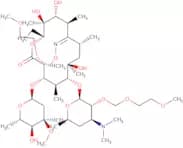
CAS:Roxithromycin impurity I is a natural metabolite of roxithromycin. The substance has been synthesized in order to serve as an analytical impurity standard for HPLC. Roxithromycin impurity 1 is also a metabolite of roxithromycin, which has been shown to produce pharmacological effects similar to those seen with the parent compound. Roxithromycin impurity I is not an API, but has been developed as a HPLC analytical impurity standard and will be used for metabolism studies.
Formula:C45H84N2O17Purity:Min. 95%Color and Shape:PowderMolecular weight:925.15 g/molRef: 3D-IR106455
Discontinued productCefdinir impurity E
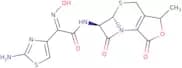
CAS:Cefdinir impurity E is a research and development, impurity standard, custom synthesis, drug product, synthetic, high purity, pharmacopoeia, drug development and analytical standard. CAS No. 946573-41-7 is the metabolite of cefdinir. It is used to study metabolism of cefdinir in vitro and in vivo. HPLC standards are available for this compound.
Purity:Min. 95%Mch-1 antagonist 1
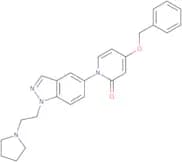
CAS:Mch-1 antagonist 1 is a drug product that is custom synthesized and is available in high purity. This compound is analytical, and it has been shown to be metabolized in vivo. Metabolism studies have been performed using this compound for the purposes of drug development. CAS No. 1039825-68-7 is the unique identification number for this compound, and it appears on the U.S. Drug Enforcement Administration's list of controlled substances as a natural product. It can be found in the pharmacopoeia as both a synthetic and natural product, with its synthetic form being an impurity standard for HPLC analysis. Mch-1 antagonist 1 has also been studied for its potential use in niche areas such as research and development of drugs or as an analytical standard for HPLC analysis.
Formula:C25H26N4O2Purity:Min. 95%Molecular weight:414.5 g/molRef: 3D-PRB82568
Discontinued productCarmoxirole hydrochloride
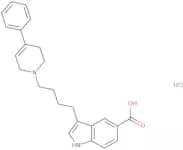
CAS:Carmoxirole hydrochloride is a hypoglycemic agent that is used in the treatment of type II diabetes. It is an analog of pergolide mesylate, which is a dopamine receptor agonist and has been shown to cause carcinogenesis in laboratory animals. Carmoxirole hydrochloride is synthesized from the reaction of 3-hydroxy-2-quinuclidinyl benzilate with chloroacetaldehyde, followed by hydrolysis of the ester linkages with hydrochloric acid. It has a particle size of less than 10 μm and exhibits high lipophilicity as it passes through cell membranes and into the intracellular fluid. The drug acts on all types of receptors, including alpha 1-, alpha 2-, beta 1-, beta 2-, and dopaminergic receptors.
Formula:C24H27ClN2O2Purity:Min. 95%Molecular weight:410.9 g/molRef: 3D-QEA09285
Discontinued product11-[3-(Dimethylamino)propyl]-6,11-dihydrodibenz[b,e]oxepin-11-ol
CAS:Dispersants are substances that are used to break up and disperse particles in a liquid. The dispersant 11-[3-(dimethylamino)propyl]-6,11-dihydrodibenz[b,e]oxepin-11-ol is an active substance that is used in the production of granules, tablets or other solidified forms of medicaments. It is a substance that has a physiologically active effect on humans and animals. This product can be applied as droplets or particles.
Formula:C19H23NO2Purity:Min. 95%Color and Shape:PowderMolecular weight:297.39 g/molRef: 3D-ID45253
Discontinued productrac-1,2,3,4-Tetrahydro-5-methoxy-N-propyl-2-naphthalenamine
CAS:Rac-1,2,3,4-Tetrahydro-5-methoxy-N-propyl-2-naphthalenamine is an organic compound with the molecular formula C10H14N. Racemic rac-1,2,3,4-tetrahydro-5-methoxy-N propyl 2 naphthalenamine has been used in the synthesis of rotigotine. The enantiomers can be separated by means of an electrophoretic method. Racemic rac 1,2 3 4 tetrahydro 5 methoxy n propyl 2 naphthalenamine has a melting point range of 138 to 141 °C and a boiling point range of 285 to 288 °C at atmospheric pressure. This compound is soluble in organic solvents such as chloroform and ethanol and insoluble in water. It has a density of 1.07 g/cm3 at 20 °C and it isFormula:C14H21NOPurity:Min. 95%Molecular weight:219.32 g/molRef: 3D-DAA89907
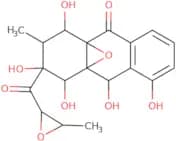
Discontinued productCervicarcin
CAS:Cervicarcin is a potent inhibitor of human kinases and a promising analog for the treatment of tumors. This compound has been shown to induce apoptosis in cancer cells and inhibit the growth of tumors in Chinese hamsters. Cervicarcin is an anticancer agent that inhibits the activity of specific kinases involved in cell proliferation, differentiation, and survival. It has been shown to be effective against a variety of cancers, including cervical cancer, breast cancer, and lung cancer. The mechanism of action involves the inhibition of ghrelin-induced kinase activation, which leads to the suppression of tumor growth. Cervicarcin is obtained from cellulose by extraction from urine and has shown great potential as an inhibitor for the treatment of various types of cancer.
Formula:C19H20O9Purity:Min. 95%Molecular weight:392.4 g/molRef: 3D-TAA70078
Discontinued product1,4-Bis[(tetrahydro-2-furanyl)carbonyl]-piperazine
CAS:1,4-Bis[(tetrahydro-2-furanyl)carbonyl]-piperazine is a synthetic drug product. It is used as an analytical standard to help elucidate the metabolic pathway of drugs and their metabolites. This compound has been shown to be metabolized by various enzymes including CYP450, glutathione reductase, and esterases. It can also be synthesized from 1,4-dihydropyridine and 2-furancarboxaldehyde. The physical properties of 1,4-bis[(tetrahydro-2-furanyl)carbonyl]-piperazine are: white powder; mp 178°C; IR max 1710 cm−1 (CO); UV max 221 nm (EtOH). The impurities in this product are: 1-(2H)-Quinolinone (CAS No. 2467-94-1) which may have a maximum concentration
Formula:C14H22N2O4Purity:Min. 95%Molecular weight:282.34 g/molKM91104
CAS:KM91104 is a potent inhibitor of protein kinases that has been shown to induce apoptosis in cancer cells. It is derived from a traditional Chinese medicinal plant and has demonstrated anticancer activity against various human cancer cell lines. KM91104 specifically targets the cell cycle and inhibits tumor growth by blocking the activity of certain proteins involved in cell division. This compound has also been found in urine samples, indicating that it may have potential as a diagnostic marker for cancer. Overall, KM91104 shows promising potential as an effective and selective inhibitor for the treatment of cancer.
Formula:C14H12N2O4Purity:Min. 95%Molecular weight:272.26 g/molRef: 3D-EMA48160
Discontinued product(E/Z)-It-603
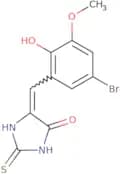
CAS:Please enquire for more information about (E/Z)-It-603 including the price, delivery time and more detailed product information at the technical inquiry form on this page
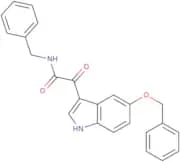
Formula:C11H9BrN2O3SPurity:Min. 95%Molecular weight:329.17 g/molN,5-Dibenzyl-5-hydroxy-indole-3-glyoxylamide
CAS:N,5-Dibenzyl-5-hydroxy-indole-3-glyoxylamide is a drug product that can be used as an analytical reference standard and an impurity standard. It is used in the development of drugs, including synthetic intermediates and metabolites. N,5-Dibenzyl-5-hydroxy-indole-3-glyoxylamide is a natural metabolite. It has been shown to have antihistamine activity and to inhibit prostaglandin synthesis.
Formula:C24H20N2O3Purity:Min. 95%Molecular weight:384.43 g/molRef: 3D-CEA75441
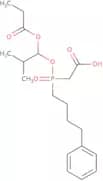
Discontinued product2-((2-Methyl-1-(propionyloxy)propoxy)(4-phenylbutyl)phosphoryl)acetic acid
CAS:2-((2-Methyl-1-(propionyloxy)propoxy)(4-phenylbutyl)phosphoryl)acetic acid (KZPBA) is a zoonotic antibiotic that has been shown to be active against agalactiae. It is a prodrug, which is metabolized to the active form, KZPBA, in humans and other mammals. The mechanism of action of KZPBA is not yet known; however, it has been hypothesized that its activity may be due to inhibition of DNA gyrase and topoisomerase IV. This drug has also been shown to have an effect on mastitis in dairy cows.Formula:C19H29O6PPurity:Min. 95%Molecular weight:384.4 g/molRef: 3D-IM27637
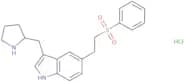
Discontinued productN-Desmethyl eletriptan hydrochloride
CAS:Please enquire for more information about N-Desmethyl eletriptan hydrochloride including the price, delivery time and more detailed product information at the technical inquiry form on this page
Formula:C21H25ClN2O2SPurity:Min. 95%Molecular weight:405 g/molRef: 3D-RFC05478
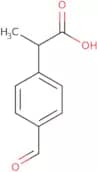
Discontinued product2-(4-Formylphenyl)propionic acid - Racemic
CAS:2-(4-Formylphenyl)propionic acid is a racemic mixture of 2-formylphenylacetic acid and 4-formylphenylacetic acid. This compound is used in the treatment of bacterial infections and inflammation. It is an organic solution that can be injected, administered orally, or applied topically. The 2-(4-formylphenyl)propionic acid has been shown to have anti-inflammatory properties, but also has side effects such as skin irritation when it is applied topically. This drug can also cause nausea, vomiting, and diarrhea when administered orally.
Formula:C10H10O3Purity:Min. 95%Color and Shape:White PowderMolecular weight:178.18 g/molRef: 3D-IF27430
Discontinued productRemdesivir impurity 9
CAS:CAS No.: 159970-52-6
Remdesivir impurity 9 is a synthetic, natural and drug development impurity standard. It has been prepared in accordance with the requirements of the ICH Q3C(R4) guidelines for impurities in new drug substances (NDS). Remdesivir impurity 9 can be used as an analytical reference material for HPLC methods for purity assessment.
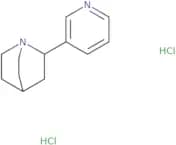
This product is available for custom synthesis and research and development purposes.Formula:C27H35N6O8PPurity:Min. 95%Molecular weight:602.58 g/molRjr 2429 dihydrochloride
CAS:Rjr 2429 dihydrochloride is a tumor promoter that has been shown to induce tumor growth in tissues and in cell culture. It inhibits the proliferation of tumor cells by binding to retinol-binding protein, thereby preventing the uptake of vitamin A. Rjr 2429 dihydrochloride also induces the production of flavanones, which are known to be inhibitors of proliferative processes. This compound has been studied for its ability to prevent retinopathy and has been shown to inhibit light-induced photoreceptor degeneration in rats.
Formula:C12H18Cl2N2Purity:Min. 95%Molecular weight:261.19 g/molRef: 3D-WQB41853
Discontinued product


![11-[3-(Dimethylamino)propyl]-6,11-dihydrodibenz[b,e]oxepin-11-ol](/_next/image/?url=https%3A%2Fstatic.cymitquimica.com%2Fproducts%2F3D%2Fthumb-webp%2FID45253.webp&w=3840&q=75)
![1,4-Bis[(tetrahydro-2-furanyl)carbonyl]-piperazine](/_next/image/?url=https%3A%2Fstatic.cymitquimica.com%2Fproducts%2F3D%2Fthumb-webp%2FIB63853.webp&w=3840&q=75)