


Amino Acids (AA)
Amino acids (AAs) are the fundamental building blocks of proteins, playing a crucial role in various biological processes. These organic compounds are essential for protein synthesis, metabolic pathways, and cell signaling. In this category, you will find a comprehensive range of amino acids, including essential, non-essential, and modified forms, which are vital for research in biochemistry, molecular biology, and nutritional sciences. At CymitQuimica, we provide high-quality amino acids to support your research and development needs, ensuring accuracy and reliability in your experimental outcomes.
Subcategories of "Amino Acids (AA)"
- Amino Acid Derivatives(3,970 products)
- Amino Acid and Amino Acid Related Compounds(3,476 products)
- Amino Acids with Oxygen or Sulphur(168 products)
- Boc- Amino Acids(351 products)
- Fmoc Amino Acids(1,710 products)
Found 38286 products of "Amino Acids (AA)"
Sort by
Purity (%)
0
100
|
0
|
50
|
90
|
95
|
100
1-[(2,6-Difluorophenyl)Methyl]-4-Methyl-2-Propan-2-Ylbenzimidazole
CAS:Controlled Product<p>1-[(2,6-Difluorophenyl)Methyl]-4-Methyl-2-Propan-2-Ylbenzimidazole is a broad spectrum HIV drug that inhibits the HIV transcriptase. It binds to the active site of the enzyme and blocks the binding of nucleotides, preventing RNA synthesis. 1-[(2,6-Difluorophenyl)Methyl]-4-Methyl-2-Propan-2-Ylbenzimidazole has been shown to be effective against HIV in vitro and in vivo. This inhibitor has been shown to inhibit both wild type and mutant forms of HIV transcriptase by binding to the same region of the enzyme. The molecule also shows good activity against other types of viruses, including influenza virus, vesicular stomatitis virus and poliovirus.</p>Formula:C18H18F2N2Purity:Min. 95%Molecular weight:300.35 g/molN-Acetyl-L-glutamic acid
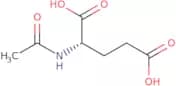
CAS:<p>N-Acetylglutamic acid is a biologically active compound that is found in the cells. It is a product of the urea cycle and has been shown to inhibit the activity of enzymes such as ester hydrochloride synthetase, which catalyzes the conversion of arginine and citrulline to ornithine and carbamoyl phosphate. N-Acetylglutamic acid also plays an important role in cellular physiology, such as transcriptional regulation and protein synthesis. Deficiency can lead to glutamate accumulation and neurological disorders such as epilepsy. The biochemical properties of N-acetylglutamic acid are still not well known, but it has been shown to react with ammonia to form glutamine.</p>Formula:C7H11NO5Purity:Min 98%Color and Shape:White PowderMolecular weight:189.17 g/mol2-Methylindole
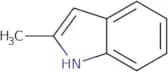
CAS:<p>2-Methylindole is a reactive molecule that can undergo electrophilic substitution at the 2-position. It reacts with a variety of nitrogen nucleophiles, acylating them at the 2-position. These reactions are catalyzed by enzymes such as carbonyl reductase and methyl ketone reductase. The reaction mechanism is not yet fully understood, but it has been proposed that it proceeds through an acylation reaction between two molecules of 2-methylindole to form a linear product. The regiospecificity of this reaction has been demonstrated in vivo using a model system.</p>Formula:C9H9NColor and Shape:PowderMolecular weight:131.17 g/molUlifloxacin
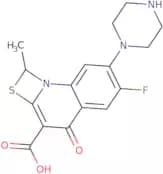
CAS:<p>Extensive research has been conducted on the antimicrobial activity of 6-fluoro-1-methyl-4-oxo-7-(1-piperazinyl)-4H-(1,3)thiazeto(3,2a)quinoline-3-carboxylic acid (FPMT). FPMT is a levorotatory compound that is rapidly metabolized by esterases to 6FMT, which is also active against bacteria. FPMT inhibits bacterial growth, but does not inhibit mammalian cell growth. The main mechanism of action for FPMT is probably through its ability to inhibit the synthesis of bacterial DNA and RNA. This drug has been shown to be effective against sinusitis caused by bacterial rhinosinusitis and urinary tract infections caused by Escherichia coli and Pseudomonas aeruginosa. FPMT can be used as an alternative to prulifloxacin for the treatment of these types of infections</p>Formula:C16H16FN3O3SPurity:Min. 98 Area-%Molecular weight:349.38 g/molL-Histidine methyl ester dihydrochloride
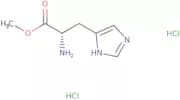
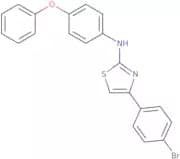
CAS:<p>L-Histidine methyl ester dihydrochloride is a β-amino acid with the chemical formula HNCH2CH(CH3)CO2H. It has the functional group of an isopropyl group and a chloride ion. L-Histidine methyl ester dihydrochloride has been shown to bind to receptors in the central nervous system that are involved in pain perception. As a result, it can be used for the treatment of neuropathic pain, chronic pain, and cancer pain. This drug also inhibits nitric oxide production by binding to iron ions or copper ions. L-Histidine methyl ester dihydrochloride has been shown to have antiinflammatory effects as well as antioxidant properties.</p>Formula:C7H11N3O2•(HCl)2Purity:Min. 95%Color and Shape:PowderMolecular weight:242.1 g/mol(4-(4-bromophenyl)(2,5-thiazolyl))(4-phenoxyphenyl)amine
CAS:<p>Please enquire for more information about (4-(4-bromophenyl)(2,5-thiazolyl))(4-phenoxyphenyl)amine including the price, delivery time and more detailed product information at the technical inquiry form on this page</p>Purity:Min. 95%16-Methyl-16-dehydropregnenolone
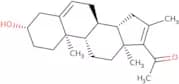
CAS:Controlled Product<p>16-Methyl-16-dehydropregnenolone is a steroid that is used as an intermediate in the synthesis of other steroids. It is synthesized by the oxidation of tetrahydropyran with an aldehyde, followed by the addition of chloride to give 16-methyl-16-dehydropregnenolone. The acetonedicarboxylate group of 16-methyl-16-dehydropregnenolone can be removed by treatment with tert-butyl or cyclopentanedione, which yields intermediates for elaboration into other biologically active compounds such as steroids.</p>Formula:C22H32O2Purity:Min. 95%Color and Shape:PowderMolecular weight:328.49 g/mol2,4-Bis(dodecylthiomethyl)-6-methylphenol
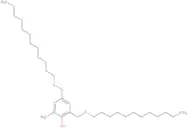
CAS:2,4-Bis(dodecylthiomethyl)-6-methylphenol is a block copolymer that contains polystyrene and polyvinyl chloride in a 1:1 ratio. It is used as an additive for polymers to improve the stability of the polymer. 2,4-Bis(dodecylthiomethyl)-6-methylphenol has been shown to be synergistic with silicone, diethylene glycol, and ethylene glycol. This additive stabilizes the polymer by preventing it from breaking down into its component parts.Formula:C33H60OS2Purity:Min. 95%Color and Shape:White Slightly Yellow PowderMolecular weight:536.96 g/molN-[3-(4,4,5,5-TetraMethyl-[1,3,2]dioxaborolan-2-yl)-phenyl]succinamic acid
CAS:<p>N-[3-(4,4,5,5-TetraMethyl-[1,3,2]dioxaborolan-2-yl)-phenyl]succinamic acid is an intermediate in the synthesis of a variety of compounds. It is also a useful building block in the synthesis of complex compounds. In addition to its use as a research chemical and reagent, N-[3-(4,4,5,5-TetraMethyl-[1,3,2]dioxaborolan-2-yl)-phenyl]succinamic acid can be used as a speciality chemical.</p>Formula:C16H22BNO5Purity:Min. 95%Molecular weight:319.16 g/molH-Trp-Trp-Trp-OH
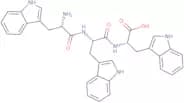
CAS:<p>H-Trp-Trp-Trp-OH is a protonated tripeptide that has hydrophobic properties. It is highly soluble in water, but not in organic solvents. The protonation of the amino acid residues in H-Trp-Trp-Trp-OH has been shown to be pH dependent. This compound is synthesized by reacting an amino acid with a carboxylic acid, which gives the product a bitter taste. The synthesis of this compound also yields reaction products that are acidic and exhibit anti tumor effects. This product can be used as a prebiotic to promote the growth of beneficial bacteria in the gastrointestinal tract.</p>Formula:C33H32N6O4Purity:Min. 95%Color and Shape:PowderMolecular weight:576.65 g/molBenzoylphenylalanyllysine fluoromethane
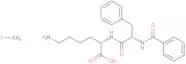
CAS:Controlled Product<p>Benzoylphenylalanyllysine fluoromethane is a competitive anticoagulant that inhibits the action of kallikrein, an enzyme involved in the activation of factor XII. This drug is used to prevent or treat thrombosis and embolism. It has been shown to be effective in vitro against coagulation factors II, VII, IX, X, XI, XII and XIII. Benzoylphenylalanyllysine fluoromethane is not metabolized by cysteine proteinase and does not interact with norvaline.</p>Formula:C23H30FN3O4Purity:Min. 95%Molecular weight:431.5 g/molTrimethylolpropane tris(2-methyl-1-aziridinepropionate)
CAS:<p>Trimethylolpropane tris(2-methyl-1-aziridinepropionate) is a crosslinker that belongs to the group of aziridines. It is a reaction product of trimethylolpropane and 2-methyl-1,3-aziridinium chloride. Trimethylolpropane tris(2-methyl-1-aziridinepropionate) can be used as a coating additive or an additive in the production of polymers. In this way, it can be used to modify the properties of polymer films and plastics. Trimethylolpropane tris(2-methyl-1-aziridinepropionate) has been shown to have excellent adhesion and flexibility when used in coatings. This product also has good resistance to degradation by light, heat and acids</p>Formula:C24H41N3O6Purity:Min. 98.00%Color and Shape:Colorless Clear LiquidMolecular weight:467.6 g/molEthyl 5-(4-bromophenyl)-2-phenylpyrrole-3-carboxylate
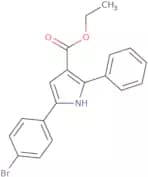
CAS:<p>Please enquire for more information about Ethyl 5-(4-bromophenyl)-2-phenylpyrrole-3-carboxylate including the price, delivery time and more detailed product information at the technical inquiry form on this page</p>Purity:Min. 95%S-Methylisovalerate
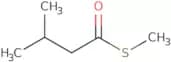
CAS:<p>S-Methylisovalerate is a branched fatty acid that is an intermediate in the biosynthesis of valine. It has been isolated from Corynebacterium glutamicum and Brevibacterium sp. S-Methylisovalerate has been identified by gas chromatography/mass spectrometry (GC/MS) as a major component of the volatile organic compounds produced by strains of Corynebacterium glutamicum and Brevibacterium sp. The GC/MS profile of these strains consists mainly of ester compounds, such as methyl ethyl acetate and butyric acid.</p>Formula:C6H12OSPurity:Min. 95%Color and Shape:Colorless Clear LiquidMolecular weight:132.22 g/molL-Valine
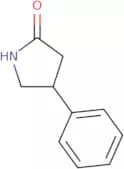
CAS:<p>Amino acid</p>Formula:C5H11NO2Purity:min 98%Color and Shape:White PowderMolecular weight:117.15 g/mol4-Phenyl-2-pyrrolidone
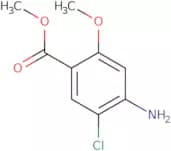
CAS:<p>4-Phenyl-2-pyrrolidone (4PP) is a chemical that inhibits bacterial growth by binding to the fatty acids required for cellular membrane synthesis. 4PP has been shown to inhibit the production of gamma-aminobutyric acid (GABA), an inhibitory neurotransmitter, and also has an aromatic hydrocarbon structure, which may be important for its antibacterial activity. The effective dose of 4PP is 10 µg/mL and it can be used in aerobic environments. This chemical also has a kinetic effect on the production of RNA sequences, which could play a role in its ability to inhibit bacterial growth.</p>Formula:C10H11NOPurity:Min. 95%Color and Shape:PowderMolecular weight:161.2 g/molMethyl 4-amino-5-chloro-2-methoxybenzoate
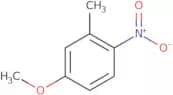
CAS:<p>Methyl 4-amino-5-chloro-2-methoxybenzoate is an organic compound with the chemical formula CH3C6H4(OCH3)2Cl. It is a useful building block, reagent, and speciality chemical. This compound can be used as a versatile building block for the synthesis of complex compounds. Methyl 4-amino-5-chloro-2-methoxybenzoate can also be used as a reaction component or a useful intermediate.</p>Formula:C9H10ClNO3Purity:Min. 95%Color and Shape:PowderMolecular weight:215.63 g/mol3-Methyl-4-nitroanisole
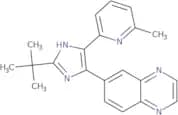
CAS:<p>3-Methyl-4-nitroanisole is a chemical compound used in the preparation of other compounds. It is obtained by reacting nitromethane with anisole in the presence of hydrochloric acid and a catalyst such as zinc chloride or copper chloride. It can be used to make melatonin, which is a hormone that regulates sleep cycles and seasonal changes in animals. 3-Methyl-4-nitroanisole can also be used to prepare nitrophenol, which is a precursor in the production of nylon. The luminescent properties of 3-methyl-4-nitroanisole are useful for analytical techniques such as UV spectroscopy, which can detect concentrations of this chemical at less than 1 ppm.</p>Formula:C8H9NO3Purity:Min. 95%Color and Shape:PowderMolecular weight:167.16 g/molSB-525334
CAS:<p>SB-525334 is a synthetic compound that has been shown to be an inhibitor of the actin molecule. It has been used in cell-based assays to investigate the effects of SB-525334 on renal proximal tubule cells. The compound inhibits the growth and proliferation of carcinoma cells and virus cells, as well as the activity of various types of cell growth factors. SB-525334 is being investigated as a potential diagnostic tool for cancer and other diseases.</p>Formula:C21H21N5Purity:Min. 95%Color and Shape:PowderMolecular weight:343.43 g/mol7-Amino-3-[[(2,5-dihydro-6-hydroxy-2-methyl-5-oxo- 1,2,4-triazin-3-yl)thio]methyl]cephalosporanic acid
CAS:<p>Ceftriaxone is a semisynthetic, broad-spectrum antibiotic that is used to treat bacterial infections. It is especially effective against the following microorganisms: Gram-positive cocci and rods, Gram-positive bacilli, Gram-negative cocci and rods, and anaerobic bacteria. Ceftriaxone is a crystalline solid that can be dissolved in water or an organic solvent. It has been shown to have excellent stability in acidic solutions and at high temperatures. Ceftriaxone has a residue of 3% when it is administered intravenously or intramuscularly. The use of ceftriaxone as an antibiotic can be optimized by using reverse-phase chromatography with a cyclic gradient elution method.</p>Formula:C12H13N5O5S2Purity:95%NmrColor and Shape:PowderMolecular weight:371.39 g/mol
![1-[(2,6-Difluorophenyl)Methyl]-4-Methyl-2-Propan-2-Ylbenzimidazole](/_next/image/?url=https%3A%2Fstatic.cymitquimica.com%2Fproducts%2F3D%2Fthumb-webp%2FFD98108.webp&w=3840&q=75)

![N-[3-(4,4,5,5-TetraMethyl-[1,3,2]dioxaborolan-2-yl)-phenyl]succinamic acid](/_next/image/?url=https%3A%2Fstatic.cymitquimica.com%2Fproducts%2F3D%2Fthumb-webp%2FFT39771.webp&w=3840&q=75)

![7-Amino-3-[[(2,5-dihydro-6-hydroxy-2-methyl-5-oxo- 1,2,4-triazin-3-yl)thio]methyl]cephalosporanic …](/_next/image/?url=https%3A%2Fstatic.cymitquimica.com%2Fproducts%2F3D%2Fthumb-webp%2FFA17508.webp&w=3840&q=75)