Amino Acids (AA)
Subcategories of "Amino Acids (AA)"
- Amino Acid Derivatives(4,015 products)
- Amino Acid and Amino Acid Related Compounds(3,490 products)
- Amino Acids with Oxygen or Sulphur(168 products)
- Boc- Amino Acids(351 products)
- Fmoc Amino Acids(1,710 products)
Found 38368 products of "Amino Acids (AA)"
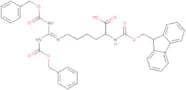
Fmoc-Homoarg (Z)2-OH
CAS:Please enquire for more information about Fmoc-Homoarg (Z)2-OH including the price, delivery time and more detailed product information at the technical inquiry form on this page
Formula:C38H38N4O8Purity:Min. 95%Molecular weight:678.73 g/mol(Tyr0)-Stresscopin (human)
CAS:Please enquire for more information about (Tyr0)-Stresscopin (human) including the price, delivery time and more detailed product information at the technical inquiry form on this pageFormula:C204H335N57O55S2Purity:Min. 95%Molecular weight:4,530.33 g/molCholecystokinin Octapeptide (1-2) (desulfated)
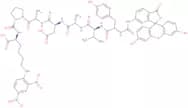
CAS:Cholecystokinin octapeptide (1-2) (desulfated) H-Asp-Tyr-OH is a peptide that has been found to have hypotensive properties. It is an agonist of the CCK receptor and has been shown to be effective in lowering blood pressure. Cholecystokinin octapeptide (1-2) (desulfated) H-Asp-Tyr-OH stabilizes membranes, which may account for its ability to reduce the permeability of erythrocyte membranes. This peptide also interacts with histidine residues in striate muscle, which may account for its ability to relax smooth muscle. Cholecystokinin octapeptide (1-2) (desulfated) H-Asp-Tyr-OH is orally administered or can be hydrolyzed into amino acids in the gastrointestinal tract.Formula:C13H16N2O6Purity:Min. 95%Molecular weight:296.28 g/molFITC-Tyr-Val-Ala-Asp-Ala-Pro-Lys(Dnp)-OH (Contains FITC isomer I)
CAS:Please enquire for more information about FITC-Tyr-Val-Ala-Asp-Ala-Pro-Lys(Dnp)-OH (Contains FITC isomer I) including the price, delivery time and more detailed product information at the technical inquiry form on this page
Formula:C62H67N11O20SPurity:Min. 95%Molecular weight:1,318.32 g/molH-Ala-Pro-pNA hydrochloride salt
CAS:H-Ala-Pro-pNA hydrochloride salt is a protease inhibitor that is used as a therapeutic agent for the treatment of hepatitis C. It has been shown to inhibit the activity of serine proteases, such as trypsin and chymotrypsin, by binding to their active site. H-Ala-Pro-pNA hydrochloride salt also inhibits the activity of DPPIV (dipeptidyl peptidase IV), which is an enzyme that cleaves the third amino acid from peptides in some blood cells. H-Ala-Pro-pNA hydrochloride salt has been shown to be effective in preventing diabetic nephropathy in animal models by inhibiting DPPIV activity. H-Ala-Pro-pNA hydrochloride salt can be used to treat chronic hepatitis B and C infections. It binds to virus particles and prevents them from attaching themselves to host cells, thus preventing viral replication.Formula:C14H18N4O4Purity:Min. 95%Molecular weight:306.32 g/molHistatin-8
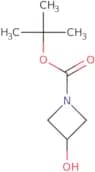
CAS:Please enquire for more information about Histatin-8 including the price, delivery time and more detailed product information at the technical inquiry form on this pageFormula:C70H99N25O17Purity:Min. 95%Molecular weight:1,562.69 g/molN-Boc-3-Azetidinol
CAS:This linker is chemically stable and not cleavable under standard intracellular or extracellular conditions. N-Boc-3-Azetidinol is also a versatile organic intermediate used primarily in the pharmaceutical industry for synthesizing a wide range of drugs, including antibacterials, immunosuppressants, and cancer therapies.Formula:C8H15NO3Purity:Min. 95%Molecular weight:173.21 g/molBpoc-Gly-OH·DCHA
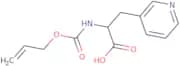
CAS:Controlled ProductPlease enquire for more information about Bpoc-Gly-OH·DCHA including the price, delivery time and more detailed product information at the technical inquiry form on this pageFormula:C18H19NO4·C12H23NPurity:Min. 95%Molecular weight:494.67 g/molAloc-beta-(3-pyridyl)-DL-Ala-OH
CAS:Please enquire for more information about Aloc-beta-(3-pyridyl)-DL-Ala-OH including the price, delivery time and more detailed product information at the technical inquiry form on this page
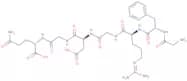
Formula:C12H14N2O4Purity:Min. 95%Molecular weight:250.25 g/molH-Gly-Phe-Arg-Gly-Asp-Gly-Gln-OH
CAS:Arg-gly-asp is a synthetic peptide that has been shown to have biological activity in vitro. This peptide is an agonist of the receptor for extracellular matrix proteins, such as fibronectin and vitronectin. It has been shown to reversibly inhibit the binding of fibronectin and vitronectin to immobilized antibody in vitro and also to inhibit endometrial cell proliferation in vivo. Arg-gly-asp was found to be dose-dependent with a maximal effect at 1 microgram/mL.Formula:C30H45N11O11Purity:Min. 95%Molecular weight:735.75 g/molSomatostatin-14 (7-14) trifluoroacetate salt
CAS:Please enquire for more information about Somatostatin-14 (7-14) trifluoroacetate salt including the price, delivery time and more detailed product information at the technical inquiry form on this pageFormula:C49H66N10O12SPurity:Min. 95%Molecular weight:1,019.17 g/mol(Nle 35)-Amyloid b-Protein (1-42) ammonium salt
CAS:Please enquire for more information about (Nle 35)-Amyloid b-Protein (1-42) ammonium salt including the price, delivery time and more detailed product information at the technical inquiry form on this pageFormula:C204H313N55O60Purity:Min. 95%Molecular weight:4,496 g/molFmoc-Gly-Wang resin (100-200 mesh)
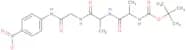
Please enquire for more information about Fmoc-Gly-Wang resin (100-200 mesh) including the price, delivery time and more detailed product information at the technical inquiry form on this pagePurity:Min. 95%Boc-Ala-Ala-Gly-pNA
CAS:Boc-Ala-Ala-Gly-pNA is a peptide that has been synthesized using the Fmoc/tBu strategy. It has an acidic pH, and its proteolytic activity can be enhanced by the addition of chromogenic or fluorogenic substrates. Boc-Ala-Ala-Gly-pNA is used as a substrate in fingerprint analysis and can be used to identify bacteria such as Proteus mirabilis, Pseudomonas aeruginosa, and Bacillus cereus. This peptide can also be used to identify strains of Escherichia coli, Enterococci, Staphylococci, Streptococci, and Haemophilus influenzae.Formula:C19H27N5O7Purity:Min. 95%Color and Shape:PowderMolecular weight:437.45 g/molBoc-D-Cys(NPys)-OH
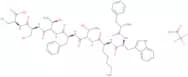
CAS:Please enquire for more information about Boc-D-Cys(NPys)-OH including the price, delivery time and more detailed product information at the technical inquiry form on this pageFormula:C13H17N3O6S2Purity:Min. 95%Molecular weight:375.42 g/molH-Gly-Arg-Gly-Asp-Ser-Cys-OH trifluoroacetate salt
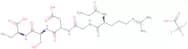
CAS:H-Gly-Arg-Gly-Asp-Ser-Cys-OH trifluoroacetate salt is a photoelectron that binds to the integrin receptor. It has been shown that H-Gly-Arg-Gly-Asp-Ser-Cys-OH trifluoroacetate salt can inhibit protein synthesis in mesenchymal stromal cells. H Gly Arg Gly Asp Ser Cys OH trifluoroacetate salt can also be used as a reagent to determine the presence of amide bonds and to identify proteins. This compound may have biotechnological applications due to its biochemical properties.Formula:C20H35N9O10SPurity:Min. 95%Molecular weight:593.61 g/molCholecystokinin Octapeptide (desulfated)
CAS:Cholecystokinin octapeptide (CCK-8) is a peptide hormone that is secreted from the pancreas. It is a conjugate of CCK and desulfated cholinesterase, which has been shown to have surfactant properties. The concentration-response curves for CCK-8 are biphasic, with an initial increase in contractility followed by a decrease. This response is caused by activation of both the B2 and B1 receptors in the paraventricular nucleus of the hypothalamus and subsequently release of pancreatic enzymes into the bloodstream. CCK-8 has also been shown to stimulate protein synthesis in gland cells such as those found in the pancreas.Formula:C49H62N10O13S2Purity:Min. 95%Molecular weight:1,063.21 g/molFmoc-p-phenyl-D-phenylalanine
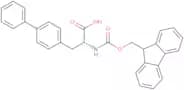
CAS:Please enquire for more information about Fmoc-p-phenyl-D-phenylalanine including the price, delivery time and more detailed product information at the technical inquiry form on this pageFormula:C30H25NO4Purity:Min. 95%Molecular weight:463.52 g/molAc-Gln-Gln-OH
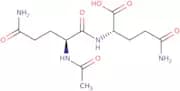
CAS:Glutamine is a non-essential amino acid that is found in the cell in large amounts. It functions as a precursor of glutamate, an important neurotransmitter and intermediate in protein synthesis. Glutamine also has antioxidant properties, which may be due to its ability to donate hydrogen atoms or act as a reducing agent. Glutamine can be synthesized by glutaminase from glutamate and ammonia, but it can also be obtained from dietary sources. The uptake of glutamine is rapid at low concentrations, but becomes slower at higher concentrations. Glutamine is catabolized by the liver and kidney into glutamate and ammonia. Glutamate dehydrogenase (GLDH) catalyzes the conversion of glutamate to α-ketoglutarate, producing NADH and H+. The genetic mechanisms underlying the synthesis of glutamine are not well understood; however, one hypothesis states that glutamine could be synthesized from alpha-ketoglutarate via the reverse transamination reaction during periods when glucoseFormula:C12H20N4O6Purity:Min. 95%Molecular weight:316.31 g/molH-Lys-Gly-Glu-OH
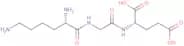
CAS:H-Lys-Gly-Glu-OH is a peptide that binds to epidermal growth factor, increasing the production of new cells. This molecule has been shown to inhibit the growth of viruses, such as herpes simplex virus, and matrix metalloproteinase. This peptide also interacts with toll-like receptor 4, which is a protein that recognizes lipopolysaccharides in Gram-negative bacteria. Titration calorimetry has shown that H-Lys-Gly-Glu-OH has an effect on epidermal growth factor, which may be due to its effects on fatty acid metabolism or growth factors.
Formula:C13H24N4O6Purity:Min. 95%Molecular weight:332.35 g/mol