Apoptosi
Gli inibitori dell'apoptosi sono composti che prevengono o ritardano il processo di morte cellulare programmata, noto come apoptosi. Questi inibitori sono fondamentali per lo studio dei meccanismi di sopravvivenza cellulare e vengono utilizzati per indagare sulle malattie in cui l'apoptosi è disregolata, come il cancro, i disturbi neurodegenerativi e le malattie autoimmuni. Modulando l'apoptosi, questi inibitori possono aiutare nello sviluppo di terapie mirate a controllare la morte cellulare. Presso CymitQuimica, offriamo una vasta selezione di inibitori dell'apoptosi di alta qualità per supportare le tue ricerche in biologia cellulare, oncologia e campi correlati.
Sottocategorie di "Apoptosi"
- ASK(9 prodotti)
- BCL(8 prodotti)
- Caspasi(147 prodotti)
- FOXO1(3 prodotti)
- IAP(67 prodotti)
- Mdm2(12 prodotti)
- PD-1/PD-L1(140 prodotti)
- PDK(9 prodotti)
- PERK(26 prodotti)
- Chinasi di serina/treonina(19 prodotti)
- Survivin(14 prodotti)
- TNF(91 prodotti)
- c-RET(61 prodotti)
- p53(63 prodotti)
Mostrare 6 più sottocategorie
Trovati 6114 prodotti di "Apoptosi"
Ordinare per
Purezza (%)
0
100
|
0
|
50
|
90
|
95
|
100
Apoptosis inducer 42
CAS:Apoptosis inducer42 is an apoptosis inducer that triggers late-stage apoptosis and inhibits the secretion of IL-6. It exhibits high cytotoxicity toward cancer cells and is applicable in cancer research, including studies on colon cancer.Formula:C11H13OPSColore e forma:SolidPeso molecolare:224.26ERK-MYD88 interaction inhibitor 1
CAS:ERK-MYD88 Interaction Inhibitor 1, an agent that disrupts the interaction between ERK and MYD88, has demonstrated the ability to trigger an HRI-mediated integrated stress response (ISR) that specifically promotes immunogenic cell apoptosis (apoptosis) in cancer cells. Additionally, in models using Lewis lung cancer mice, this compound has been shown to stimulate anti-tumor T cell responses, thereby exhibiting significant anti-tumor activity.
Formula:C22H21N5O2Colore e forma:SolidPeso molecolare:387.43UR-AK49
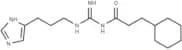
CAS:UR-AK49 (compound 11) is an agonist for the human histamine H1 and H2 receptors. It exhibits an EC50 of 23 nM in the GTPase assay involving hH2R-Gsalpha fusion protein expressed in Sf9 insect cells. UR-AK49 is applicable in neurologically related research.Formula:C16H27N5OColore e forma:SolidPeso molecolare:305.42AKT-IN-3
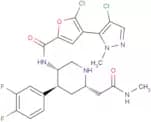
CAS:AKT-IN-3: potent oral Akt inhibitor with low hERG blockage. IC50: 1.4-1.7 nM for Akt1-3. Inhibits AGC kinases like PKA, PKC.Formula:C23H23Cl2F2N5O3Purezza:98%Colore e forma:SolidPeso molecolare:526.36T-1-PMPA
CAS:T-1-PMPA, a potent EGFR inhibitor, demonstrates apoptotic properties and effectively inhibits EGFR WT and EGFR 790m, with IC50 values of 86 nM and 561.73 nM, respectively [1].Formula:C16H17N5O3Peso molecolare:327.34Minnelide free acid
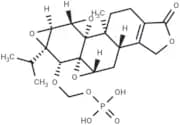
CAS:Minnelide treats pancreatic cancer, hinders androgen-related prostate growth, shrinks tumors, and improves survival.Formula:C21H27O10PColore e forma:SolidPeso molecolare:470.41Topoisomerase I/II inhibitor 8
CAS:TopoisomeraseI/II inhibitor 8 (Compound Ru7) is a dual catalytic inhibitor of TopoisomeraseI/II that induces DNA damage and activates PARP-1, leading to the activation of RIPK1, RIPK3, and MLKL, ultimately causing necroptosis. It shows significant anticancer activity by effectively targeting cancer cell nuclei and inducing cell death through necroptosis, offering substantial clinical potential in overcoming resistance in cancer treatment.Formula:C14H11Br2NO5S2Colore e forma:SolidPeso molecolare:497.179NLRP3-IN-81
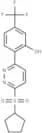
CAS:NLRP3-IN-81 (N102) is an inhibitor capable of crossing the blood-brain barrier, effectively countering NLRP3 inflammasome-dependent pyroptosis with an EC50 of 0.029 μM for Nigericin-induced pyroptosis. It significantly suppresses caspase-1 activation and IL-1β release that depend on NLRP3. Additionally, NLRP3-IN-81 disrupts the interaction between NLRP3 and the adaptor protein ASC, while inhibiting ASC oligomerization. This compound is applicable in research on pyroptosis-related diseases, such as inflammatory bowel disease and type 2 diabetes.Formula:C16H15F3N2O3SColore e forma:SolidPeso molecolare:372.36p53 Activator 11
CAS:P53 Activator 11 (compound A-1) is a highly effective p53 activator, demonstrating an EC50 value of 0.478 µM for p53 (Y220C). It holds potential for cancer research [1].Formula:C26H29N7O2SColore e forma:SolidPeso molecolare:503.62N-Nitrosonornicotine
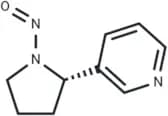
CAS:N-Nitrosonornicotine, a tobacco-specific nitrosamine, exhibits carcinogenic and mutagenic properties, and is capable of inducing micronuclei in C3A cells. Additionally, N-Nitrosonornicotine can form DNA adducts.Formula:C9H11N3OColore e forma:SolidPeso molecolare:177.2PD-L1/Nampt-IN-1
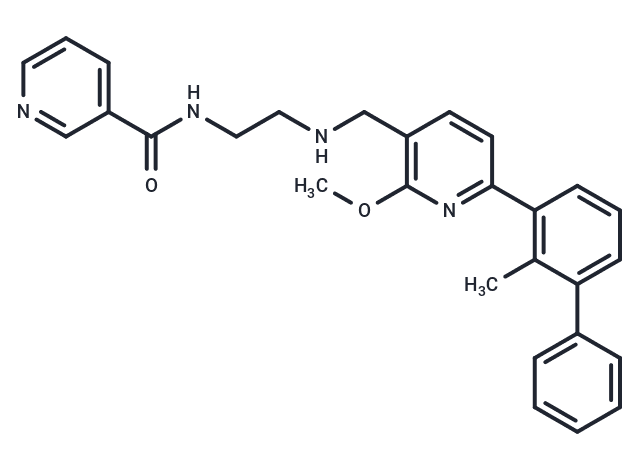
CAS:PD-L1/Nampt-IN-1 is an orally active inhibitor that targets both PD-L1 and NAMPT (nicotinamide phosphoribosyltransferase), with IC50 values of 63 nM and 582 nM, respectively. It exhibits cross-species affinity, with KD values of 52.6 nM for hPD-L1 and 49.1 nM for mPD-L1. This compound effectively suppresses tumor growth by activating the tumor immune microenvironment and is applicable in melanoma research.Formula:C28H28N4O2Colore e forma:SolidPeso molecolare:452.55JND4135
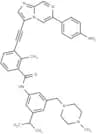
CAS:JND4135, a type II TRK inhibitor, exhibits IC50 values targeting TRKA, TRKB, and TRKC at 2.79, 3.19, and 3.01 nM, respectively. It can overcome resistance due to TRKxDFG and other mutations in the BaF3 stable model, inhibiting the phosphorylation of TRKs WT, xDFG mutations, and their downstream signaling molecules. Additionally, JND4135 induces G0/G1 phase arrest and cell apoptosis (apoptosis) in BaF3–CD74-TRKA-G667C cells. This compound also demonstrates antitumor activity in a BaF3-CD74-TRKA-G667C mouse xenograft model by suppressing tumor growth.Formula:C37H39N7OColore e forma:SolidPeso molecolare:597.75XJTU-L453
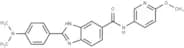
CAS:XJTU-L453, a PI3Kα inhibitor, exhibits an IC50 of 0.4 nM. It inhibits the proliferation of breast cancer cell lines T47D and MCF7, with IC50 values of 0.2 μM and 0.5 μM respectively. Additionally, XJTU-L453 disrupts the PI3K pathway, leading to cell cycle arrest and cell apoptosis (apoptosis). It also demonstrates antitumor activity in MCF7 xenograft mice.Formula:C22H22N4O3Colore e forma:SolidPeso molecolare:390.44GA001
CAS:GA001 is a potent G9a antagonist with an IC50 of 1.32 μM. It can induce autophagy and apoptosis, and is applicable in the treatment of breast cancer.Formula:C29H24BrN3OColore e forma:SolidPeso molecolare:510.42YLL545
CAS:YLL545 is an inhibitor of Vascular Endothelial Growth Factor Receptor 2 (VEGFR2). It inhibits VEGF-induced phosphorylation of VEGFR2 and the activation of downstream signaling mediators (such as phosphorylated STAT3 and phosphorylated ERK1/2) in human umbilical vein endothelial cells (HUVEC). Additionally, YLL545 suppresses HUVEC proliferation, migration, invasion, and angiogenesis. It also induces apoptosis and inhibits tumor growth in a mouse model of breast cancer.Formula:C19H13F3N6O2Colore e forma:SolidPeso molecolare:414.34Z-VAD-AMC
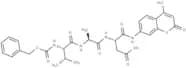
CAS:Z-VAD-AMC acts as a substrate specifically for caspase-9.Formula:C30H34N4O9Peso molecolare:594.61GlcNAc-MurNAc
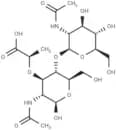
CAS:GlcNAc-MurNAc is a disaccharide and mild TLR4 agonist with a Kd of 383 μM for mouse TLR4. It directly binds to TLR4, activating the downstream NF-κB and IRF pathways. Additionally, GlcNAc-MurNAc ameliorates dextran sulfate sodium salt (DSS)-induced colitis in mice through a TLR4-dependent mechanism, making it useful for inflammatory bowel disease research.Formula:C19H32N2O13Colore e forma:SolidPeso molecolare:496.46Anticancer agent 17
Anticancer agent 17 was effective against HeLa cells (IC50: 0.19 μM) and A2780 cells (IC50: 0.09 μM).Formula:C27H34BrN3OColore e forma:SolidPeso molecolare:496.48(±)-Perillaldehyde
CAS:(±)-Perillaldehyde exhibits antidepressant effects in mice with stress-induced depressive-like behavior by modulating the olfactory nervous system. Additionally, it demonstrates anti-inflammatory activity by activating JNK in RAW264.7 cells and suppressing the expression of TNF-α, with an IC50 value of 171.7 μM.Formula:C10H14OColore e forma:SolidPeso molecolare:150.22Apoptosis inducer 5
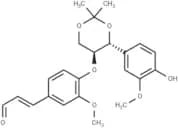
Apoptosis Inducer 5, a lignan enantiomer extracted from Crataegus pinnatifida, demonstrates cytotoxic properties through inducing apoptosis and autophagy inFormula:C23H26O7Colore e forma:SolidPeso molecolare:414.45