Apoptosi
Gli inibitori dell'apoptosi sono composti che prevengono o ritardano il processo di morte cellulare programmata, noto come apoptosi. Questi inibitori sono fondamentali per lo studio dei meccanismi di sopravvivenza cellulare e vengono utilizzati per indagare sulle malattie in cui l'apoptosi è disregolata, come il cancro, i disturbi neurodegenerativi e le malattie autoimmuni. Modulando l'apoptosi, questi inibitori possono aiutare nello sviluppo di terapie mirate a controllare la morte cellulare. Presso CymitQuimica, offriamo una vasta selezione di inibitori dell'apoptosi di alta qualità per supportare le tue ricerche in biologia cellulare, oncologia e campi correlati.
Sottocategorie di "Apoptosi"
- ASK(9 prodotti)
- BCL(11 prodotti)
- Caspasi(144 prodotti)
- FOXO1(3 prodotti)
- IAP(67 prodotti)
- Mdm2(12 prodotti)
- PD-1/PD-L1(139 prodotti)
- PDK(9 prodotti)
- PERK(27 prodotti)
- Chinasi di serina/treonina(18 prodotti)
- Survivin(14 prodotti)
- TNF(93 prodotti)
- c-RET(62 prodotti)
- p53(63 prodotti)
Mostrare 6 più sottocategorie
Trovati 6063 prodotti di "Apoptosi"
Ordinare per
Purezza (%)
0
100
|
0
|
50
|
90
|
95
|
100
SJ11646
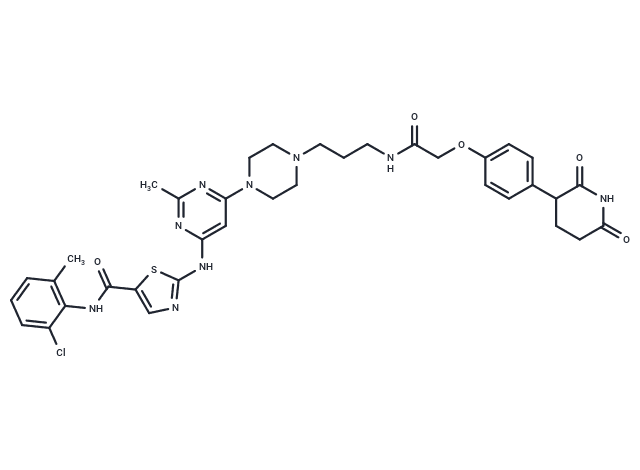
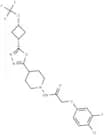
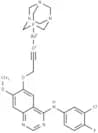
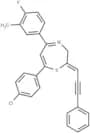
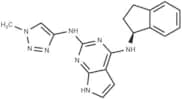
CAS:SJ11646 is a Dasatinib-based LCK PROTAC degrader with a DC50 of 0.00838 pM. It exhibits potent cytotoxicity against LCK-activated T-cell acute lymphoblastic leukemia (T-ALL) cells and primary leukemia samples, significantly prolongs LCK signal inhibition, and induces apoptosis in T-ALL cells. SJ11646 binds with high affinity to 51 human kinases, particularly ABL1, KIT, and DDR1. In mouse models of T-ALL, SJ11646 demonstrates exceptional anti-leukemic efficacy.Formula:C36H40ClN9O5SColore e forma:SolidPeso molecolare:746.28c-Myc inhibitor 16 iodide
CAS:c-Myc inhibitor16 iodide (Compound W11) is a selective inhibitor of the c-MycG-quadruplex (c-MycG4). It suppresses the transcription and translation of the c-Myc gene, disrupts the tumor cell cycle by halting growth at the G0/G1 phase, and activates mitochondrial apoptotic pathways, leading to early apoptosis in cancer cells. This compound shows potential for research in breast cancer.Formula:C26H24INOColore e forma:SolidPeso molecolare:493.379NLRP3-IN-26
CAS:NLRP3-IN-26 (compound 15Z), with an IC50 of 0.13 μM, functions as an inhibitor of NLRP3. It is applicable in studies involving the DSS-induced colitis model [1].Formula:C31H33ClN2O6SColore e forma:SolidPeso molecolare:597.12DeFer-2
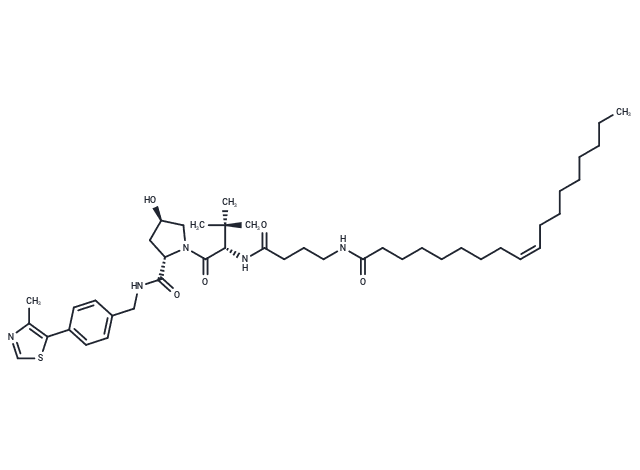
CAS:DeFer-2 is a ferritin PROTAC degrader (Kd= 17.1 μM). It triggers the degradation of ferritin leading to the accumulation of free iron ions and an increase in ROS, which subsequently initiates caspase 3-GSDME mediated pyroptosis in cancer cells. DeFer-2 significantly inhibits tumor growth and extends the survival of mice with subcutaneous B16F10 tumors, and it is useful for melanoma research.Formula:C44H69N5O5SColore e forma:SolidPeso molecolare:780.11GL0388
GL0388, a Bax activator, induces apoptosis, hinders breast cancer growth, and has IC50 of 0.299-1.57 μM.Formula:C21H17FN2OColore e forma:SolidPeso molecolare:332.37Cofpropamine
CAS:Cofpropamine, a caffeine derivative that inhibits polyadenylation, enhances the suppressive effects of Cyclophosphamide in animal models of rat adjuvant arthritis and mouse collagen-induced arthritis.Formula:C13H21N5O3Colore e forma:SolidPeso molecolare:295.34MGD-22
CAS:MGD-22 is a molecular glue and orally active degrader of IKZF1/2/3, with DC50 values of 8.33 nM, 9.91 nM, and 5.74 nM, respectively. It exhibits strong anti-proliferative activity against various hematological cancer cells and induces cell apoptosis (apoptosis). MGD-22 demonstrates significant anti-tumor efficacy in mice with NCI-H929 or WSU-DLCL-2 xenografts. This compound is useful for researching blood cancers, including multiple myeloma (MM), acute myeloid leukemia (AML), and diffuse large B-cell lymphoma (DLBCL).Formula:C33H35N7O3Colore e forma:SolidPeso molecolare:577.68ISR modulator-1
CAS:ISR Modulator-1 (Compound 212) acts as a regulator for the integrated stress response pathway (ISR).Formula:C20H21ClF4N4O4Colore e forma:SolidPeso molecolare:492.85Autophagy-IN-1
Autophagy-IN-1 blocks autophagy in cancer cells, hinders tumor growth in mice, and aids in studying colorectal cancer.Formula:C23H25NO7Colore e forma:SolidPeso molecolare:427.45Decarbamoylmitomycin C
CAS:Decarbamoylmitomycin C, an analog of Mitomycin C (MC), functions as a DNA alkylating agent. It is capable of activating chromatin relaxation by the ataxia-telangiectasia and Rad3-related protein (ATR) in a p53-independent manner.Formula:C14H17N3O4Colore e forma:SolidPeso molecolare:291.302TrxR/EGFR-IN-1
CAS:TrxR/EGFR-IN-1 (Compound L1Au2) is a TrxR/EGFR inhibitor with activity against both gefitinib-sensitive and -resistant lung cancer, effectively suppressing tumor proliferation and promoting apoptosis. It enhances GPX4 degradation through autophagosome-lysosome and proteasome pathways, leading to ferroptosis. Additionally, it induces endoplasmic reticulum stress and triggers immunogenic cell death, making it applicable for studies on gefitinib-resistant lung cancer.Formula:C24H24AuClFN6O2PColore e forma:SolidPeso molecolare:710.878Akt/NF-κB/JNK-IN-1
Akt/NF-κB/JNK-IN-1 (Compound 2i) is an inhibitor of Akt, NF-κB and JNK signalling pathways.Akt/NF-κB/JNK-IN-1 exhibits an inhibitory effect on nitric oxideFormula:C22H22N2O6Colore e forma:SolidPeso molecolare:410.42t9,t11,c15-CLNA
CAS:t9,t11,c15-CLNA is an isomer of conjugated linolenic acid (CLNA) produced by Lactobacillus plantarum ZS2058. It exhibits key activities including anti-inflammatory and antioxidant effects, as well as enhancement of intestinal barrier function. The regulatory mechanisms of t9,t11,c15-CLNA involve the upregulation of tight junction proteins, the inhibition of pro-inflammatory cytokines (such as TNF-α, IL-6), and the activation of antioxidant enzymes (such as SOD, CAT). t9,t11,c15-CLNA can be utilized in research on inflammatory bowel disease (like colitis).Formula:C18H30O2Colore e forma:SolidPeso molecolare:278.43KIRA9
KIRA9 inhibits IRE1 with a 4.8 μM IC50, blocking ER-stress-induced mRNA decay and apoptosis by fully binding IRE1's ATP site.Formula:C27H27F3N6O3SColore e forma:SolidPeso molecolare:572.6TZEP7
CAS:<p>TZEP7 functions as an EGFR kinase inhibitor in cancer cells. It exhibits cytotoxicity and induces apoptosis within these cells. TZEP7 downregulates the anti-apoptotic protein Bcl-2, upregulates the pro-apoptotic protein Bax, and increases caspase levels. This compound holds potential for research in anticancer drug development.</p>Formula:C27H19ClFNSColore e forma:SolidPeso molecolare:443.963LRRK2-IN-17
CAS:LRRK2-IN-17 is an orally active LRRK2 inhibitor with IC50 values of 3.5 nM for WT and 3.3 nM for G2019S, and it also inhibits RET kinase with an IC50 of 59 nM. LRRK2-IN-17 is utilized in research related to cancer and Parkinson's disease (PD).Formula:C18H18N8Colore e forma:SolidPeso molecolare:346.39EMT inhibitor-3
CAS:EMT inhibitor-3 (compound 11i) is an epithelial-mesenchymal transition (EMT) inhibitor that effectively suppresses the proliferation, migration, and invasion of SK-N-SH neuroblastoma cells, with an IC50 value of 2.5 μM. It induces mitochondrial-mediated intrinsic apoptosis in tumor cells by enhancing the Bax/Bcl-2 protein expression ratio, promoting the release of cytochrome C from mitochondria, and activating caspase 9 and caspase 3. EMT inhibitor-3 is applicable for cancer research.Formula:C29H21F2N3O4SeColore e forma:SolidPeso molecolare:592.45Apoptosis inducer 36
CAS:<p>Apoptosisinducer 36 (Compound 42) exhibits anti-leukemic activity by reducing leukemia stem cells (LSC) and inducing differentiation. It inhibits proliferation of AML cells by causing cell cycle arrest in the G1 phase, and induces PANoptosis, which includes apoptosis, pyroptosis, and necrosis.</p>Formula:C23H40O3SiColore e forma:SolidPeso molecolare:392.647MD102
CAS:MD102, with an IC50 value of 0.35 μM, is a potent TG2 inhibitor that stabilizes p53 by inhibiting TG2. This results in a decrease in p-AKT and p-mTOR downstream signaling, ultimately inducing tumor cell apoptosis [1].Formula:C13H4BrCl2FN2O2Colore e forma:SolidPeso molecolare:389.99RET-IN-30
CAS:RET-IN-30 (Compound 28) is a RET inhibitor that exhibits inhibitory activity against both wild-type RET and some of its mutants. It is capable of inhibiting the proliferation of A549 cells and demonstrates antitumor properties.Formula:C26H26FN5OColore e forma:SolidPeso molecolare:443.52