Apoptose
Os inibidores da apoptose são compostos que previnem ou retardam o processo de morte celular programada, conhecido como apoptose. Esses inibidores são vitais no estudo dos mecanismos de sobrevivência celular e são usados para investigar doenças onde a apoptose é desregulada, como câncer, distúrbios neurodegenerativos e doenças autoimunes. Ao modular a apoptose, esses inibidores podem ajudar no desenvolvimento de terapias destinadas a controlar a morte celular. Na CymitQuimica, oferecemos uma ampla seleção de inibidores da apoptose de alta qualidade para apoiar sua pesquisa em biologia celular, oncologia e áreas relacionadas.
Subcategorias de "Apoptose"
- ASK(6 produtos)
- BCL(11 produtos)
- Caspase(127 produtos)
- FOXO1(3 produtos)
- IAP(66 produtos)
- Mdm2(12 produtos)
- PD-1/PD-L1(126 produtos)
- PDK(9 produtos)
- PERK(23 produtos)
- Serina/treonina quinase(15 produtos)
- Survivina(13 produtos)
- TNF(91 produtos)
- c-RET(51 produtos)
- p53(62 produtos)
Exibir 6 mais subcategorias
Foram encontrados 5618 produtos de "Apoptose"
Ordenar por
Pureza (%)
0
100
|
0
|
50
|
90
|
95
|
100
ONC213
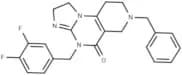
CAS:<p>ONC213, an αKGDH inhibitor, functions by hindering αKGDH activity, thus suppressing mitochondrial respiration and elevating α-ketoglutarate levels, ultimately inducing apoptosis (Apoptosis) in AML cells. It is utilized in the study of acute myeloid leukemia.</p>Fórmula:C23H22F2N4OCor e Forma:SolidPeso molecular:408.44Mps-BAY1
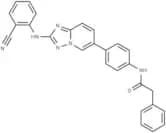
CAS:Mps-BAY1, an MPS1 inhibitor, exhibits anticancer activity. It inhibits cell proliferation and induces cell apoptosis by activating mitotic aberrations in cancer cells, leading to overall aneuploidy and polyploidy. Mps-BAY1 is used in research pertaining to colorectal and cervical cancer.Fórmula:C27H20N6OCor e Forma:SolidPeso molecular:444.49Tubulin polymerization-IN-68
CAS:<p>Tubulin polymerization-IN-68 (compound 32) serves as a tubulin inhibitor, disrupting cellular microtubule networks by hindering tubulin polymerization. It also upregulates PARP-1 and caspase-3 expression, thereby inducing apoptosis and exhibiting anticancer properties. Notably, Tubulin polymerization-IN-68 effectively suppresses HepG2 cells with an IC50 of 93 nM and markedly reduces the growth of HepG2 xenograft tumors in nude mice through oral administration.</p>Fórmula:C16H13N3OCor e Forma:SolidPeso molecular:263.29PF-3837
CAS:PF-3837 is an inhibitor of the Mps1 kinase, with a Ki value of 0.33 nM and an IC50 value of 5.5 nM. It disrupts cell cycle checkpoints by inhibiting the catalytic activity of Mps1, thereby reducing genomic stability and leading to cancer cell apoptosis (Apoptosis). PF-3837 is utilized in the study of breast cancer.Fórmula:C21H26N8O2Cor e Forma:SolidPeso molecular:422.48Sampangine
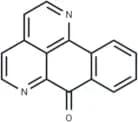
CAS:<p>Sampangine, an alkaloid, induces apoptosis by causing cell cycle arrest at the G0/G1 phase and inhibits the biosynthesis of heme.</p>Fórmula:C15H8N2OCor e Forma:SolidPeso molecular:232.24SLCB050
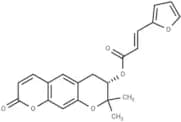
CAS:<p>SLCB050 is a compound with anticancer activity that inhibits the interaction between DX2 and p14/ARF. It decreases the viability of human lung cancer cells, particularly small cell lung cancer cells, in a p14/ARF-dependent manner, and induces cell apoptosis (apoptosis) and senescence.</p>Fórmula:C21H18O6Cor e Forma:SolidPeso molecular:366.36WK88-1
CAS:<p>WK88-1, an inhibitor of Hsp90, effectively induces the degradation of various oncogenic signaling molecules, including EGFR, ErbB2, and ErbB3, in the gefitinib-resistant H1975 cell line. This leads to subsequent growth arrest and apoptosis.</p>Fórmula:C28H42N2O6Cor e Forma:SolidPeso molecular:502.64ZNU-IMB-Z15
CAS:Compound Z15 (ZNU-IMB-Z15) acts as an antagonist and degrader of the androgen receptor (AR). It inhibits the proliferation of castration-resistant prostate cancer (CRPC) cell lines that are AR-positive and induces apoptosis. Compound Z15 exhibits anticancer activity both in vivo and in vitro.Fórmula:C20H17N3O3S2Cor e Forma:SolidPeso molecular:411.5Thalidomide-NH-amido-C4-NH2
CAS:<p>Thalidomide-NH-amido-C4-NH2 is a synthetic E3 ligase ligand-linker conjugate composed of a Thalidomide-based cereblon ligand and a linker, which is utilized in the synthesis of PROTAC.</p>Fórmula:C19H23N5O5Peso molecular:401.42OICR12694
CAS:<p>OICR12694 (JNJ-65234637) is an orally active inhibitor of B cell lymphoma 6 (BCL6) .</p>Fórmula:C29H28ClF3N8O4Cor e Forma:SolidPeso molecular:645.03JR5-26B
CAS:<p>JR5-26B is an orally active apoptosis (apoptosis) inducer. It induces cell death via copper-mediated apoptosis and necroptosis (necroptosis). JR5-26B exhibits antiproliferative activity against MIA PaCa-2, PANC-1, PAN02, SU.86.86, and KPC-2 cells, with IC50 values of 0.6, 4.4, 8.0, 1.1, and 3.4 μM, respectively.</p>Fórmula:C19H17FN6OCor e Forma:SolidPeso molecular:364.38TFCP2L1-IN-1
CAS:TFCP2L1-IN-1 is a TFCP2L1 transcription factor inhibitor that regulates cell proliferation and promotes antitumor effect of Sorafenib by STAT3/NANOG pathway.Fórmula:C15H13BrN2OSPureza:98.86%Cor e Forma:SolidPeso molecular:349.25GP130-IN-1
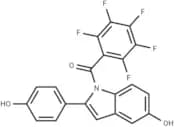
CAS:<p>GP130-IN-1 (compound 49) is an effective inhibitor of GP130, demonstrating significant in vitro anti-tumor activity and higher selectivity compared to Bazedoxifene. It induces ultrastructural changes in cells, leading to a time-dependent arrest of the cell cycle at the G0/G1 phase, and triggers both apoptosis and autophagy. GP130-IN-1 is useful for research on triple-negative breast cancer.</p>Fórmula:C21H10F5NO3Cor e Forma:SolidPeso molecular:419.30PD-L1/VISTA-IN-1
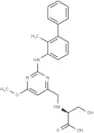
CAS:<p>PD-L1/VISTA-IN-1 (Compound P17) is an orally active dual inhibitor targeting PD-L1 and VISTA. It effectively hinders the PD-1/PD-L1 interaction (IC50: 0.1492 μM) and the VISTA pathway (KD: 0.2723 μM), leading to the reactivation of T cells. Additionally, PD-L1/VISTA-IN-1 exhibits antitumor activity.</p>Fórmula:C22H24N4O4Cor e Forma:SolidPeso molecular:408.45p53 Stabilizer 2
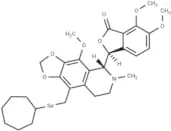
CAS:<p>p53 Stabilizer 2 (Compound 17a16) is a p53 stabilizing agent. It can induce S-phase arrest and apoptosis in both p53-functional and p53-deficient cancer cells. Additionally, p53 Stabilizer 2 triggers mitochondrial stress and activates two immune checkpoint pathways: NA-PKcs dependent p53 stabilization and the ATR-Chk1 axis activation. It also inhibits tumor growth in p53-deficient xenograft models.</p>Fórmula:C30H37NO7SeCor e Forma:SolidPeso molecular:602.58Fluvastatin sodium monohydrate
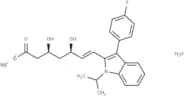
CAS:<p>Fluvastatin (XU 62-320) sodium monohydrate, a fully synthetic competitive HMG-CoA reductase inhibitor, features an IC 50 of 8 nM. This compound also safeguards vascular smooth muscle cells from oxidative stress via the Nrf2-dependent antioxidant pathway [1] [2].</p>Fórmula:C24H27FNNaO5Cor e Forma:SolidPeso molecular:451.46PDEδ/NAMPT IN-1
CAS:<p>PDEδ/NAMPT IN-1 (Compound 17d) is a dual inhibitor targeting phosphodiesterase 6 (PDE6) with a dissociation constant (KD) of 0.410 nM and nicotinamide phosphoribosyltransferase (NAMPT) with an inhibitory concentration (IC50) of 2.21 nM. It disrupts KRAS-related signaling by inhibiting NAMPT's role in the synthesis of nicotinamide adenine dinucleotide (NAD+), consequently inducing apoptosis in pancreatic cancer cells with KRAS mutations. This compound holds potential for research in KRAS-mutant pancreatic cancer.</p>Fórmula:C26H30N4O4SCor e Forma:SolidPeso molecular:494.61BTK-IN-7
<p>BTK-IN-7 is a potent inhibitor for BTK with 4.0 nM IC50, highly selective over ITK and EGFR, showing strong antitumor activity.</p>Fórmula:C30H32N6O4Cor e Forma:SolidPeso molecular:540.61WF-47-JS03
<p>WF-47-JS03: RET kinase inhibitor, crosses blood-brain barrier, 500x more selective for KDR, IC50: 1.7 nM in Ba/F3 cells, 5.3 nM in LC-2/ad lung cancer cells.</p>Fórmula:C30H38N6O2Cor e Forma:SolidPeso molecular:514.66CK156
CAS:<p>CK156 inhibits DAPK with high selectivity; IC50: 182 nM (DRAK1), 34 μM (CK2a1), 39 μM (CK2a2); key in autoimmune/inflammation research.</p>Fórmula:C21H25N5O3Cor e Forma:SolidPeso molecular:395.45