Apoptose
Os inibidores da apoptose são compostos que previnem ou retardam o processo de morte celular programada, conhecido como apoptose. Esses inibidores são vitais no estudo dos mecanismos de sobrevivência celular e são usados para investigar doenças onde a apoptose é desregulada, como câncer, distúrbios neurodegenerativos e doenças autoimunes. Ao modular a apoptose, esses inibidores podem ajudar no desenvolvimento de terapias destinadas a controlar a morte celular. Na CymitQuimica, oferecemos uma ampla seleção de inibidores da apoptose de alta qualidade para apoiar sua pesquisa em biologia celular, oncologia e áreas relacionadas.
Subcategorias de "Apoptose"
- ASK(6 produtos)
- BCL(11 produtos)
- Caspase(125 produtos)
- FOXO1(3 produtos)
- IAP(66 produtos)
- Mdm2(12 produtos)
- PD-1/PD-L1(125 produtos)
- PDK(9 produtos)
- PERK(25 produtos)
- Serina/treonina quinase(15 produtos)
- Survivina(13 produtos)
- TNF(92 produtos)
- c-RET(51 produtos)
- p53(62 produtos)
Exibir 6 mais subcategorias
Foram encontrados 5592 produtos de "Apoptose"
Ordenar por
Pureza (%)
0
100
|
0
|
50
|
90
|
95
|
100
PPIA-IN-1
<p>PPIA-IN-1 (Compound 20b) is an inhibitor of peptidyl-prolyl isomerase A (PPIA) with a KD of 0.52 μM. It demonstrates antiproliferative activity across various cancer cell lines, including an IC50 of 0.69 μM in HCT116 cells, induces cell cycle arrest at the G0/G1 phase, and exhibits antimetastatic effects in HCT116 cells. PPIA-IN-1 elevates ROS levels, causing DNA damage, ER stress, and mitochondrial dysfunction, and induces apoptosis in HCT116 cells via the MAPK pathway. Additionally, PPIA-IN-1 shows antitumor activity in a CT26 xenograft mouse model.</p>Fórmula:C23H21Cl2FN4O7Cor e Forma:SolidPeso molecular:555.34Hydrocinchonine
CAS:<p>Hydrocinchonine is an Alkaloid from Olea europaea and is found in fruits.</p>Fórmula:C19H24N2OCor e Forma:SolidPeso molecular:296.41DC-Y13-27
<p>Dc-y13-27, a derivative of DC-Y13, is a potent YTHDF2 inhibitor (KD: 37.9 μM).</p>Fórmula:C14H10N2O2SPureza:99.75%Cor e Forma:SoildPeso molecular:270.31CBI1
<p>CBI1 is a covalent BAX inhibitor. It selectively derivatizes BAX at C126 and inhibits BAX activation by triggering a ligand or through point mutations. CBI1 prevents the lipidation and oligomerization of BAX by t-2-hex. It also inhibits BAX activation induced by BH3 ligands, F116A mutation, or t-2-hex.</p>Fórmula:C15H19BrN4OS2Peso molecular:414.01837RIPK1-IN-22
<p>RIPK1-IN-13 (compound 28) is a selective inhibitor of receptor-interacting serine/threonine-protein kinase 1 (RIPK1), showing a pKi of 7.66 as measured by the ADP-Glo kinase assay. It exhibits inhibitory effects in human leukemia U937 cells with a pIC50 of 7.2.</p>Fórmula:C22H22N4O3SPeso molecular:422.14126GGTI298 Trifluoroacetate
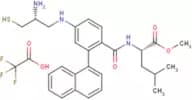
CAS:<p>GGTI298 trifluoroacetate (GGTI298TFA salt) is a geranylgeranyltransferase I inhibitor that causes cell cycle arrest and induces apoptosis.</p>Fórmula:C27H33N3O3S·C2HF3O2Pureza:98.07% - >99.99%Cor e Forma:SolidPeso molecular:593.66OPBP-1
<p>OPBP-1 is a D-peptide developed through phage display screening, molecular docking, and molecular dynamics simulations. It exhibits high stability, strong antitumor activity, and oral bioavailability. OPBP-1 selectively binds to the PD-L1 protein, significantly blocking the interaction between PD-1 and PD-L1, which helps restore and enhance T lymphocyte function while reducing the proportion of myeloid-derived suppressor cells (MDSCs), counteracting tumor-induced immune evasion. OPBP-1 is applicable for research in cancer immunotherapy.</p>Fórmula:C64H92N20O19SPeso molecular:1476.65683RIP1 kinase inhibitor 9
<p>RIP1 kinase inhibitor 9 (compound SY-1) is a selective inhibitor of RIP kinase. It effectively reduces central inflammatory responses caused by seizures. RIP1 kinase inhibitor 9 also obstructs Z-VAD-FMK-induced necroptosis in HT-29 cells, with an EC50 of 7.04 nM.</p>Fórmula:C25H21N3O3Peso molecular:411.15829PROTAC PD-L1 degrader-1
<p>PROTACPD-L1 degrader-1 is a CRBN-based PD-L1-PROTAC degrader with significant PD-L1 protein degradation capacity. It demonstrates strong PD-L1 degradation activity in 4T1 cells, with a DC50 of 0.609 μM. This compound is applicable to breast cancer research.</p>Anticancer agent 204
<p>Anticanceragent 204 (Compound 6) is a fluorinated derivative of cinnamamides with anticancer activity. It can arrest the cell cycle of HepG2 cells in the G1 phase and induces apoptosis by reducing mitochondrial membrane polarization (MMP) levels.</p>Fórmula:C26H18FN5O3SPeso molecular:499.11144PRDX1-IN-2
<p>PRDX1-IN-2 (compound 15) is a selective inhibitor of the antioxidant enzyme Peroxiredoxin 1 (PRDX1) with an IC50 of 0.35 μM. It reduces mitochondrial membrane potential in SW620 cells, potentially due to increased ROS resulting from PRDX1 inhibition, leading to apoptosis. PRDX1-IN-2 is applicable in colorectal cancer research.</p>Thalidomide-NH-C10-COOH
<p>Compound 6b is a synthetic Thalidomide-VHL E3 ligase-linker for PROTACs.</p>Fórmula:C24H31N3O6Pureza:98%Cor e Forma:SolidPeso molecular:457.52HDAC6-IN-28
<p>HDAC6-IN-28 (compound 10C) is a potent inhibitor of HDAC6 with an IC50 of 261 nM. It significantly induces apoptosis in B16-F10 cells and causes S phase arrest. Additionally, HDAC6-IN-28 effectively increases the expression of acetylated-α-tubulin both in vitro and in vivo.</p>Fórmula:C23H16FN3O2Peso molecular:385.12265LC-1-40
<p>LC-1-40 is a PROTAC that selectively degrades NUDT1 (DC50=0.97 nM). In mouse models, LC-1-40 selectively inhibits tumor growth induced by MYCN and induces nucleotide damage and apoptosis (cell death) in MYCN-associated tumors. It is applicable for cancer research.</p>Fórmula:C49H48N8O6Peso molecular:844.36968FOXJ1 agonist 1
<p>FOXJ1 agonist 1 (compound 16c), an orally effective small molecule, effectively enhances FOXJ1 expression and acts on multiciliated cells (MCC) in the mammalian airway system to prevent chronic obstructive pulmonary disease (COPD). Foxj1-IN-1 induces motile cilia production in the respiratory system of both zebrafish and mammals and inhibits elastase-induced COPD in mouse models. Additionally, Foxj1-IN-1 demonstrates good liver microsomal stability and favorable in vivo pharmacokinetic (PK) curves and area under the curve (AUC). It exhibits negligible inhibition of CYP and hERG and lacks significant cytotoxicity.</p>Fórmula:C24H27N5O3Cor e Forma:SolidPeso molecular:433.5Chlopynostat
<p>Chlopynostat (Compound 6c) is an HDAC1 inhibitor with an IC50 value of 67 nM. It induces apoptosis by inhibiting HDAC1, thereby reversing STAT4/p66Shc defects.</p>Fórmula:C22H17ClN4O2Peso molecular:404.104EGFR-IN-107
<p>EGFR-IN-107 (compound 3r) is an orally active EGFR inhibitor with IC50 values of 0.4333 μM for EGFRWT and 0.0438 μM for EGFRL858R/T790M. It exhibits antiproliferative activity, effectively inhibiting the proliferation of H1975 cells and inducing apoptosis (apoptosis). EGFR-IN-107 is applicable in cancer research.</p>Fórmula:C34H36FN7O2Peso molecular:593.29145Cu(I) chelator 1
<p>Cu(I) chelator 1 (Compound LH2) is a chelating agent specifically targeting the Cu(I) redox state. It inhibits the production of ROS.</p>Fórmula:C16H27NO4S3Peso molecular:393.11022P-gp inhibitor 16
<p>P-gp inhibitor 16 (compound 14) is an inhibitor of p-glycoprotein. It significantly enhances apoptosis induced by doxorubicin and displays anticancer properties.</p>Fórmula:C35H35N5O4Peso molecular:589.2689Thalidomide-NH-amido-C6-NH2 hydrochloride
<p>Thalidomide-NH-amido-C6-NH2 hydrochloride is a synthetic E3 ligase ligand-linker conjugate that includes a thalidomide-based cereblon ligand and a linker, designed for the synthesis of PROTAC.</p>Fórmula:C21H28ClN5O5Peso molecular:465.1779