Apoptose
Os inibidores da apoptose são compostos que previnem ou retardam o processo de morte celular programada, conhecido como apoptose. Esses inibidores são vitais no estudo dos mecanismos de sobrevivência celular e são usados para investigar doenças onde a apoptose é desregulada, como câncer, distúrbios neurodegenerativos e doenças autoimunes. Ao modular a apoptose, esses inibidores podem ajudar no desenvolvimento de terapias destinadas a controlar a morte celular. Na CymitQuimica, oferecemos uma ampla seleção de inibidores da apoptose de alta qualidade para apoiar sua pesquisa em biologia celular, oncologia e áreas relacionadas.
Subcategorias de "Apoptose"
- ASK(6 produtos)
- BCL(11 produtos)
- Caspase(125 produtos)
- FOXO1(3 produtos)
- IAP(66 produtos)
- Mdm2(12 produtos)
- PD-1/PD-L1(125 produtos)
- PDK(9 produtos)
- PERK(25 produtos)
- Serina/treonina quinase(15 produtos)
- Survivina(13 produtos)
- TNF(92 produtos)
- c-RET(51 produtos)
- p53(62 produtos)
Exibir 6 mais subcategorias
Foram encontrados 5600 produtos de "Apoptose"
Ordenar por
Pureza (%)
0
100
|
0
|
50
|
90
|
95
|
100
1-Alaninechlamydocin
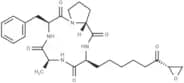
CAS:<p>1-Alaninechlamydocin, a fungal metabolite from Tolypocladium sp., inhibits HDACs and reduces cell proliferation with GI50s 5.3-14 nM.</p>Fórmula:C27H36N4O6Cor e Forma:SolidPeso molecular:512.607CQ-ER
<p>CQ-ER is a Coumarin-quinazolinone-based photosensitizer targeting the endoplasmic reticulum (ER). It induces ferroptosis, thereby enhancing photodynamic therapy (PDT).</p>Fórmula:C33H33N7O6SCor e Forma:SolidPeso molecular:655.72PIM-1/CK2-IN-2
<p>PIM-1/CK2-IN-2 (compound 3aA) is an inhibitor of the PIM-1/CK2 enzymes. This compound can induce the mitochondrial apoptosis pathway in CCRF-CEM cells and is utilized in cancer research.</p>Fórmula:C15H8Br4N2OCor e Forma:SolidPeso molecular:551.85BCL-XL-IN-1
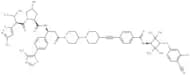
<p>BCL-XL-IN-1 (Compound 11) is a selective inhibitor of BCL-XL, exhibiting a Ki of less than 0.01 nM against BCL-XLTR-FERT. It is primarily used in cancer research.</p>Fórmula:C46H55N7O6SCor e Forma:SolidPeso molecular:834.04Ferroptosis-IN-12
<p>Ferroptosis-IN-12 (Cpd-A1) is an inhibitor of ferroptosis. It effectively suppresses ferroptosis in mouse renal tubular epithelial cells (mTECs) treated with Erastin and improves renal function in dose-dependent manners in mouse models of acute kidney injury (AKI) induced by ischemia/reperfusion (I/R) or cecal ligation and puncture (CLP). This compound also reduces renal tubular damage and eliminates inflammation. Exhibiting good plasma stability and high distribution in renal tissues during pharmacokinetic studies in mice, Ferroptosis-IN-12 shows promising potential for research in the field of AKI.</p>Cor e Forma:Odour SolidARD-61
CAS:<p>ARD-61: potent PROTAC, degrades AR/PR in AR+ cancers, triggers apoptosis, inhibits tumor growth in mice.</p>Fórmula:C61H71ClN8O7SCor e Forma:SolidPeso molecular:1095.8LSD1-IN-36
<p>LSD1-IN-36, an effective LSD1 inhibitor with an IC50 value of 0.8 nM, induces cell apoptosis and arrests the cell cycle. This compound also exhibits antitumor activity.</p>Fórmula:C22H25N3O6SCor e Forma:SolidPeso molecular:459.52L-threo-PPMP
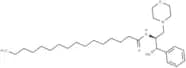
CAS:<p>L-threo-PPMP blocks GlcT, curbs glycosphingolipid creation, and triggers cell death, showing anti-cancer effects.</p>Fórmula:C29H50N2O3Cor e Forma:SolidPeso molecular:474.73Antiproliferative agent-59
<p>Antiproliferative agent-59 (Compound 14u) acts as an inhibitor of tubulin polymerization. Demonstrating anticancer activity in Huh7, SGC-7901, and MCF-7 cell lines, this compound achieves IC50 values of 0.03, 0.18, and 0.13 μM, respectively. Additionally, it arrests the cell cycle at the G2/M phase and induces apoptosis in Huh7 cells. In a xenograft mouse model utilizing Huh7 cells, Antiproliferative agent-59 exhibits antitumor effects against hepatocellular carcinoma without significant toxicity.</p>Fórmula:C26H22N2O3Cor e Forma:SolidPeso molecular:410.46NA-Ir
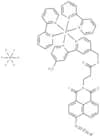
CAS:<p>NA-Ir is a ferroptosis (Ferroptosis) inducer that targets mitochondrial DNA (mtDNA) and activates the cGAS-STING pathway to stimulate ferritin autophagy (). It also induces the production of reactive oxygen species (ROS) through photodynamic therapy (PDT), depletes glutathione (GSH), and downregulates glutathione peroxidase 4 (GPX4), thereby triggering lipid peroxidation and ferroptosis. NA-Ir exhibits enhanced anticancer activity under light exposure and selectively inhibits cancer cells with high H2S content.</p>Fórmula:C49H36F6IrN8O4PCor e Forma:SolidPeso molecular:1138.04ZMF-24
<p>ZMF-24 is an anti-triple-negative breast cancer (TNBC) agent that exhibits IC50 values of 0.22 μM and 0.44 μM against BT-549 and MDA-MB-231 TNBC cell proliferation, respectively. It targets the eukaryotic translation initiation factor 3 subunit D (EIF3D), disrupting TNBC's energy supply by inhibiting glycolysis. Additionally, ZMF-24 induces TNBC cell apoptosis (apoptosis) by stimulating sustained endoplasmic reticulum stress.</p>Cor e Forma:Odour SolidHDAC-IN-79
<p>HDAC-IN-79 (compound 4) is an orally active dual inhibitor of xanthine oxidase and HDAC, exhibiting potent anti-hyperuricemia and antitumor activities in vivo (Xanthine oxidase: IC50=6.6 nM; HDAC1: IC50=134 nM; HDAC2: IC50=284 nM; HDAC3: IC50=173 nM; HDAC6: IC50=1.32 nM). Among leukemia cells, it is most effective in inhibiting the growth of HL60 cells (IC50=0.706 μM) and induces both apoptosis and autophagy. HDAC-IN-79 also modulates the expression levels of biomarkers associated with intracellular HDAC inhibition.</p>Cor e Forma:Odour SolidTrichostatin C
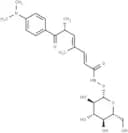
CAS:<p>Trichostatin C, a natural glycosylated hydroxamate, is a histone deacetylase inhibitor with antifungal properties and can induce cell differentiation.</p>Fórmula:C23H32N2O8Cor e Forma:SolidPeso molecular:464.515RSM3 TFA
<p>RSM3 TFA is a stapled peptide and an inhibitor of METTL3-METTL14, exhibiting a dissociation constant (Kd) of 3.10 μM. It inhibits tumor growth and induces cell apoptosis. RSM3 TFA is utilized in cancer research.</p>Cor e Forma:Odour SolidProdigiosin hydrochloride
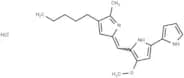
CAS:<p>Prodigiosin hydrochloride is a bioactive red pigment from bacteria with antibacterial, antifungal, anticancer properties, and inhibits Wnt/β-catenin.</p>Fórmula:C20H26ClN3OCor e Forma:SolidPeso molecular:359.9CDK9-IN-24
<p>CDK9-IN-24 (compound 21a) is a potent and selective inhibitor of CDK9 that exhibits a pronounced inhibitory impact on tumor proliferation.</p>Fórmula:C27H31N3O4Pureza:98%Cor e Forma:SolidPeso molecular:461.55Met-12
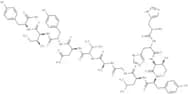
CAS:<p>Met-12 is a peptide inhibitor of the Fas receptor. It suppresses Fas receptor-mediated apoptosis in photoreceptor cells and reduces Caspase activation, making it a potential candidate for research on photoreceptor protectants.</p>Fórmula:C71H99N17O17Cor e Forma:SolidPeso molecular:1462.65Arisostatin A
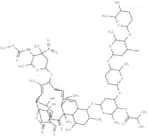
CAS:<p>Arisostatin A is a secondary metabolite produced by microorganisms, recognized as an antibiotic (antibiotic) with activity against Gram-positive bacteria. This compound also exhibits potent antitumor properties. It induces apoptosis (apoptosis) by activating caspase-3 and generating reactive oxygen species (ROS) in AMC-HN-4 cells.</p>Fórmula:C69H100N2O24Cor e Forma:SolidPeso molecular:1341.53CGP 3466B maleate
CAS:<p>CGP 3466B (Omigapil) is an oral drug inhibiting GAPDH nitrosylation and apoptosis, potentially treating Alzheimer's and CMD.</p>Fórmula:C23H21NO5Pureza:98.58%Cor e Forma:SolidPeso molecular:391.42D-CopA3
CAS:<p>D-CopA3 is an inhibitor of MDM2 and an activator of the p53 signaling pathway. It exhibits cytotoxicity in colorectal cancer cells HCT-116, LoVo, and RKO with IC50 values of 15-18 μM and induces JNK/Beclin-1 mediated autophagy. D-CopA3 downregulates the expression of the cell cycle inhibitor protein p21Cip1/Waf1, enhances mucosal barrier function, and reduces infiltration of inflammatory mediators. It shows anti-inflammatory properties in mouse models of acute enteritis induced by C. difficile toxin A and chronic colitis induced by DSS. Additionally, D-CopA3 demonstrates antitumor activity in a mouse HCT-116 xenograft model.</p>Fórmula:C96H184N30O18S2Cor e Forma:SolidPeso molecular:2110.81