Nucleotídeos
Os nucleotídeos são compostos orgânicos que servem como building blocks dos ácidos nucleicos, essenciais para a formação de DNA e RNA. Cada nucleotídeo é composto por uma base nitrogenada, uma molécula de açúcar e um ou mais grupos fosfato. Esses nucleotídeos se unem para formar longas cadeias, criando o material genético que carrega e transmite informações genéticas em todos os organismos vivos. Nesta seção, você encontrará uma ampla variedade de nucleotídeos cruciais para pesquisas em genética, biologia molecular e bioquímica. Eles são fundamentais para estudar processos genéticos, sintetizar ácidos nucleicos e desenvolver ferramentas diagnósticas e terapêuticas. Na CymitQuimica, oferecemos nucleotídeos de alta qualidade para apoiar suas pesquisas científicas e aplicações, garantindo precisão e confiabilidade em seus experimentos.
Subcategorias de "Nucleotídeos"
Foram encontrados 2637 produtos de "Nucleotídeos"
Ordenar por
Pureza (%)
0
100
|
0
|
50
|
90
|
95
|
100
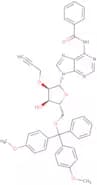
N4-Benzoyl-5'-O-DMT-2'-O-propargyl adenosine
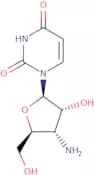
CAS:N4-Benzoyl-5'-O-DMT-2'-O-propargyl adenosine is a novel nucleoside that was synthesized by converting the ribonucleoside 5'-O-DMT to its deoxyribonucleoside form. N4-Benzoyl-5'-O-DMT-2'-O-propargyl adenosine is an antiviral and antiproliferative agent that inhibits DNA synthesis. It also has anticancer activity, but does not have any effect on RNA synthesis. This product is available in high quality and high purity with CAS No. 171486-51-4.Fórmula:C41H37N5O7Pureza:Min. 95%Cor e Forma:PowderPeso molecular:711.76 g/mol3'-Amino-3'-deoxyuridine
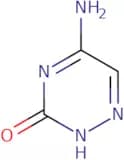
CAS:3'-Amino-3'-deoxyuridine is a nucleoside that is phosphoramidated to the 3' hydroxyl group of uridine. It has been shown to be detectable experimentally and has regiospecificity. The imidazole ring has been shown to be acidic, making it an excellent candidate for kinetics studies. 3'-Amino-3'-deoxyuridine is activated by cleavage of its phosphodiester bond by nucleophilic attack. This nucleotide can be used in the research of nucleic acids and imidazole derivatives.Fórmula:C9H13N3O5Pureza:Min. 95%Cor e Forma:PowderPeso molecular:243.22 g/mol6-Azacytosine
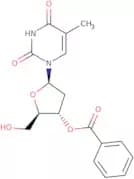
CAS:Nucleoside analogue; anti-viral; anti-tumoral agentFórmula:C3H4N4OPureza:Min. 95%Cor e Forma:PowderPeso molecular:112.09 g/mol3'-O-Benzoylthymidine
CAS:3'-O-Benzoylthymidine is a nucleoside that is used in the synthesis of DNA. It is a monomeric compound that contains two deoxyribose sugars and one deoxyribonucleotide. 3'-O-Benzoylthymidine interacts with the phosphite triester, which stabilizes the nucleobase. This reaction leads to the formation of a glycosidic bond between the phosphate group and the 5' carbon atom in the sugar ring of 3'-O-benzoylthymidine. The chloride ion is then added to form an intermediate compound with a reactive electrophilic carbon center that can be used for subsequent reactions with other compounds or nucleobases. 3'-O-Benzoylthymidine can also be conjugated to other compounds through covalent bonds, such as phosphonates, to form more complex molecules.Fórmula:C17H18N2O6Pureza:Min. 95%Cor e Forma:PowderPeso molecular:346.34 g/molUDP-N-azidoacetylgalactosamine triethylamine
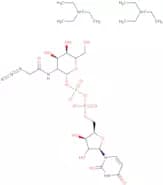
CAS:UDP-N-azidoacetylgalactosamine (UDP-GlcNAz) is an analogue of UDP-GalNAc, bearing an azido group on the N-acyl side chain. It acts as an unnatural substrate for the polypeptide N-R-acetylgalactosaminyltransferases (ppGalNAcTs) which are enzymes that play a role in mucin-type O-linked glycoprotein biosynthesis. UDP-GlcNAz is accepted as a nucleotide-sugar donor, appending an azidosugar onto its native substrates, which can then be detected using azide-reactive chemical probes. The azide group can be detected by the conjugation with phosphine probes via the Staudinger ligation, or alkyne probes via cycloaddition reactions.Fórmula:C17H26N6O17P2Pureza:Min. 90 Area-%Cor e Forma:PowderPeso molecular:848.73 g/molAdenosine 5′-phosphosulfate sodium salt
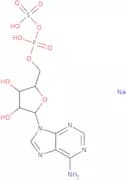
CAS:Adenosine 5′-phosphosulfate sodium salt has been used quantify pyrophosphate and in enzyme-linked bioluminescence assay for adenosine triphosphate (ATP)Fórmula:C10H14N5O10PSPureza:Min. 90 Area-%Cor e Forma:PowderPeso molecular:427.29 g/molAdenosine - Endotoxin level below 1000 EU/g
CAS:Adenosine is a naturally-occurring organic solvent found in the human body. It has been shown to inhibit fibroid growth and to have an anti-inflammatory effect on the uterus. Adenosine is also a potent endogenous vasodilator, which may be due to its ability to activate adenosine receptors. In addition, it has been demonstrated that adenosine inhibits the synthesis of target enzymes such as collagenase and hyaluronidase. The uptake of adenosine by cells is inhibited by nevirapine, which is an HIV protease inhibitor. This inhibition leads to increased extracellular levels of adenosine, which stimulates phosphorylation of extracellular-regulated kinases (ERKs) and decreases histamine release from mast cells. The ERKs are activated in response to many stimuli including cytokines, growth factors, and stressors such as UV light or heat shock.BR> In vitro studies using human tissue have shown that adFórmula:C10H13N5O4Pureza:(Titration) 99.0 To 101.0%Cor e Forma:White Off-White PowderPeso molecular:267.24 g/mol4-Amino-6-hydroxy-2-mercapto-5-nitrosopyrimidine ammonium
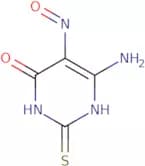
CAS:The 4-Amino-6-hydroxy-2-mercapto-5-nitrosopyrimidine ammonium salt is a solvent that has been used in the synthesis of various organic and inorganic compounds. It is a five membered ring compound with solvents, such as chlorides, and it can be found in diffraction patterns. 4-Amino-6-hydroxy-2-mercapto-5 nitrosopyrimidine ammonium salt can also act as a ligand in metal complexes. The molecule has carbonyl groups which chelate to the metal atom and form a ring with chlorine atoms.Fórmula:C4H4N4O2S•NH3Pureza:Min. 95%Cor e Forma:PowderPeso molecular:189.2 g/mol6-Chloro-9-(2'-deoxy-β-D-ribofuranosyl)purine
CAS:6-Chloro-9-(2'-deoxy-b-D-ribofuranosyl)purine is a nucleoside analogue that inhibits the replication of the hepatitis C virus. It binds to the viral RNA polymerase and blocks the synthesis of viral RNA, thereby preventing infection. This drug also has antiviral activity against HIV and herpes simplex viruses. The antiviral effect is due to its ability to inhibit phosphatases and carboxylates, which are involved in the initiation of mRNA transcription and protein translation, respectively. 6-Chloro-9-(2'-deoxy-b-D-ribofuranosyl)purine is metabolized by deoxyadenosine kinase into 6-chloropurine ribonucleotide, which can be converted into other purines.Fórmula:C10H11ClN4O3Pureza:Min. 95%Cor e Forma:PowderPeso molecular:270.68 g/molThymidine-5'-monophosphate disodium salt
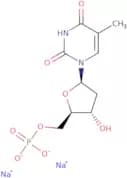
CAS:Thymidine-5'-monophosphate disodium salt is a nucleoside that is synthesized by reductive phosphorylation of thymidine. It is a substrate for nucleotide synthesis and can be used as a reagent in the synthesis of oligonucleotides. Thymidine-5'-monophosphate disodium salt can be reduced to form thymidine, which can then be converted to 5-thio-2'-deoxyuridylate or 5-thio-2'-deoxycytidylate. This conversion takes place through the cleavage reaction of the thymidine residue from the disodium salt.Fórmula:C10H13N2Na2O8PPureza:Min. 98 Area-%Cor e Forma:White PowderPeso molecular:366.17 g/mol9-(b-D-Arabinofuranosyl)guanine
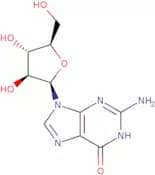
CAS:9-(b-D-Arabinofuranosyl)guanine is an arabinoside derivative that has high affinity for DNA. 9-(b-D-Arabinofuranosyl)guanine binds to the phosphate groups in DNA and inhibits the synthesis of DNA. It is used in vitro assays to study molecular pathogenesis and in vivo as a drug against leukemia, lymphomas, and other cancers. 9-(b-D-Arabinofuranosyl)guanine also inhibits protein synthesis by binding to ribosomes. This drug can cause significant side effects such as gastrointestinal distress, diarrhea, nausea, vomiting, and abdominal pain. It can also cause blood dyscrasias and liver damage.Fórmula:C10H13N5O5Pureza:Min. 97 Area-%Cor e Forma:White PowderPeso molecular:283.24 g/molN6-Acetyladenosine
CAS:N6-Acetyladenosine is a nucleoside that belongs to the group of N-acetylated adenosines. It is found in thermophilic organisms and has been shown to be involved in optimal growth. N6-Acetyladenosine has also been found to be an important part of the coding and population modifications of crenarchaeota, archaeal organisms that are phylogenetically related to methanogens. Unfractionated populations of methanogen contain both N6-acetyladenosine residues and other modified adenosines, with each organism differing in the types of modifications they contain. Transfer of these modified adenosines from one organism to another can lead to changes in their coding and population modifications.Fórmula:C12H15N5O5Pureza:Area-% Min. 90 Area-%Cor e Forma:White PowderPeso molecular:309.28 g/mol2',3'-O-Isopropylideneuridine
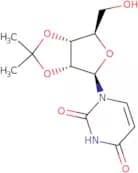
CAS:2′,3′-O-Isopropylideneuridine serves as a key intermediate in the chemical synthesis of N-benzoyl uridine derivatives and N3-substituted 2′,3′-O-isopropylideneuridines, which exhibit central nervous system (CNS) depressant propertiesFórmula:C12H16N2O6Pureza:Min. 95%Cor e Forma:White PowderPeso molecular:284.27 g/mol2'-Deoxy-5-formyluridine
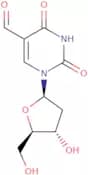
CAS:2'-Deoxy-5-formyluridine (2DFO) is a nucleobase analogue that inhibits the enzymatic activity of DNA glycosylases, which are enzymes that remove sugar residues from damaged DNA. 2DFO has been shown to induce apoptosis in cancer cells by inhibiting DNA synthesis and promoting oxidative damage to the cell's DNA. 2DFO has also been shown to inhibit the growth of DU-145 cells in vitro and in vivo models. This drug was found to be more effective at preventing metastasis of colorectal cancer when it was administered with a platinum-based chemotherapy drug.Fórmula:C10H12N2O6Pureza:Min. 95 Area-%Cor e Forma:White Off-White PowderPeso molecular:256.21 g/mol2'-Deoxy-L-guanosine
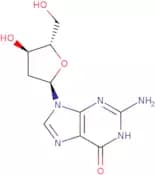
CAS:2'-Deoxy-L-guanosine is a nucleoside that is used as an antibiotic. It inhibits protein synthesis, which leads to cell death. This drug has a high level of resistance against bacteria and is effective in the treatment of gram-positive bacteria. 2'-Deoxy-L-guanosine binds to the ribose phosphate backbone of DNA, phosphorylating it and preventing the base pairing of adenosine with thymine. This inhibits the production of DNA and RNA, leading to cell death. 2'-Deoxy-L-guanosine has been shown to be active against Listeria monocytogenes and Mycobacterium tuberculosis. The enantiomer form is more potent than the racemic mixture, but both forms are effective antibiotics.
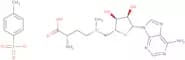
Fórmula:C10H13N5O4Pureza:Min. 95%Cor e Forma:PowderPeso molecular:267.25 g/molS-Adenosyl-L-methionine p-toluenesulfonate
CAS:Methyl donor and a cofactor for enzyme-catalyzed methylationsFórmula:C15H23N6O5S•C7H7O3SPureza:Min. 95%Cor e Forma:White PowderPeso molecular:570.64 g/mol5-(2-Amino-2-oxoethyl)-2-thiouridine
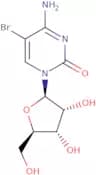
CAS:5-(2-Amino-2-oxoethyl)-2-thiouridine is a modified deoxyribonucleoside that is used as a phosphoramidite to synthesize oligonucleotides. 5-(2-Amino-2-oxoethyl)-2-thiouridine inhibits the synthesis of viral DNA and RNA, and its antiviral activity has been shown in vitro. It also may have anticancer activity due to its ability to inhibit DNA synthesis and cell proliferation. This compound has high quality, high purity, and novel properties.Fórmula:C11H15N3O6SPureza:Min. 95%Cor e Forma:PowderPeso molecular:317.32 g/mol5-Bromocytidine
CAS:5-Bromocytidine is a pyrimidine nucleoside that has been shown to inhibit the replication of influenza virus in cell culture. It stabilizes the ribonucleotide reductase enzyme, which is responsible for converting ribonucleosides to deoxyribonucleosides. This inhibition prevents the production of viral RNA and protein synthesis, leading to inhibition of viral growth. 5-Bromocytidine has also been shown to have antiviral effects against HIV and herpes simplex virus type 1 (HSV1) in cell cultures.Fórmula:C9H12BrN3O5Pureza:Min. 95%Cor e Forma:White PowderPeso molecular:322.11 g/molN4-Aminocytidine
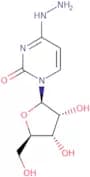
CAS:N4-Aminocytidine is an analog of uridine that can be used as an inhibitor of the growth of bacteria. It has been shown to inhibit the growth of Escherichia coli and Salmonella typhimurium in vitro. N4-Aminocytidine binds to the bacterial ribosome and inhibits protein synthesis, which results in cell death. This drug has also been found to act as a potent synthetic cannabinoid receptor agonist in vivo and inhibits uptake of cannabinoids into cells in culture. N4-Aminocytidine has also been shown to bind to dna duplexes and chemically react with them, altering their structure. This drug has not yet been tested for safety or efficacy in humans.Fórmula:C9H14N4O5Pureza:Min. 95%Cor e Forma:PowderPeso molecular:258.23 g/mol3'-O-Aminothymidine
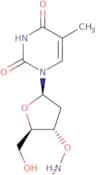
CAS:3'-O-Aminothymidine is an isomer of thymidine, a nucleoside that is found in DNA and RNA. It has a neutral charge and belongs to the category of nucleosides. 3'-O-Aminothymidine is synthesized by the coupling of an amino group with a hydroxyl group. This reaction is efficient and can be used to produce dimers. 3'-O-Aminothymidine can also be used as a precursor for other nucleotides or as a synthetic intermediate in other chemical reactions.Fórmula:C10H15N3O5Pureza:Min. 95%Cor e Forma:PowderPeso molecular:257.24 g/mol