Sais metálicos
Foram encontrados 2872 produtos de "Sais metálicos"
Potassium bicarbonate
CAS:Potassium bicarbonate is a chemical compound that is used as a buffer in a variety of applications. It is commonly used to maintain the pH of laboratory solutions and can be found in many home products such as baking powder, fire extinguishers, and antacids. Potassium bicarbonate has been shown to bind to metal ions, such as hydrogen fluoride and metal chelates, which may be responsible for its ability to inhibit cox-2 activity. Potassium bicarbonate also has high water permeability properties. This property makes it useful in blood sampling, where it causes the red blood cells to swell up and burst so they can be removed by centrifugation. Potassium bicarbonate also has hydrogen bonding interactions with water molecules (H2O).
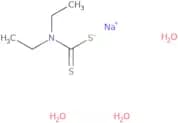
Fórmula:KHCO3Pureza:Min. 99.0%Cor e Forma:White Clear LiquidPeso molecular:100.12 g/molDiethyldithiocarbamic acid sodium trihydrate
CAS:Diethyldithiocarbamic acid sodium salt trihydrate (DDC) is an inhibitor of the response element that belongs to a class of pharmacological agents called diethyldithiocarbamates. DDC inhibits the growth of tumor cells by blocking enzyme activities and decreasing the production of GSH-Px enzymes, which are required for cellular protection against oxidative stress. DDC is also a potent inducer of experimental models for myocardial infarcts. The matrix effect is another mechanism by which DDC exerts its antitumor activity. This effect is due to its ability to inhibit protein synthesis in tumor cells and its ability to inhibit the synthesis of collagen in endothelial cells, thereby preventing angiogenesis.Fórmula:C5H11NS2•Na•(H2O)3Pureza:Min. 95%Cor e Forma:PowderPeso molecular:226.32 g/molEthylenediaminetetraacetic acid tripotassium salt dihydrate
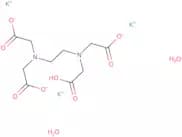
CAS:Ethylenediaminetetraacetic acid tripotassium salt dihydrate is an anticoagulant that can be used as a coagulant for blood samples. It is often used in polymerase chain reactions to synthesize DNA, or to isolate and purify genomic DNA. This compound has ferroelectric properties and can be used as a target cell in optical imaging applications. Ethylenediaminetetraacetic acid tripotassium salt dihydrate is also used in the production of polyurethanes and as a polymerization inhibitor in cinnamon oil.Fórmula:C10H13K3N2O8·2H2OPureza:Min. 95%Peso molecular:442.54 g/molH-Cys(SO3H)-OH sodium salt
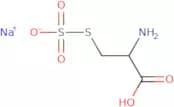
CAS:Please enquire for more information about H-Cys(SO3H)-OH sodium salt including the price, delivery time and more detailed product information at the technical inquiry form on this page
Fórmula:C3H7NO5S2·xNaPureza:Min. 98 Area-%Cor e Forma:White PowderPeso molecular:201.22 g/molZinc lactate
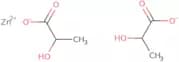
CAS:Zinc lactate is an ionic salt that contains zinc and lactate ions. It is a particle that can be used as an oral supplement to treat zinc deficiency. Zinc lactate is soluble in water, which makes it easy to take orally. The other benefits of this supplement include its ability to reduce the risk of dental cavities and promote wound healing. In addition, zinc lactate has been shown to have antibacterial properties against throat infections and cavity-causing bacteria such as Streptococcus mutans. This product is also beneficial for brain cells due to its ability to remove polyphosphates from neurons, which are toxic substances that accumulate when brain cells are injured or diseased.Fórmula:C6H10O6ZnPureza:Min. 95%Cor e Forma:White PowderPeso molecular:243.52 g/molPotassium ferrocyanide trihydrate
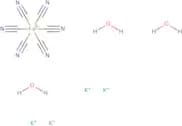
CAS:Potassium ferrocyanide trihydrate is a stable compound that has high resistance to corrosion by acids and bases. It is an inorganic compound that belongs to the class of ferroelectric materials. The crystal structure of potassium ferrocyanide trihydrate is a metastable phase with a very high thermal expansion coefficient. This compound can be synthesized by reacting ethylene diamine with hydrochloric acid and sodium carbonate, followed by adding potassium hydroxide. Potassium ferrocyanide trihydrate can also be produced from potassium malonate, which is prepared from malonic acid and potassium hydroxide in the presence of an aryl halide.Fórmula:C6FeN6•(H2O)3•K4Pureza:Min. 95%Peso molecular:422.39 g/molTianeptine sodium salt
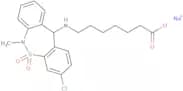
CAS:Produto ControladoFull agonist of the μ-opioid receptor (MOR) with Ki of 383 nM. It also weakly agonizes the δ-opioid receptor (DOR) with a Ki >10 μM. Tianeptine has antidepressant effects but can also regulate neuroplasticity in the amygdala and stress-induced release of glutamate. It can generate analgesia and reward, typical opiate-like behavioural effects, but does not induce tolerance or withdrawal.
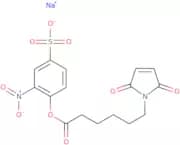
Fórmula:C21H24ClN2NaO4SPureza:Min. 98.5 Area-%Cor e Forma:White Slightly Yellow PowderPeso molecular:458.93 g/molEpsilon-Maleimidocaproic acid-(2-nitro-4-sulfo)-phenyl ester·sodium salt
CAS:Epsilon-Maleimidocaproic acid-(2-nitro-4-sulfo)-phenyl ester·sodium salt (EMAP) is a crosslinker that belongs to the group of heterobifunctional reagents. It has been used to conjugate monoclonal antibodies with other molecules, such as toxins. EMAP is activated by the dianion generated by protonation of the nitro groups on the phenyl ring and reacts with free amines or thiols in proteins. EMAP can be used for labeling immunotoxins for diagnostic use, maximizing detection sensitivity, and crosslinking DNA molecules for use in molecular cloning experiments.Fórmula:C16H15N2NaO9SPureza:Min. 95%Peso molecular:434.35 g/molSodium ferriceddha
CAS:Sodium ferriceddha is a chemical compound that belongs to the family of ferrocenes. It has been used in research as a useful building block and reagent, as well as in the synthesis of various compounds. Sodium ferriceddha is a versatile building block that can be used in the synthesis of complex compounds, such as pharmaceuticals, agricultural chemicals, and other specialty chemicals. It can also be used as an intermediate or scaffold for drug discovery.
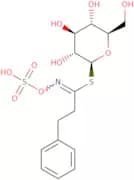
Fórmula:C18H16FeN2NaO6Cor e Forma:PowderPeso molecular:435.16 g/molPhenethyl glucosinolate potassium salt
CAS:Phenethyl glucosinolate potassium salt is a compound found in plants belonging to the Brassicaceae family. It has been shown to be highly toxic to larvae of the cabbage butterfly and other insects that feed on brassica plants. Phenethyl glucosinolate potassium salt has been shown to inhibit the development of these insects, probably by inhibiting protein synthesis in the insect's gut. The major sulfur-containing compound in this product is gluconasturtiin, which has been shown to inhibit growth of pekinensis at high temperatures. This compound also inhibits radiation-induced DNA damage and does not show significant effects on nonsignificant organisms such as yeast and mold.Fórmula:C15H20NO9S2KPureza:Min. 95%Cor e Forma:PowderPeso molecular:461.55 g/mol[4,4'-Di-t-butyl-2,2'-bipyridine][bis[5-(t-butyl)-2-[4-(t-butyl)-2-pyridinyl-kN]phenyl-kC]iridium(III) hexafluorophosphate
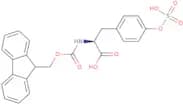
CAS:Please enquire for more information about [4,4'-Di-t-butyl-2,2'-bipyridine][bis[5-(t-butyl)-2-[4-(t-butyl)-2-pyridinyl-kN]phenyl-kC]iridium(III) hexafluorophosphate including the price, delivery time and more detailed product information at the technical inquiry form on this pageFórmula:C56H72F6IrN4PPureza:Min. 95%Peso molecular:1,138.38 g/molFmoc-Tyr(SO3H)-OH barium salt
CAS:Please enquire for more information about Fmoc-Tyr(SO3H)-OH barium salt including the price, delivery time and more detailed product information at the technical inquiry form on this pageFórmula:C24H21NO8SPureza:Min. 95%Peso molecular:483.49 g/molBis(N-butylcyclopentadienyl)zirconiumdichloride
CAS:Please enquire for more information about Bis(N-butylcyclopentadienyl)zirconiumdichloride including the price, delivery time and more detailed product information at the technical inquiry form on this pageFórmula:C18H26Cl2ZrPureza:Min. 95%Peso molecular:404.53 g/molPamoic acid disodium salt monohydrate
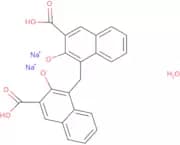
CAS:Pamoic acid is a disodium salt of p-aminobenzoic acid. It is an excipient that is considered safe for use in food and pharmaceuticals. Pamoic acid has been used as a preservative and an antioxidant. It prevents the oxidation of fats, oils, and other lipids by reacting with them to form stable compounds. The most common use of pamoic acid is as an anti-spasmodic drug to manage colitis, although it also has been used to treat seizures and spasticity in people with nervous system diseases. Pamoic acid can be used in combination with benzalkonium chloride as a preservative for injectable drugs such as antibiotics or chemotherapy agents. When combined with benzalkonium chloride, pamoic acid acts as a sweetener and particle size modifier.Fórmula:C23H14O6·2Na·H2OPureza:Min. 95%Cor e Forma:SolidPeso molecular:450.35 g/molCalcium silicate
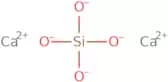
CAS:Calcium silicate is a crystalline compound of calcium and silicon with the chemical formula CaSiO3. It is chemically stable and has a high resistance to particle wear. Calcium silicate is used in the production of dental cements, adhesives, sealants, and other dental restorations. In addition, it is used in the manufacture of paints and coatings as well as in papermaking. Calcium silicate also has biological properties that make it useful for cell culture. It can be used to support the growth of primary cells such as human osteosarcoma cells or epidermal growth factor-stimulated fibroblasts. It also has been shown to have a basic structure that can bind to basic proteins such as laminin
Fórmula:CaSiO3Pureza:Min. 95%Cor e Forma:White PowderPeso molecular:116.16Methotrexate disodium
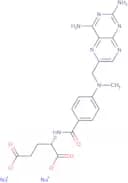
CAS:Methotrexate is a drug that suppresses the immune system by inhibiting the production of white blood cells. It is used in the treatment of a number of diseases, including some cancers and autoimmune diseases such as rheumatoid arthritis and psoriasis. Methotrexate is metabolized to its active form, methotrexate, by an enzyme called dihydrofolate reductase (DHFR). The DHFR inhibitor activity of methotrexate blocks the synthesis of folate-dependent enzymes and prevents DNA synthesis in rapidly dividing cells. Methotrexate has been used in combination with other drugs to treat cancer. Methotrexate has also been shown to have antifungal properties against opportunistic fungal infections.Fórmula:C20H20N8Na2O5Pureza:Min. 95%Cor e Forma:PowderPeso molecular:498.4 g/molN-Acetoacetylcresidine sulfonic acid sodiumsalt
CAS:Please enquire for more information about N-Acetoacetylcresidine sulfonic acid sodiumsalt including the price, delivery time and more detailed product information at the technical inquiry form on this page
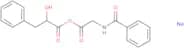
Fórmula:C12H14NNaO6SPureza:Min. 95%Peso molecular:323.3 g/molO-Hippuryl-L-b-phenyllactic acid sodium salt
CAS:Please enquire for more information about O-Hippuryl-L-b-phenyllactic acid sodium salt including the price, delivery time and more detailed product information at the technical inquiry form on this pageFórmula:C18H16NNaO5Pureza:Min. 95%Peso molecular:349.31 g/molBispyribac sodium
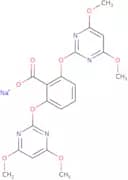
CAS:Produto ControladoBispyribac sodium is a herbicide that belongs to the triazolopyrimidine class. It inhibits plant growth by inhibiting photosynthesis. Bispyribac sodium has been shown to be effective against the following plants: Triticum aestivum, eclipta prostrata, and cationic surfactant when applied at a concentration of 0.5 kg/ha. This herbicide is not active against plants with a neutral pH, such as corn and soybeans. The herbicide does not inhibit the enzyme activities in plants with an acidic pH, such as rice and wheat.
Fórmula:C19H17N4NaO8Pureza:Min. 95%Cor e Forma:PowderPeso molecular:452.35 g/molSodium stearate
CAS:Sodium stearate is a sodium salt that is commonly used as a surfactant and emulsifying agent in the food industry. The drug interactions with sodium stearate are not well known, but it has been shown to have an effect on fetal bovine serum (FBS) cell viability at concentrations above 10%. Sodium stearate typically shows a thermal expansion of 5–6% per degree Celsius. It is also used in conjunction with CO2 flow to produce anhydrous sodium carbonate and sodium bicarbonate. Sodium stearate can be found in foods such as margarine, shortening, and baking powder. It also has metabolic effects such as promoting the production of insulin and reducing blood sugar levels. It has also been shown to inhibit tumor growth in bone cancer cell lines.Fórmula:C18H35NaO2Pureza:Min. 95%Cor e Forma:White/Off-White SolidPeso molecular:306.46 g/mol



![[4,4'-Di-t-butyl-2,2'-bipyridine][bis[5-(t-butyl)-2-[4-(t-butyl)-2-pyridinyl-kN]phenyl-kC]iridium(…](/_next/image/?url=https%3A%2Fstatic.cymitquimica.com%2Fproducts%2F3D%2Fthumb-webp%2FFD159336.webp&w=3840&q=75)