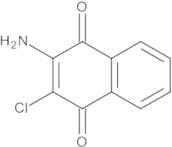
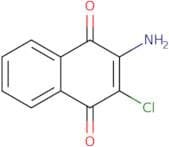
CAS 2797-51-5
:Quinoclamine
Description:
Quinoclamine, with the CAS number 2797-51-5, is a chemical compound that belongs to the class of quinoline derivatives. It is characterized by its heterocyclic structure, which includes a quinoline ring system. Quinoclamine is primarily recognized for its pharmacological properties, particularly its use as an antimalarial agent. The compound exhibits a range of biological activities, including potential antimicrobial and anti-inflammatory effects. Its mechanism of action is thought to involve interference with nucleic acid synthesis in pathogens. Quinoclamine is typically presented as a crystalline solid and is soluble in organic solvents, though its solubility in water is limited. Safety data indicate that, like many chemical substances, it should be handled with care, as it may pose health risks if ingested or inhaled. Overall, quinoclamine represents a significant compound in medicinal chemistry, with ongoing research into its therapeutic applications and mechanisms of action.
Formula:C10H6ClNO2
InChI:InChI=1S/C10H6ClNO2/c11-7-8(12)10(14)6-4-2-1-3-5(6)9(7)13/h1-4H,12H2
InChI key:InChIKey=OBLNWSCLAYSJJR-UHFFFAOYSA-N
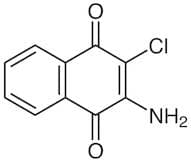
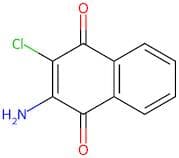
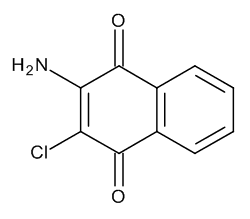
SMILES:O=C1C=2C(C(=O)C(N)=C1Cl)=CC=CC2
Synonyms:- 06K-Quinone
- 06K50W
- 1,4-Naphthalenedione, 2-amino-3-chloro-
- 1,4-Naphthoquinone, 2-Amino-3-Chloro-
- 2-Amino-3-Chloro-1,4-Naphtoquinone
- 2-Amino-3-Chloro-4-Naphthalenedione
- 2-Amino-3-Chloro-4-Naphthoquinone
- 2-Amino-3-Chloronaphthalene-1,4-Dione
- 2-Amino-3-Chloronaphthoquinone
- 2-Amino-3-chloro-1,4-dihydronaphthalene-1,4-dione
- 2-Amino-3-chloro-1,4-naphthalenedione
- 2-Chloro-3-Amino-1,4-Naphthoquinone
- 3-Chloro-2-Amino-1,4-Naphthoquinone
- Acnq
- Mogeton
- Mogeton G
- Mogeton Granule
- Mogetong
- Mogetongranule
- NSC 3910
- NSC 642009
- O 6K-Quinone
- Quinoclamin
- Quinoclamine
- Timtec-Bb Sbb008204
- See more synonyms
Sort by
Purity (%)
0
100
|
0
|
50
|
90
|
95
|
100
Found 10 products.
2-Amino-3-chloro-1,4-naphthoquinone
CAS:Formula:C10H6ClNO2Purity:>98.0%(HPLC)(N)Color and Shape:Orange to Amber to Dark red powder to crystalMolecular weight:207.61LC PestiMix 6 10 µg/mL in Acetonitrile
CAS:- 1007-28-9
- 1114-71-2
- 113036-88-7
- 113136-77-9
- 114420-56-3
- 115086-54-9
- 115852-48-7
- 116255-48-2
- 119791-41-2
- 121776-33-8
- 126535-15-7
- 130000-40-7
- 136849-15-5
- 138164-12-2
- 139528-85-1
- 147150-35-4
- 149508-90-7
- 180409-60-3
- 181274-17-9
- 1929-88-0
- 199119-58-9
- 2008-41-5
- 210631-68-8
- 211867-47-9
- 221667-31-8
- 223580-51-6
- 23576-24-1
- 239110-15-7
- 2439-10-3
- 25606-41-1
- 27314-13-2
- 27605-76-1
- 2797-51-5
- 302-27-2
- 321-54-0
- 32889-48-8
- 3337-71-1
- 335104-84-2
- 33820-53-0
- 35367-31-8
- 37019-18-4
- 372137-35-4
- 4151-50-2
- 422556-08-9
- 42609-52-9
- 4849-32-5
- 55861-78-4
- 57160-47-1
- 58011-68-0
- 6119-70-6
- 61432-55-1
- 64-10-8
- 66-81-9
- 69335-91-7
- 69806-50-4
- 74051-80-2
- 74222-97-2
- 76578-12-6
- 8065-36-9
- 81103-11-9
- 81335-77-5
- 82211-24-3
- 838-85-7
- 86811-58-7
- 88678-67-5
- 90982-32-4
- 91-22-5
- 93697-74-6
- 944-22-9
- 951659-40-8
- 96182-53-5
- 96525-23-4
- 97780-06-8
- 97886-45-8
- 99105-77-8
Color and Shape:MixtureQuinoclamine 100 µg/mL in Acetone
CAS:Controlled ProductFormula:C10H6ClNO2Color and Shape:Single SolutionMolecular weight:207.61Quinoclamine
CAS:Quinoclamine is a naphthoquinone derivative and is an NF-κB inhibitor.Formula:C10H6ClNO2Purity:99.13% - 99.28%Color and Shape:Orange PowderMolecular weight:207.612-Amino-3-chloronaphthalene-1,4-dione
CAS:Formula:C10H6ClNO2Purity:95.0%Color and Shape:SolidMolecular weight:207.612-Amino-3-chloro-1,4-naphthoquinone
CAS:Controlled ProductFormula:C10H6ClNO2Color and Shape:NeatMolecular weight:207.61Quinoclamine
CAS:Quinoclamine is a redox-active film-forming polymer that has been shown to be effective against bacterial strains such as S. aureus, E. coli and B. subtilis. Quinoclamine inhibits the growth of bacteria by targeting their respiratory electron transport chain and reducing its activity. This leads to an accumulation of reactive oxygen species (ROS) in the cells which can cause oxidative stress, leading to cell death. Quinoclamine has also been shown to have antibacterial efficacy against Hl-60 cells and prevents the formation of carbonyl groups in mitochondria, which are toxic to cells. Quinoclamine is metabolized by cytochrome P450 enzymes into quinolinic acid, which is then converted into nicotinamide adenine dinucleotide phosphate (NADP+).Formula:C10H6ClNO2Purity:Min. 95%Molecular weight:207.61 g/mol