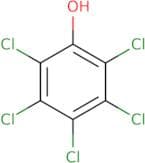
CAS 87-86-5
:Pentachlorophenol
- 1-Hydroxy-2,3,4,5,6-pentachlorobenzene
- 1-Hydroxypentachlorobenzene
- 2,3,4,5,6-Pentachlorophenol
- Chlon
- Chlorophenasic acid
- Chlorophenate
- Dowicide 7
- Dowicide EC 7
- Dura Treet II
- EP 30 (pesticide)
- Ep 30
- Fungifen
- Grundier Arbezol
- Lauxtol
- Liroprem
- Nsc 263497
- PCP
- PCP (pesticide)
- PKhF
- Penchlorol
- Penta
- Pentachlorophenol
- Pentachlorophenol (PCP)
- Pentachlorphenol
- Pentaclorofenol
- Penton 70
- Pentor 70
- Perchlorophenol
- Permasan
- Phenol, 2,3,4,5,6-pentachloro-
- Pol Nu
- Pole topper
- Pole topper fluid
- Preventol P
- Santophen 20
- Satophen
- Witophen P
- Woodtreat A
- Pentachlorophenol tech
- Phenol, pentachloro-
- PENTA(R)
- SANTOPHEN 20(R)
- angelmist
- Acutox
- angelhair
- PCP(R)
- SONTOX(R)
- CHLOROPHEN(R)
- DOWICIDE 7(R)
- PENTA(TM)
- BIOCEL
- angeldust
- 1-(1-phenylcyclohexyl)-piperidin
- See more synonyms
EPA Method 8270 Calibration Mixture 500-1000 µg/mL in Dichloromethane
CAS:Controlled Product- 100-01-6
- 100-02-7
- 100-25-4
- 100-51-6
- 101-55-3
- 103-23-1
- 103-33-3
- 105-67-9
- 106-44-5
- 106-46-7
- 106-47-8
- 108-39-4
- 108-60-1
- 108-95-2
- 110-86-1
- 111-44-4
- 111-91-1
- 117-81-7
- 117-84-0
- 118-74-1
- 120-12-7
- 120-82-1
- 120-83-2
- 121-14-2
- 122-39-4
- 129-00-0
- 131-11-3
- 132-64-9
- 191-24-2
- 193-39-5
- 205-99-2
- 206-44-0
- 207-08-9
- 208-96-8
- 218-01-9
- 50-32-8
- 51-28-5
- 528-29-0
- 53-70-3
- 534-52-1
- 541-73-1
- 56-55-3
- 58-90-2
- 59-50-7
- 606-20-2
- 62-53-3
- 62-75-9
- 621-64-7
- 67-72-1
- 7005-72-3
- 77-47-4
- 78-59-1
- 83-32-9
- 84-66-2
- 84-74-2
- 85-01-8
- 85-68-7
- 86-73-7
- 86-74-8
- 87-68-3
- 87-86-5
- 88-06-2
- 88-74-4
- 88-75-5
- 90-12-0
- 91-20-3
- 91-57-6
- 91-58-7
- 935-95-5
- 95-48-7
- 95-50-1
- 95-57-8
- 95-95-4
- 98-95-3
- 99-09-2
- 99-65-0
Formula:C6H3Cl3Color and Shape:MixtureMolecular weight:181.45Pentachlorophenol
CAS:Controlled ProductPentachlorophenol is a chlorinated phenolic compound that is used as an industrial chemical and in wastewater treatment. It is toxic to humans, causing reproductive and developmental effects, neurotoxicity, and damage to the liver and kidneys. Pentachlorophenol has been shown to inhibit the polymerase chain reaction (PCR) in human cells by interacting with DNA gyrase. Pentachlorophenol also inhibits mitochondrial membrane potential, which leads to apoptosis. The toxicity of pentachlorophenol varies with its concentration in the body: at low levels it causes genotoxic activity; at higher levels it causes acute effects such as liver cell necrosis, kidney injury, and death. Pentachlorophenol's genotoxic effects have been shown using wild-type strains of Escherichia coli and Saccharomyces cerevisiae.
Formula:C6HCl5OPurity:Min. 95%Color and Shape:PowderMolecular weight:266.34 g/molRef: 3D-FP26797
Discontinued product