Polycyclic Compounds
Subcategories of "Polycyclic Compounds"
- Acridines(98 products)
- Anthraquinones(533 products)
- Anthraquinonesulfonic Acids(16 products)
- Azobenzenes(270 products)
- Azonaphthalenes(98 products)
- Azoxybenzenes(12 products)
- Azulenes(11 products)
- Benzimidazoles(1,476 products)
- Benzodioxanes(27 products)
- Benzofurans(928 products)
- Benzothiophenes(701 products)
- Benzotriazoles(438 products)
- Binaphthyls(133 products)
- Carbazoles(464 products)
- Chromanes, Chromenes(480 products)
- Coumarins(1,125 products)
- Cyclophanes(11 products)
- Fluorenes and Fluorenones(384 products)
- Imidazopyridines(10 products)
- Indans(118 products)
- Indazoles(2,038 products)
- Indenes(22 products)
- Indoles(3,986 products)
- Indolines(119 products)
- Isatins(234 products)
- Isobenzofurans(17 products)
- N-Substituted Phthalimides(153 products)
- Naphthalenes(2,438 products)
- Naphthyridines(17 products)
- Naphtoquinone(2 products)
- Perylenes(36 products)
- Phenazines(25 products)
- Phthalazines(33 products)
- Phthalimide(153 products)
- Polycyclic Aromatic Hydrocarbons (PAHs)(284 products)
- Polyphenol(270 products)
- Pteridines(52 products)
- Pyrenes(87 products)
- Quinuclidine(1 products)
- Tetracenes(7 products)
Found 4575 products of "Polycyclic Compounds"
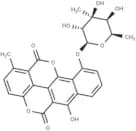
Elsamicin B
CAS:Elsamicin B is an antitumor antibiotic belonging to the Chartreusin group.Formula:C26H22O10Color and Shape:SolidMolecular weight:494.447Methyl 6-nitropyrido[1,2-a]benzimidazole-8-carboxylate
CAS:Please enquire for more information about Methyl 6-nitropyrido[1,2-a]benzimidazole-8-carboxylate including the price, delivery time and more detailed product information at the technical inquiry form on this pageFormula:C13H9N3O4Purity:Min. 95%Molecular weight:271.23 g/mol(+)(1S,2S,4R)-Bicyclo[2.2.1]heptane-2-amine
CAS:(+)(1S,2S,4R)-Bicyclo[2.2.1]heptane-2-amine is a heterocyclic compound that contains a nitrogen atom and an amine group. It has been shown to be a potent inhibitor of the enzyme activities of malonic acid decarboxylase and acetylcholinesterase. This compound can be used as a diagnostic tool for chronic kidney disease, specifically in cases of renal failure and polycystic kidney disease. The palladium complexes can be used for the synthesis of (+)(1S,2S,4R)-bicyclo[2.2.1]heptane-2-amine in high yield from malonic acid and ammonia.
Formula:C7H13NPurity:Min. 95%Molecular weight:111.18 g/mol2-Hydroxyamino-3-methyl-3H-imidazo[4,5-f]quinoline
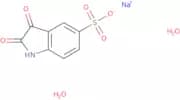
CAS:2-Hydroxyamino-3-methyl-3H-imidazo[4,5-f]quinoline (2HAIQ) is a reactive compound that binds to DNA. It has been shown to be a potent inhibitor of the enzyme cytosolic protein kinase C, which plays an important role in regulating cellular metabolism. 2HAIQ also inhibits the activity of enzymes such as hydroxylases and polymerases. The binding of 2HAIQ to DNA is thought to inhibit transcription by preventing RNA polymerase from transcribing DNA. 2HAIQ may also inhibit replication by binding to the dinucleotide phosphate molecule, which is essential for DNA synthesis.Formula:C11H10N4OPurity:Min. 95%Molecular weight:214.22 g/molIsatin-5-sulfonic acid sodium salt dihydrate
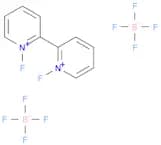
CAS:Isatin-5-sulfonic acid sodium salt dihydrate is a potent inhibitor of caspases. It has been shown to inhibit the activity of caspase-3 in vitro, thereby inhibiting apoptosis. Isatin-5-sulfonic acid sodium salt dihydrate has also been shown to increase survival rates in animal models of neurodegenerative diseases such as Parkinson's disease and Huntington's disease. Isatin-5-sulfonic acid sodium salt dihydrate may have neuroprotective effects by inhibiting the release of proinflammatory cytokines and nitric oxide, which are associated with neuronal death. This drug also inhibits monoamine oxidase A (MAO-A) and zymosterone B (ZVAD).Formula:C8H4NNaO5S·2H2OPurity:Min. 95%Color and Shape:PowderMolecular weight:285.21 g/mol2,2'-Bipyridinium, 1,1'-difluoro-, tetrafluoroborate(1-) (1:2)
CAS:Formula:C10H8B2F10N2Purity:95%Color and Shape:SolidMolecular weight:367.79001-Azabicyclo[2.2.2]octan-3-one, hydrochloride (1:1)
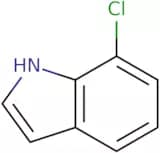
CAS:Formula:C7H12ClNOPurity:98%Color and Shape:SolidMolecular weight:161.62937-Chloroindole
CAS:7-Chloroindole is a potent compound that inhibits bacterial growth. It has been shown to inhibit the growth of tumour cell lines at submicromolar concentrations, with an IC50 of 0.5 µM. 7-Chloroindole also strongly inhibits the growth of Staphylococcus aureus, with an IC50 of 0.1 µM. This compound does not cause cell death by caspase-independent pathways, but rather induces a dry weight increase and surface methodology changes in cells treated with this compound. 7-Chloroindole belongs to the class of compounds known as carotenoids and has been shown to have a neutral pH optimum. It is formed through an enzymatic reaction involving two molecules of malonyl-CoA and one molecule each of acetate and chlorophyllide a.
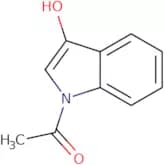
Formula:C8H6ClNColor and Shape:PowderMolecular weight:151.59 g/molN-Acetyl-3-hydroxyindole
CAS:N-Acetyl-3-hydroxyindole is a colorless liquid that inhibits the activity of enzymes such as butyric acid, active methylene, and acyl halides. It is also used to inhibit the enzyme eosinophil peroxidase in clinical tests. N-Acetyl-3-hydroxyindole has been shown to be an efficient method for high-throughput analysis of enzymatic reactions. This chemical can be immobilized on porous supports and used to measure enzyme activities. N-Acetyl-3-hydroxyindole has been shown to have therapeutic effects in clinical data with a potent inhibitor of eosinophil peroxidase.
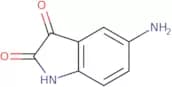
Formula:C10H9NO2Purity:Min. 95%Color and Shape:Orange PowderMolecular weight:175.18 g/mol5-Aminoisatin
CAS:5-Aminoisatin is a serotonin receptor agonist and has been shown to have protective effects against liver cancer in vitro in human liver cancer cells. It also has a number of other biological activities, including anti-inflammatory, natriuretic, and leukemia inhibitory activities. 5-Aminoisatin interacts with the mitochondrial membrane and prevents cell death by inhibiting the opening of the mitochondrial permeability transition pore (MPTP). This activity may be due to its ability to form ternary complexes with ATP and the voltage sensor domain of the mitochondrial protein voltage dependent anion channel (VDAC). 5-Aminoisatin binds to both the alpha subunit and beta subunit of the calcium/calmodulin-dependent protein kinase II (CaMKII) enzyme. The binding of 5-aminoisatin to CaMKII leads to inhibition of phosphorylation at serine residue 397, which disrupts ATP binding.
Formula:C8H6N2O2Purity:(%) Min. 85%Color and Shape:PowderMolecular weight:162.15 g/mol4-Chloroindole
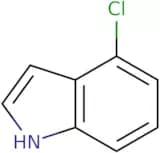
CAS:4-Chloroindole is an indole compound that is a derivative of salicylic acid. It is used in the production of ethylene and casein, as well as being a major metabolite of anthranilic acid. 4-Chloroindole is also found in environmental pollutants and has been shown to be active against plant pathogens such as Pseudomonas syringae. It has been shown to inhibit the growth of Bacillus cereus by binding to its ribosomal RNA and inhibiting protein synthesis. In addition, it inhibits the biosynthesis of methylindole, which may be due to its ability to inhibit the enzyme tryptophan synthase.
Formula:C8H6ClNPurity:Min. 98 Area-%Color and Shape:Clear LiquidMolecular weight:151.59 g/molAngelicin
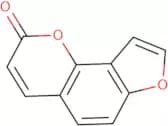
CAS:Angelicin is a furanocoumarin compound, which is derived from various plant sources, particularly within the Apiaceae family. The source of angelicin is often linked to traditional medicinal plants, where it is extracted and subsequently isolated for scientific investigation. Angelicin's mode of action involves intercalating within DNA strands, thereby affecting transcription and replication processes. This action is understood to be primarily photoactivated, leading to the formation of covalent bonds with DNA upon exposure to ultraviolet light, which can result in cross-linking.
Formula:C11H6O3Purity:Min. 95%Color and Shape:PowderMolecular weight:186.16 g/molRef: 3D-FA17920
Discontinued product5-Nitroisoquinoline
CAS:5-Nitroisoquinoline is a nitro compound that has been shown to be a potential biomarker for liver disease. 5-Nitroisoquinoline is synthesized from the reaction of hydroxylamine, sodium carbonate, and nitric acid. This chemical can also be found in human liver tissue. The titration calorimetry experiments performed on 5-nitroisoquinoline showed that the compound has a high heat of formation (194.1 kJ/mol) and low enthalpy of formation (-19.6 kJ/mol). Vibrational analysis revealed that there are four nitrogens in the molecule and two nitrogen atoms per molecule. X-ray crystal structures were obtained for 5-nitroisoquinoline with different solvents and hydrogen bonding was observed in all cases. Molecular modeling showed that there are five nitro groups, which would explain the name "5-nitro." The five nitrogen atoms coordinate to form a trigonal bip
Formula:C9H6N2O2Purity:Min. 95%Color and Shape:PowderMolecular weight:174.16 g/molRef: 3D-FN26314
Discontinued product4,6-Dimethoxyindole
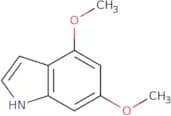
CAS:4,6-Dimethoxyindole is a molecule that can be used as an amide or chloride. The molecular modeling study indicated that the 4,6-dimethoxyindole is hydrophobic and has a molecular weight of 164.4 g/mol. In the acetylation reaction, the 4,6-dimethoxyindole was synthesized with an acetyl group on one side of the molecule and an acetate group on the other side of the molecule. This molecule has shown to have anticholinesterase activity in vitro and can be used as an antibiotic. The synthesis of this molecule was confirmed by X-ray diffraction analysis, which showed that it had a crystal structure with two molecules in space group P2(1)2(1).
Formula:C10H11NO2Purity:Min. 95%Molecular weight:177.2 g/mol(S)-(-)-3-Aminoquinuclidine 2HCl
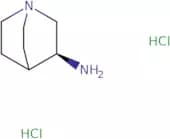
CAS:(S)-(-)-3-Aminoquinuclidine 2HCl is a cholinergic agonist that has been shown to be effective in inducing the release of acetylcholine from brain synaptosomes. This drug binds to the nicotinic acetylcholine receptor (nAChR) and inhibits the action of the enzyme acetylcholinesterase, thereby increasing the concentration of acetylcholine in the synaptic cleft. The drug is also able to cross the blood-brain barrier and bind to receptors on neurons. It has been shown that this drug can be used as an imaging agent for molecular magnetic resonance tomography (MRT), with high sensitivity and specificity.
Formula:C7H16Cl2N2Purity:Min. 95%Color and Shape:White PowderMolecular weight:199.12 g/molRef: 3D-FA03745
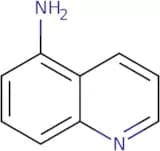
Discontinued product5-Aminoquinoline
CAS:5-Aminoquinoline (5-AQ) is a chemical compound that was originally synthesized in the 1930s. 5-AQ is a trifluoroacetic acid derivative of quinoline, which has been used as a photographic developer and an agent for the removal of silver from photographic film. This molecule also has a fluorescence property, which can be seen when irradiated by light with a wavelength greater than 350 nm. A hydrogen bond exists between the hydroxyl group and the nitrogen atom of the amine group in 5-AQ. The reaction mechanism for 5-AQ is believed to involve the diazonium salt intermediate, which reacts with silver ions to form silver diazonide and free ammonia.
5-AQ is insoluble in water but soluble in organic solvents such as acetone or alcohol. It reacts with trifluoroacetic acid to form a precipitate, which may be removed by filtFormula:C9H8N2Purity:Min. 95%Color and Shape:PowderMolecular weight:144.17 g/molRef: 3D-FA15583
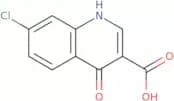
Discontinued product7-Chloro-4-hydroxyquinoline-3-carboxylic acid
CAS:7-Chloro-4-hydroxyquinoline-3-carboxylic acid is a chemical compound that has antioxidative activity and is used in the production of various organic substances. It is synthesized by reacting ammonium nitrate with a hydroxy group, an organic solvent, and phenoxy. The resulting product can be heated to form 7-chloro-4-hydroxyquinoline, which undergoes a series of reactions to produce 7-chloro-4-(2,2,2,-trichloroethoxy)quinoline. This reaction system produces a quinoline derivative that has been shown to be expressed at high levels in phosphatidylcholine (PC) and alpha-tocopherol (a vitamin E derivative). The final product is then purified by triethyl orthoformate (TEO), which removes the sulfoxide group.
Formula:C10H6ClNO3Purity:Min. 95%Color and Shape:PowderMolecular weight:223.61 g/molRef: 3D-FC44132
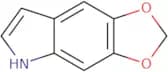
Discontinued product5,6-Methylenedioxyindole
CAS:5,6-Methylenedioxyindole (MDI) is a compound that is often used in the synthesis of other bioactive molecules. It has been shown to bind to the pyridinium moiety of receptor sites and form a stable complex, which can then be displaced by an agonist or antagonist. The binding experiments were performed using radioactive MDI and zoxazolamine as the ligand. Radiolabelled MDI was synthesized from 5-methyl-2-pyridinone with the use of a linker, methylenetriphenylphosphorane (MTPP). The molecular electrostatic potentials of the two compounds were calculated in order to investigate the possible binding interactions between them. Ellipticines are also synthesised using MDI as a precursor molecule, which is alkylated with dimethyl sulfate and then reacted with phenylhydrazine. This reaction produces a mixture containing both ellipticines and
Formula:C9H7NO2Purity:Min. 95%Molecular weight:161.16 g/molRef: 3D-FM137841
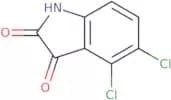
Discontinued product4,5-Dichloroisatin
CAS:4,5-Dichloroisatin is a versatile building block that can be used as a reagent for research and as a speciality chemical. It is also useful in the synthesis of complex compounds. 4,5-Dichloroisatin is a high quality compound with a CAS number of 1677-47-0. This compound is not intended for use in humans or animals.
Formula:C8H3Cl2NO2Purity:Min. 95%Color and Shape:Yellow PowderMolecular weight:216.02 g/molRef: 3D-FD70415
Discontinued product

![Methyl 6-nitropyrido[1,2-a]benzimidazole-8-carboxylate](/_next/image/?url=https%3A%2Fstatic.cymitquimica.com%2Fproducts%2F3D%2Fthumb-webp%2FFM132139.webp&w=3840&q=75)

![(+)(1S,2S,4R)-Bicyclo[2.2.1]heptane-2-amine](/_next/image/?url=https%3A%2Fstatic.cymitquimica.com%2Fproducts%2F3D%2Fthumb-webp%2FFB163197.webp&w=3840&q=75)
![2-Hydroxyamino-3-methyl-3H-imidazo[4,5-f]quinoline](/_next/image/?url=https%3A%2Fstatic.cymitquimica.com%2Fproducts%2F3D%2Fthumb-webp%2FFH24305.webp&w=3840&q=75)

![1-Azabicyclo[2.2.2]octan-3-one, hydrochloride (1:1)](/_next/image/?url=https%3A%2Fstatic.cymitquimica.com%2Fproducts%2FIN%2Fthumb-webp%2FDA000IK0.webp&w=3840&q=75)