Pharmaceutical Standards
Pharmaceutical standards are a comprehensive set of reference materials essential for ensuring the safety, efficacy, and quality of pharmaceutical products. This category includes standards for active pharmaceutical ingredients (APIs), which are the core components responsible for therapeutic effects. Additionally, it covers compounds and metabolites relevant to both the pharmaceutical and veterinary industries, providing benchmarks for the accurate measurement and analysis of these substances. Nitrosamine control standards are crucial for detecting and mitigating potentially harmful nitrosamines in drug formulations. Toxicology standards help assess the safety and potential adverse effects of pharmaceutical compounds. Furthermore, enzyme activators and inhibitors standards are vital for research and development, enabling precise studies of biochemical pathways and drug mechanisms. These pharmaceutical standards are indispensable tools for regulatory compliance, quality control, and research, ensuring that pharmaceutical products meet stringent safety and effectiveness criteria.
Subcategories of "Pharmaceutical Standards"
- APIs for research and impurities(273,720 products)
- Enzyme Activators and Inhibitors(2,827 products)
- Nitrosamines(2,605 products)
- Pharmaceutical and Veterinary Compounds and Metabolites(2,602 products)
- Toxicology(13,652 products)
Found 7836 products of "Pharmaceutical Standards"
Sort by
Purity (%)
0
100
|
0
|
50
|
90
|
95
|
100
2,2'-Diamino-4,4'-bithiazole
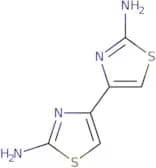
CAS:<p>2,2'-Diamino-4,4'-bithiazole (DABT) is a ligand that forms supramolecular aggregates with a variety of metal ions. It has been shown to bind to serum albumin and form an interaction that depends on the coordination geometry of the metal ion. DABT has been shown to be a fluorescent molecule with tryptophan fluorescence. The fluorescence emission spectrum of DABT is sensitive to chloride concentrations in the environment. The chemical structure and solubility properties of DABT are similar to those of chlorides; thus, it can be used as an oxidant at low pH levels.</p>Formula:C6H6N4S2Purity:Min. 95%Color and Shape:PowderMolecular weight:198.27 g/mol3'-Fluoro-4'-hydroxyacetophenone
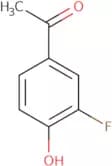
CAS:<p>3'-Fluoro-4'-hydroxyacetophenone is a fluorinated acetophenone that is synthesized by catalytic hydrogenation of 3,4-difluoroacetophenone. This reaction produces the desired product in high yield. The product can be used in the synthesis of various pharmaceuticals, such as analgesics, antihistamines and antidiabetic agents. 3'-Fluoro-4'-hydroxyacetophenone has been shown to have higher yields and better solubility than its counterparts. It also has a high boiling point, making it suitable for industrial use.</p>Formula:C8H7FO2Purity:Min. 95%Color and Shape:PowderMolecular weight:154.14 g/mol(S)-3-Amino-4-(1-naphthyl)butanoic acid hydrochloride
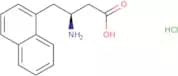
CAS:<p>(S)-3-Amino-4-(1-naphthyl)butanoic acid hydrochloride is a high quality chemical that is used as a reaction component for the synthesis of complex organic compounds. It may also be used to produce fine chemicals, pharmaceuticals, and other useful compounds. This product has a wide variety of uses including as an intermediate in the production of speciality chemicals, as a building block for synthesizing more complex compounds, or as a precursor to producing other useful chemicals.</p>Formula:C14H16ClNO2Purity:Min. 95%Color and Shape:White PowderMolecular weight:265.74 g/molL-Aspartic acid dibenzyl ester p-toluenesulfonate salt
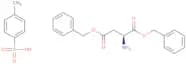
CAS:<p>Aspartic acid derivative</p>Formula:C18H19NO4·C7H8O3SPurity:Min. 95%Color and Shape:White PowderMolecular weight:485.55 g/molL-Threonine tert-butyl ester hydrochloride
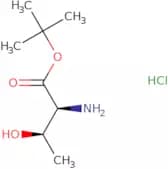
CAS:<p>L-Threonine tert-butyl ester hydrochloride is a fine chemical that is used as a building block for complex compounds. It is also a reagent and speciality chemical with many uses in research, including the synthesis of pharmaceuticals. L-Threonine tert-butyl ester hydrochloride can be used as an intermediate in the synthesis of high quality pharmaceuticals, such as antibiotics and antifungals. This product is also useful as a scaffold for new drug development.</p>Formula:C8H17NO3·HClPurity:Min. 95%Color and Shape:White PowderMolecular weight:211.69 g/mol4'-Methyl-2,2'-bipyridine-4-carboxaldehyde
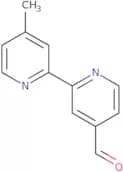
CAS:<p>4'-Methyl-2,2'-bipyridine-4-carboxaldehyde is a heterocyclic compound that contains a nitro group. It has the chemical formula C8H6N2O and the molecular weight of 122.15 g/mol. This compound belongs to the class of formyl compounds and it is composed of two formyl groups and one hydrogen atom. The bipyridines are linked by a methylene bridge to form a six-membered ring. The compound can be used as an intermediate for the synthesis of other organic compounds such as pharmaceuticals, dyes, water repellents, pesticides, and herbicides.</p>Formula:C12H10N2OPurity:Min. 95%Color and Shape:PowderMolecular weight:198.22 g/mol2-Naphthyl-3-(2-iodophenyl)propanone
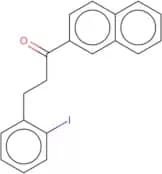
CAS:<p>2-Naphthyl-3-(2-iodophenyl)propanone (IPA) is a chemical intermediate that can be used in the synthesis of pharmaceuticals, agrochemicals, and other organic chemicals. IPA is soluble in common solvents such as water, ethanol, ether, and acetone. It is also stable to air and light. IPA has been shown to react with aniline under basic conditions to form 2-naphthylacetanilide. This reaction component can be used in the synthesis of complex compounds such as carboxylic acid derivatives and amides.</p>Formula:C19H15IOPurity:Min. 95%Molecular weight:386.23 g/mol5-(5'-Chloro-2'-hydroxy-4'-methylphenyl)-isoxazole
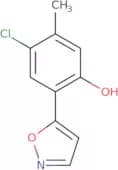
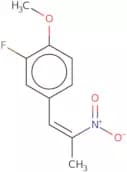
CAS:<p>5-(5'-Chloro-2'-hydroxy-4'-methylphenyl)-isoxazole is a fine chemical that is an intermediate in the synthesis of other chemicals. It has been used as a reaction component, complex compound and research chemical. 5-(5'-Chloro-2'-hydroxy-4'-methylphenyl)-isoxazole is a versatile building block that can be used to synthesize many different chemicals, including pharmaceuticals, dyes, agrochemicals and pesticides. This compound has been shown to be useful as a reagent in the synthesis of high quality products.</p>Formula:C10H8ClNO2Purity:Min. 95%Color and Shape:PowderMolecular weight:209.63 g/mol1-(3-Fluoro-4-methoxyphenyl)-2-nitropropene
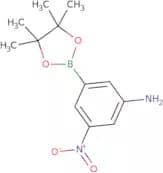
CAS:<p>1-(3-Fluoro-4-methoxyphenyl)-2-nitropropene is a chemical compound with the molecular formula CHNO. It is a high quality reagent that is useful for preparing complex compounds, scaffolds and building blocks for use in research and development. 1-(3-Fluoro-4-methoxyphenyl)-2-nitropropene is a fine chemical that can be used as a versatile building block in reactions.</p>Formula:C10H10FNO3Purity:Min. 95%Molecular weight:211.19 g/mol3-Amino-5-nitrophenylboronic acid pinacol ester
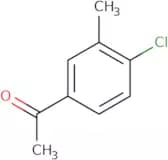
CAS:<p>3-Amino-5-nitrophenylboronic acid pinacol ester is a versatile building block that can be used in the synthesis of complex compounds. This compound has been shown to have useful properties in research chemicals and as reagents or speciality chemicals. Useful intermediates are usually synthesized from 3-Amino-5-nitrophenylboronic acid pinacol ester, which is also a useful scaffold for the synthesis of other compounds.</p>Formula:C12H17BN2O4Purity:Min. 95%Color and Shape:Yellow PowderMolecular weight:264.09 g/mol4'-Chloro-3'-methylacetophenone, 95%
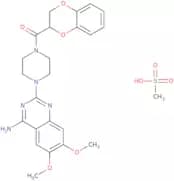
CAS:<p>4'-Chloro-3'-methylacetophenone, 95% is a white crystalline solid that is soluble in alcohols and ethers. It has been used as a reagent for the synthesis of acetophenones. The compound exhibits moderate solubility in water and reacts with aqueous alkalis to form salts. 4'-Chloro-3'-methylacetophenone, 95% also reacts with strong oxidizing agents to form peroxides and with acid chlorides to form esters.</p>Formula:C9H9ClOPurity:Min. 95%Molecular weight:168.62 g/molDoxazosin mesylate
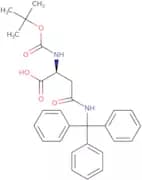
CAS:<p>α1-adrenoceptor blocker; anti-hypertensive agent</p>Formula:C24H29N5O8SPurity:Min. 95%Color and Shape:PowderMolecular weight:547.58 g/molN-a-t-Boc-N-g-trityl-L-asparagine
CAS:<p>N-a-t-Boc-N-g-trityl-L-asparagine is a recombinant human protein that has been synthesized in E. coli. It is a peptide with 17β-estradiol at its C terminus, and it binds to the oestrogen receptor α (ERα) via hydrogen bonding interactions. The linker between the asparagine and estradiol is a Boc group that can be removed by protease activity, revealing the active form of 17β-estradiol. ERα ligates to N-a-t-Boc-N-g-trityl L asparagine with high affinity, and this interaction is reversible. The linker also contains a functional group for surface attachment, which may be used to attach this peptide to a solid support or tissue culture substrate for use in cell cultures.<br>br></p>Formula:C28H30N2O5Purity:Min. 95%Color and Shape:White PowderMolecular weight:474.55 g/mol1,5-Naphthalenediol
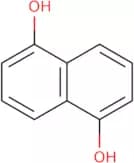
CAS:<p>1,5-Naphthalenediol is a metabolite of naphthalene and has been found to be an electrochemical marker for the detection of naphthalene. It is considered a chemical indicator for naphthalene exposure, as it can be detected in urine and blood samples. 1,5-Naphthalenediol is a heterocyclic organic compound that has been shown to have potential medical uses. It has been shown to function as an anti-inflammatory agent by inhibiting prostaglandin synthesis and can also inhibit the growth of keratinocytes. The detection time for 1,5-naphthalenediol is about 2 hours after exposure.</p>Formula:C10H8O2Purity:Min. 95%Molecular weight:160.17 g/molDiphenyliodanium 9,10-dimethoxyanthracene-2-sulfonate
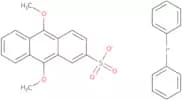
CAS:<p>Diphenyliodanium 9,10-dimethoxyanthracene-2-sulfonate is an organic compound that belongs to the class of vinyl ethers. It can be used as a photosensitive material in photolithography. The mechanism of the photoinduced crosslinking reaction has been studied by mechanistic study and shown to proceed through a Friedel-Crafts type reaction followed by a transfer mechanism. This compound can also be prepared by irradiating an ammonium formate solution with ultraviolet light. Diphenyliodanium 9,10-dimethoxyanthracene-2-sulfonate is soluble in hydroxide solution and reacts with uv irradiation to produce radicals at the carbonyl group.</p>Formula:C28H23IO5SPurity:Min. 95%Molecular weight:598.45 g/molN-α-Fmoc-Nε-7-methoxycoumarin-4-acetyl-L-lysine
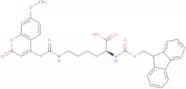
CAS:<p>N-alpha-Fmoc-Nepsilon-7-methoxycoumarin-4-acetyl-L-lysine is a fluorogenic molecule that is synthesized by the solid phase method. It is an analog of lysine, which is a bioactive amino acid. This compound binds to copper and exhibits fluorescence emission at 585 nm when excited at 488 nm. N-alpha-Fmoc-Nepsilon-7-methoxycoumarin-4-acetyl-L-lysine can be used as a substrate for bone growth in vitro and in vivo. It can also be used as a labeling reagent for bone tissue, such as bone sections or cells. It has been shown to produce osteogenic activity in vitro and in vivo.</p>Formula:C33H32N2O8Purity:Min. 97 Area-%Color and Shape:PowderMolecular weight:584.62 g/mol1-(Chloromethyl)-4-fluoronaphthalene
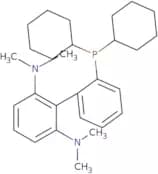
CAS:<p>1-(Chloromethyl)-4-fluoronaphthalene is a halogenated, organic compound with two different forms, a trans and cis form. The trans form is the more stable, inactive form. The cis form is more reactive and can be converted to the trans form by heating or light. It has been studied for use in polymer synthesis and as an insecticide. 1-(Chloromethyl)-4-fluoronaphthalene has not been observed in the gas phase because it does not have any dipole moments in this state. However, it does show infrared and vibrational spectra that are explainable when it is in the gaseous phase. 1-(Chloromethyl)-4-fluoronaphthalene also emits Raman spectra when it is heated or exposed to light. These spectra help to characterize the molecule quantitatively by observing its transitions at different frequencies.</p>Formula:C11H8ClFPurity:Min. 95%Color and Shape:White To Beige SolidMolecular weight:194.63 g/mol2-Dicyclohexylphosphino-2',6'-bis(N,N-dimethylamino)biphenyl
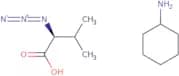
CAS:<p>2-Dicyclohexylphosphino-2',6'-bis(N,N-dimethylamino)biphenyl (PCP-DMAP) is a phosphorus compound that is used for the synthesis of aryl chlorides. It has been validated as an effective reagent for the conversion of aryl chlorides to aryl halides. PCP-DMAP can be used in peptidomimetic synthesis and profiling. It is also useful in the synthesis of natural products where activation with N,N-dimethylchloramine (DMC) is required. PCP-DMAP can be used as an efficient alternative to other methods for activation with DMC, using less time and producing less waste. This compound has been shown to be stable against hydrolysis and oxidation in both acidic and basic media, making it a good reagent for use under these conditions. PCP-DMAP can also be used in the synthesis</p>Formula:C28H41N2PPurity:Min. 95%Color and Shape:PowderMolecular weight:436.61 g/mol(S)-2-Azido isovaleric acid cyclohexylammonium
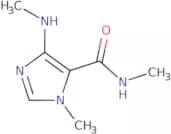
CAS:<p>Please enquire for more information about (S)-2-Azido isovaleric acid cyclohexylammonium including the price, delivery time and more detailed product information at the technical inquiry form on this page</p>Formula:C6H13N•C5H9N3O2Purity:Min. 95%Color and Shape:PowderMolecular weight:242.32 g/molCaffeidine
CAS:<p>Caffeine is a stimulant that is found in coffee, tea, and some soft drinks. It can also be used to treat certain medical conditions. Caffeine is a reactive molecule that binds to human serum proteins and has been shown to have chronic oral toxicity in rats. The methylation of caffeine leads to the formation of 1-methylxanthine, which has been shown to cause cancer in animal models when given chronically. Caffeine's carcinogenic effects are due to its ability to induce DNA mutations by reacting with oxygen radicals and oxidizing DNA bases as well as inhibiting DNA repair enzymes. Caffeine's chemical diversity makes it difficult for researchers to study its carcinogenicity.</p>Formula:C7H12N4OPurity:Min. 95%Color and Shape:White PowderMolecular weight:168.2 g/mol