Antimicrobials
Antimicrobials are agents that destroy or inhibit the growth of microorganisms, including bacteria, viruses, fungi, and parasites. These compounds are essential in the prevention and treatment of infections, playing a crucial role in medicine, agriculture, and the food industry. At CymitQuimica, we offer an extensive range of high-quality, high-purity antimicrobials suitable for various scientific and industrial applications. Our catalog includes antibiotics, antifungals, antivirals, and disinfectants, all designed to meet the needs of research and development, as well as clinical and production applications. With our products, professionals can ensure the effectiveness and safety in infection control and public health protection.
Subcategories of "Antimicrobials"
- Antibiotics(4,115 products)
- Antifungals(837 products)
- Antiparasitics(704 products)
- Antivirals(763 products)
Found 2422 products of "Antimicrobials"
Sort by
Purity (%)
0
100
|
0
|
50
|
90
|
95
|
100
Oxibendazole-amine hydrochloride
CAS:<p>Oxibendazole-amine hydrochloride is a synthetic anthelmintic compound, which is a derivative of benzimidazole, known for its broad-spectrum efficacy against various helminths. It primarily acts by disrupting the polymerization of tubulin into microtubules, effectively impairing essential cellular structures and functions within parasitic worms, leading to their death.</p>Formula:C10H13N3O•HClPurity:Min. 95%Color and Shape:PowderMolecular weight:227.69 g/molMonensin
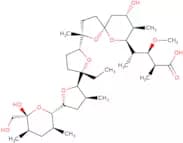
CAS:<p>Monensin is a polyether ionophore antibiotic, which is derived from the fermentation of the bacterium *Streptomyces cinnamonensis*. It operates by disrupting ion transport across biological membranes, primarily by facilitating the exchange of sodium and potassium ions. This ionophore action alters the osmotic balance in target cells, leading to their destabilization and death, particularly in Gram-positive bacteria and certain protozoa.</p>Formula:C36H62O11Purity:Min. 95%Molecular weight:670.87 g/molNikkomycin Z from streptomyces tendae
CAS:<p>Nikkomycin Z is an antifungal agent, which is a secondary metabolite isolated from the bacterium Streptomyces tendae. This compound functions as a competitive inhibitor of chitin synthase, an essential enzyme responsible for the synthesis of chitin, a vital component of the fungal cell wall. By inhibiting this enzyme, Nikkomycin Z disrupts the structural integrity of the fungal cell wall, leading to impaired growth and cell lysis in susceptible fungi.</p>Formula:C20H25N5O10Purity:Min. 95%Molecular weight:495.4 g/molHygromycin A
CAS:<p>Hygromycin A is an antimicrobial compound isolated from the bacterium *Streptomyces hygroscopicus*. It functions by inhibiting protein synthesis within microbial cells. This compound disrupts the elongation phase of translation by binding to the ribosomal subunit, therefore impeding mRNA decoding during protein assembly.</p>Formula:C23H29NO12Purity:Min. 95%Molecular weight:511.5 g/molQuinupristin
CAS:<p>Quinupristin is a semi-synthetic antibiotic, which is derived from the natural compound pristinamycin IIA produced by the bacterium Streptomyces pristinaespiralis. It operates by binding to the 50S ribosomal subunit in bacterial cells, inhibiting protein synthesis and thus exerting a bacteriostatic effect. This mechanism effectively disrupts the growth and proliferation of susceptible bacteria.</p>Formula:C53H67N9O10SPurity:Min. 95%Molecular weight:1,022.22 g/molClindamycin 3-phosphate
CAS:<p>Clindamycin 3-phosphate is an antibiotic prodrug, which is a derivative of clindamycin. It is semisynthetic with a synthetic origin, derived by chemically modifying the natural compound lincomycin obtained from the bacterium *Streptomyces lincolnensis*. The mode of action of Clindamycin 3-phosphate involves the inhibition of bacterial protein synthesis. It binds to the 50S subunit of the bacterial ribosome, thereby interfering with the translocation step in protein elongation, ultimately leading to the suppression of bacterial growth.</p>Formula:C18H34ClN2O8PSPurity:Min. 95%Color and Shape:White To Off-White SolidMolecular weight:504.96 g/molDicresulene Hydrate
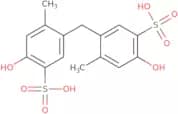
CAS:<p>Dicresulene Hydrate is an anti-inflammatory compound, which is derived from synthetic sources. It functions primarily by inhibiting specific enzymes involved in the inflammatory response. This inhibition reduces the production of pro-inflammatory mediators, thereby mitigating inflammation and associated symptoms.</p>Formula:C15H16O8S2•(H2O)xPurity:Min. 95%Color and Shape:PowderMolecular weight:388.41 g/molCyclosporin V
CAS:<p>Cyclosporin V is an immunosuppressant medication with action on calcineurin inhibition and is used for preventing organ rejection in transplants and treating autoimmune diseases.</p>Formula:C63H113N11O12Purity:Min. 95%Color and Shape:PowderMolecular weight:1,216.64 g/molAzithromycin Dihydrate
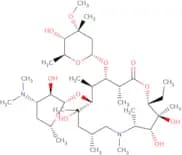
CAS:<p>Azithromycin Dihydrate is a macrolide antibiotic and is used for the treatment of various bacterial infections. It binds to the 23S rRNA of the 50S ribosomal subunit, inhibiting protein synthesis</p>Formula:C38H72N2O12·2H2OPurity:Min. 95 Area-%Color and Shape:PowderMolecular weight:785.02 g/molAripiprazole monohydrate
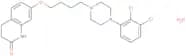
CAS:Controlled Product<p>Aripiprazole monohydrate is an atypical antipsychotic medication, which is synthesized through chemical processes involving aryl piperazine derivatives. It acts primarily as a partial agonist at dopamine D2 and serotonin 5-HT1A receptors and as an antagonist at 5-HT2A receptors, with additional activity at other neurotransmitter receptors. This unique mechanism of action sets it apart from typical antipsychotics that predominantly function as dopamine antagonists.</p>Formula:C23H29Cl2N3O3Purity:Min. 95%Color and Shape:PowderMolecular weight:466.4 g/molAmpicillin-sulbactam
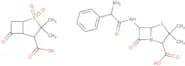
CAS:<p>Ampicillin-sulbactam is a combination antibiotic, which is a pharmaceutical product derived from the penicillin class of beta-lactam antibiotics. Its source involves semi-synthetic processes, combining ampicillin with sulbactam. The mode of action of this compound is through the inhibition of bacterial cell wall synthesis. Ampicillin specifically binds to penicillin-binding proteins, thereby disrupting the cross-linking process essential for maintaining cell wall structural integrity, leading to bacterial lysis. Sulbactam functions as a beta-lactamase inhibitor, enhancing the efficacy of ampicillin by preventing its degradation by beta-lactamase enzymes produced by certain resistant bacterial strains.</p>Formula:C25H31N3O9S2Purity:Min. 95%Molecular weight:581.7 g/molGentamicin C1 pentaacetate
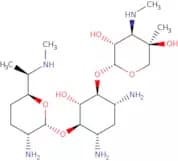
CAS:<p>Gentamicin C1 pentaacetate is an aminoglycoside antibiotic with action on bacterial protein synthesis inhibition and is used for research and analytical applications.</p>Formula:C21H43N5O7•(C2H4O2)5Purity:Min. 90%Color and Shape:Off-White PowderMolecular weight:777.86 g/molOfloxacin Q acid
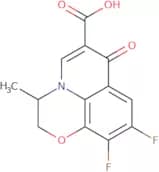
CAS:<p>Ofloxacin Q acid is a quinolone analog, which is a synthetic derivative known for its significant antibacterial properties. This compound is sourced from the chemical synthesis of fluoroquinolone derivatives, designed to enhance reactivity and efficacy in pharmaceutical applications. Ofloxacin Q acid acts by inhibiting bacterial DNA gyrase and topoisomerase IV, enzymes critical for DNA replication, transcription, and repair, thereby leading to the cessation of bacterial growth and replication.</p>Formula:C13H9F2NO4Purity:Min. 95%Molecular weight:281.21 g/molNarasin sodium
CAS:<p>Narasin sodium is an ionophore antibiotic, which is a type of compound that facilitates ion transport across biological membranes. It is derived from the fermentation of the bacterium *Streptomyces aureofaciens*. The mode of action involves the disruption of ion gradients in target organisms, specifically inhibiting the growth of certain pathogenic bacteria and protozoa by altering their cellular ionic balance.</p>Formula:C43H71NaO11Purity:Min. 95%Molecular weight:787.02 g/mol1-(6-Amino-3,5-difluoro-2-pyridinyl)-7-[3-[3-[[1-(6-amino-3,5-difluoro-2-pyridinyl)-3-carboxy-8-chloro-6-fluoro-1,4-dihydro-4-oxo-7- quinolinyl]amino]-2-hydroxypropoxy]-1-azetidinyl]-8-chloro-6-fluoro-1,4-dihydro-4-oxo-3-quinolinecarboxylic acid
CAS:<p>1-(6-Amino-3,5-difluoro-2-pyridinyl)-7-[3-[3-[[1-(6-amino-3,5-difluoro-2-pyridinyl)-3-carboxy-8-chloro-6-fluoro-1,4-dihydro-4-oxo-7-quinolinyl]amino]-2-hydroxypropoxy]-1-azetidinyl]-8-chloro-6-fluoro-1,4-dihydro-4-oxo-3-quinolinecarboxylic acid is a fluoroquinolone antibiotic, engineered through synthetic chemistry. It is derived from chemical sources involving complex organic synthesis, highlighting its intricate molecular architecture. Its mode of action is distinctive, as it inhibits bacterial DNA gyrase and topoisomerase IV, enzymes crucial for DNA replication and transcription. This interference with bacterial DNA processes results in bactericidal effects, effectively eliminating susceptible bacterial strains.</p>Formula:C36H24Cl2F6N8O8Purity:Min. 95%Molecular weight:881.52 g/molSulfadimethoxine sodium
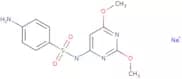
CAS:<p>Sulfadimethoxine sodium is a sulfonamide antibiotic with action on bacterial folate synthesis inhibition and is used for treating respiratory and urinary tract infections in veterinary medicine.</p>Formula:C12H13N4NaO4SPurity:Min. 95%Color and Shape:White Off-White PowderMolecular weight:332.31 g/molLactoferricin B (4-14) (bovine) trifluoroacetate salt
CAS:<p>Lactoferricin B (4-14) (bovine) trifluoroacetate salt is a peptide derivative, which is a fragment derived from bovine lactoferrin. It is obtained by enzymatic digestion of lactoferrin, a glycoprotein with a well-established role in the innate immune system. This specific peptide, Lactoferricin B (4-14), is known for its potent antimicrobial properties, attributed to its amphipathic structure that facilitates the disruption of microbial membranes. Additionally, it can modulate immune responses through interactions with immune cells, thereby influencing inflammatory processes.</p>Formula:C70H113N25O13SPurity:Min. 95%Molecular weight:1,544.87 g/molN-Acetal bromopride
CAS:<p>N-Acetal bromopride is a chemical compound that serves as a derivative of bromopride, which is a selective dopamine D2 receptor antagonist. This derivative is synthesized from bromopride, typically through organic chemical processes, and modified to possess an acetal functional group. The presence of this functional group potentially alters its pharmacokinetic or pharmacodynamic properties, although these specific changes may still be under research.</p>Formula:C16H24BrN3O3Purity:Min. 95%Molecular weight:386.28 g/molPolymyxin B1-I
CAS:<p>Polymyxin B1-I is an antimicrobial peptide, which is sourced from the bacterium *Bacillus polymyxa*. It functions by interacting with and disrupting the bacterial cell membranes. The polypeptide inserts into the phospholipid bilayer, causing increased permeability and eventual cell lysis. This mechanism is particularly effective against Gram-negative bacteria due to the structural composition of their outer membranes.</p>Formula:C56H98N16O13Molecular weight:1,203.5 g/molCeftriaxone sodium
CAS:<p>Ceftriaxone sodium is a third-generation cephalosporin antibiotic with action on bacterial cell wall synthesis and is used for treating severe bacterial infections like meningitis and pneumonia.</p>Formula:C18H18N8Na2O7S3Purity:Min. 84 Area-%Color and Shape:White Yellow PowderMolecular weight:600.56 g/mol