Nucleosides
Nucleosides are fundamental building blocks of nucleic acids, composed of a nitrogenous base attached to a sugar molecule. In this section, you can find a wide variety of nucleosides essential for research in molecular biology, biochemistry, and pharmacology. These compounds play crucial roles in the synthesis of DNA and RNA, and are also vital in various metabolic processes. Nucleosides are used in studying genetic material, developing antiviral and anticancer therapies, and understanding cellular mechanisms. At CymitQuimica, we provide high-quality nucleosides to support your research and development needs, ensuring purity and reliability for your experimental applications.
Found 3567 products of "Nucleosides"
Sort by
Purity (%)
0
100
|
0
|
50
|
90
|
95
|
100
3'-O-[(Propan-2-ylidene)amino]-thymidine 5'-triphosphate
CAS:<p>3'-O-[(Propan-2-ylidene)amino]-thymidine 5'-triphosphate is an antiviral and anticancer agent that is used for the synthesis of DNA and RNA. It is a novel nucleoside analog that has been modified to be activated by phosphoramidite chemistry. 3'-O-[(Propan-2-ylidene)amino]-thymidine 5'-triphosphate is synthesized from 2,6-diisopropylaniline, methyl 3-(aminomethyl)-1H-pyrrole-2,4-dicarboxylate, and propylamine in cyclohexane at reflux.</p>Formula:C13H22N3O14P3Purity:Min. 95%Molecular weight:537.25 g/mol3'-Amino-N6-benzoyl-2'-O-tert-butyldimethylsilyl-5'-O-DMT-3'-deoxyadenosine
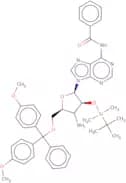
<p>3'-Amino-N6-benzoyl-2'-O-tert-butyldimethylsilyl-5'-O-DMT-3'-deoxyadenosine is a nucleoside that is synthesized by the modification of deoxyadenosine. It has antiviral and anticancer properties, as well as other novel applications. The synthesis of this compound can be achieved in two steps: first, the amino group is attached to the 3' carbon atom of the sugar ring by reacting with N6-(benzoyl)adenine. In the second step, a silyl group is attached to the 5' carbon atom of the sugar ring by reacting with tert-butyldimethylchlorosilane and DMT (dimethoxytrityl).</p>Formula:C44H50N6O6SiPurity:Min. 95%Molecular weight:786.99 g/mol2'-Deoxy-N6-DMF-5'-O-MMT-adenosine 3'-CE phosphoramidite
CAS:<p>2'-Deoxy-N6-DMF-5'-O-MMT-adenosine 3'-CE phosphoramidite is a high purity, diphosphate nucleotide analog. It is an anticancer drug that inhibits DNA synthesis and can be used to treat cancer. The 2'-deoxy-N6-DMF moiety has been shown to inhibit the activity of DNA polymerase and other enzymes involved in DNA replication. This compound also has a novel mechanism of action that is not present in any other known anticancer drugs. CAS No. 195375-66-7.br>br>2'-Deoxy-N6-DMF 5'-O-MMT adenosine 3'-cephosphoramidite is often used as a building block for oligonucleotide synthesis because it is resistant to the removal of phosphate groups by alkaline phosphatases. The lack of phosphate groups makes this compound more stable than standard nucleotides</p>Formula:C42H51N8O5PPurity:Min. 95%Molecular weight:778.9 g/molN2-Acetyl-6-[2-(4-nitrophenyl)ethoxy]-2'-O-trifluoromethanesulfonyl-3',5'-di-O-tritylguanosine
<p>N2-Acetyl-6-[2-(4-nitrophenyl)ethoxy]-2'-O-trifluoromethanesulfonyl-3',5'-di-O-tritylguanosine is a novel nucleotide that is activated by the addition of 2'-deoxyribonucleosides and has antiviral activity. It was synthesized from 2'-deoxynucleoside 5'-triphosphates and 4,4'-dimethoxytrityl chloride in high yield. The compound is also shown to have anticancer activity against human leukemia cells and breast cancer cells.</p>Purity:Min. 95%5-Azacytidine
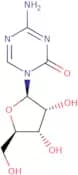
CAS:<p>An azanucleoside and epigenetic modulator that interferes with nucleic acid metabolism. The compound gets incorporated into RNA and inhibits ribonucleotide reductase subunit RRM2 in leukemia cell lines. Intracellularly, 5-azacytidine can get converted into 2′-deoxy-5-azacytidine (decitabine) and subsequently incorporated in DNA, where it irreversibly inhibits DNMT1 methyltransferase. In human epithelial cell lines, this compound decreases Src-activated expression of a histone chaperone CAF1 and inhibits cell motility and invasiveness.</p>Formula:C8H12N4O5Purity:Min. 95%Color and Shape:White Off-White PowderMolecular weight:244.21 g/mol4-Chloro-7-(2-deoxy-3,5-bis-O-(p-toluoyl)-β-D- ribofuranosyl)-5-iodo-7H-pyrrolo[2,3-d]pyrimidine
<p>4-Chloro-7-(2-deoxy-3,5-bis-O-(p-toluoyl)-beta-D-ribofuranosyl)-5-iodo-7H-pyrrolo[2,3-d]pyrimidine is a synthetic activator that selectively activates the transcription of genes in cells. It has been shown to have anticancer activity and may be useful as a therapeutic agent for the treatment of certain cancers. 4C 7 (2dEB 3,5BT) 5I is also known to be an antiviral agent against HIV and influenza virus. The modification on the 2'-deoxyribose sugar moiety can enhance both activation and antiviral activities.</p>Purity:Min. 95%1-(2’-Deoxy-2’-fluoro-b-D-arabinofuranosyl)-N3-(2S)-(2-amino-3-carbonyl]propyluracil
CAS:<p>1-(2’-Deoxy-2’-fluoro-β-D-arabinofuranosyl)-N3-(2S)-(2-amino-3-carbonyl]propyluracil is a novel, anticancer drug. It is active against both RNA and DNA viruses, such as HIV, influenza virus and herpes virus. 1-(2’-Deoxy-2’-fluoro-β-D-arabinofuranosyl)-N3-(2S)-(2-amino-3-carbonyl]propyluracil has been shown to be an activator for phosphoramidites in aqueous solution. This compound is of high purity with CAS No. 2072145–25–4. It is also a synthesized, monophosphate nucleoside that can be used in the production of modified nucleosides for therapeutic purposes or as antiviral agents</p>Purity:Min. 95%4-Thiothymidine
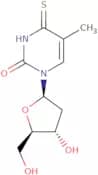
CAS:<p>4-Thiothymidine is a nucleoside analog that is converted to thymidine by the enzyme thymidine kinase. It has been shown to inhibit the growth of human skin cancer cells by binding to DNA duplexes and inhibiting the synthesis of new DNA strands. 4-Thiothymidine has also been shown to be effective against radiation-induced damage in cultured human cells and inhibits tumor growth in mice bearing a transplantable mouse skin cancer. 4-Thiothymidine can be used as an inhibitor for chemotherapy or radiation therapy for cancer patients. It is active on both site-specific and cell-specific gene targets, with a reactive hydrogen bond that helps stabilize its formation.</p>Formula:C10H14N2O4SPurity:Min. 98 Area-%Color and Shape:Yellow PowderMolecular weight:258.3 g/mol2',3'-Dideoxyinosine
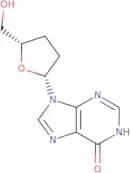
CAS:<p>2',3'-Dideoxyinosine is a purine analog that can suppress human immunodeficiency virus (HIV) replication after intracellular metabolic conversion</p>Formula:C10H12N4O3Purity:Min. 95 Area-%Color and Shape:White Off-White PowderMolecular weight:236.23 g/mol5-Hydroxycytidine
CAS:<p>5-Hydroxycytidine is a pyrimidine nucleoside that is found in DNA and RNA. It can be produced by the conversion of cytidine 5-monophosphate to cytidine 5'-diphosphate, which is then hydrolyzed to produce 5-hydroxycytidine. This conversion requires the enzyme cytidylate kinase. The structure of 5-hydroxycytidine differs from other pyrimidine nucleosides as its hydroxyl group does not have an acidic proton present. Biological functions that have been attributed to 5-hydroxydihydrocytidylic acid include its ability to inhibit translation and induce cell death in lung cells. This compound has also been shown to modify DNA duplexes and form bioconjugates with proteins or small molecules, such as fluorescein and digoxigenin. These modifications are used in analytical methods such as phase chromatography, nuclear magnetic resonance spectroscopy</p>Formula:C9H13N3O6Purity:Min. 95 Area-%Color and Shape:PowderMolecular weight:259.22 g/mol5'-O-Pixylthymidine
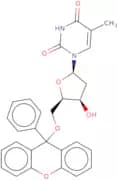
<p>5'-O-Pixylthymidine is a modified nucleoside that has been shown to have anticancer and antiviral activity. It is an analog of thymidine, which is a deoxynucleoside. 5'-O-Pixylthymidine can be converted into diphosphate form by addition of phosphoramidites or ribonucleosides. This nucleotide can also be used as a building block for the synthesis of oligonucleotides, which are synthetic DNA molecules with therapeutic applications.</p>Formula:C29H26N2O6Purity:Min. 95%Molecular weight:498.53 g/mol8-Bromoguanosine hydrate
CAS:<p>8-Bromoguanosine hydrate is a brominated form of guanosine. It is used as a marker for colorectal cancer in urine samples. 8-Bromoguanosine hydrate can be used to calibrate the results of chromatographic analyses and to identify metabolic disorders, such as fatty acid oxidation defects. The compound is also an endogenous ligand that interacts with adenosine receptors and may have pro-apoptotic effects on cancer cells by triggering their death. 8-Bromoguanosine hydrate has been shown to be more effective than other brominated nucleosides in inducing apoptosis in malignant cells, including colorectal carcinoma cells.</p>Formula:C10H12BrN5O5·xH2OPurity:Min. 95%Color and Shape:PowderMolecular weight:362.14 g/mol5'-O-(p-Toluoyl)-2'-O-acetyl-3'-deoxy-3'-fluorouridine
CAS:<p>5'-O-(p-Toluoyl)-2'-O-acetyl-3'-deoxy-3'-fluorouridine is a novel nucleoside that has antiviral and anticancer properties. It is an activator of the monophosphate phosphoramidites and has been shown to inhibit the growth of cancer cells in vitro. 5'-O-(p-Toluoyl)-2'-O-acetyl-3'-deoxy-3'-fluorouridine is also able to inhibit viral replication by terminating cellular DNA synthesis at the level of RNA polymerase II. This results in the synthesis of defective viral genomes that are unable to produce new viruses, thereby preventing viral spread.</p>Formula:C19H19FN2O7Purity:Min. 95%Molecular weight:406.36 g/molN6-Benzoyl-5'-O-2'-deoxyadenosine
<p>N6-Benzoyl-5'-O-2'-deoxyadenosine is a modified nucleoside that contains a benzoyl group. This nucleoside has been shown to be an antiviral and anticancer agent, and is also active against herpes simplex virus type 1 (HSV1). N6-Benzoyl-5'-O-2'-deoxyadenosine may be a potential therapeutic for the treatment of HSV1 infection. It is also believed to have anti-inflammatory properties. The synthesis of this compound can be achieved by reacting 5'-O-tetraisopropyldiphenylphosphoramidite with benzoyl chloride in the presence of triethylamine.</p>Formula:C36H31N5O4Purity:Min. 95%Molecular weight:597.66 g/mol2,4-Dithiothymidine
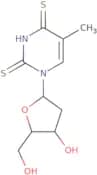
CAS:<p>2,4-Dithiothymidine (DT) is a chemotherapeutic that has been shown to be clinically effective in the treatment of hematopoietic malignancies. It is an oligothymidylate analogue that contains a pyrimidine heterocycle and an ethylthio group. DT is not a nucleoside analog, but it inhibits DNA synthesis by binding to the enzyme thymidylate synthase and preventing the formation of thymine from uracil. DT also binds to single-stranded DNA with high affinity and alters its conformation, which may inhibit transcription and replication. The photophysical properties of this molecule are studied theoretically using quantum mechanics and population analysis theory. The reagent DT can be used to focus attention on other molecules or conformation states of proteins that might have improved biological activity.</p>Formula:C10H14N2O3S2Purity:Min. 95%Molecular weight:274.36 g/mol8-Hydroxyadenosine
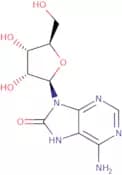
CAS:<p>8-Hydroxyadenosine (8-OHdG) is a purine nucleoside that is formed as a result of oxidative DNA damage. It is not an essential metabolite because it can be synthesized de novo. 8-OHdG has been shown to have potent anti-tumor activity in vitro and in vivo, which may be due to its ability to inhibit DNA replication. The biological effects of 8-OHdG are attributed to its ability to form hydrogen bonds with guanine residues in the double helix, and electrochemical detectors have been developed for its detection.</p>Formula:C10H13N5O5Purity:Min. 98 Area-%Color and Shape:PowderMolecular weight:283.25 g/mol5'-O-p-Anisoyl-2'-deoxyuridine
<p>5'-O-p-Anisoyl-2'-deoxyuridine is a novel activator that is an analogue of pyrimidine and has been synthesized for the first time. It belongs to the group of nucleosides and has been modified chemically. This compound can be used as a pharmaceutical drug for the treatment of cancer or viral infections.</p>Formula:C17H18N2O7Purity:Min. 95%Molecular weight:362.33 g/molN6-Benzyladenosine 5'-monophosphate sodium salt monohydrate
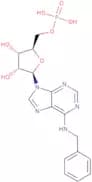
CAS:<p>N6-Benzyladenosine 5'-monophosphate sodium salt is a nucleoside that is not identified. It has been shown to be metabolized by adenosine deaminase and may have antitumor activity. N6-Benzyladenosine 5'-monophosphate sodium salt is also a radioactively labeled adenine analog that has been used in the study of metabolic pathways.</p>Formula:C17H18N5Na2O7P·H2OPurity:Min. 97 Area-%Color and Shape:PowderMolecular weight:499.32 g/molTFA-aa-dUPhosphoramidite
<p>TFA-aa-dUPhosphoramidite is a high quality, novel DNA phosphoramidite. It is used for the synthesis of deoxyribonucleosides and ribonucleosides. TFA-aa-dUPhosphoramidite has been shown to be an activator in the synthesis of RNA and DNA, and it is also resistant to degradation by nucleases. This product has CAS No.</p>Formula:C44H51N5O9PPurity:Min. 95%Molecular weight:824.88 g/mol5’-O-DMT-3’-O-levulinyl-2’-deoxyadenosine
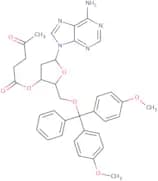
CAS:<p>5’-O-DMT-3’-O-levulinyl-2’-deoxyadenosine is a monophosphate antiviral agent. It has been shown to inhibit the activity of DNA and RNA polymerases in vitro. The drug is novel, and its antiviral properties have not been tested in vivo. 5’-O-DMT-3’-O-levulinyl-2’-deoxyadenosine has been synthesized using phosphoramidites and was found to be of high quality and purity. It has also been modified at the 2' position with an acetyl group and at the 3' position with a levulinoyl group.</p>Purity:Min. 95%
![3'-O-[(Propan-2-ylidene)amino]-thymidine 5'-triphosphate](/_next/image/?url=https%3A%2Fstatic.cymitquimica.com%2Fproducts%2F3D%2Fthumb-webp%2FNP145591.webp&w=3840&q=75)


![N2-Acetyl-6-[2-(4-nitrophenyl)ethoxy]-2'-O-trifluoromethanesulfonyl-3',5'-di-O-tritylguanosine](/_next/image/?url=https%3A%2Fstatic.cymitquimica.com%2Fproducts%2F3D%2Fthumb-webp%2FNA34795.webp&w=3840&q=75)
![4-Chloro-7-(2-deoxy-3,5-bis-O-(p-toluoyl)-β-D- ribofuranosyl)-5-iodo-7H-pyrrolo[2,3-d]pyrimidine](/_next/image/?url=https%3A%2Fstatic.cymitquimica.com%2Fproducts%2F3D%2Fthumb-webp%2FNC162932.webp&w=3840&q=75)
![1-(2’-Deoxy-2’-fluoro-b-D-arabinofuranosyl)-N3-(2S)-(2-amino-3-carbonyl]propyluracil](/_next/image/?url=https%3A%2Fstatic.cymitquimica.com%2Fproducts%2F3D%2Fthumb-webp%2FND162854.webp&w=3840&q=75)