Aminoacids and derivatives
Amino acids are compounds with a structure based on an amino group (-NH₂) and a carboxyl group (-COOH), both attached to a central carbon atom. This structure makes them essential for the synthesis of proteins and other biomolecules. Their derivatives can have regulatory properties over metabolic processes and biological systems, with applications in nutrition, health, and regenerative medicine.
At CymitQuimica, we offer a wide range of amino acids and their derivatives, ideal for research and the formulation of bioactive products.
Found 12270 products of "Aminoacids and derivatives"
Sort by
Purity (%)
0
100
|
0
|
50
|
90
|
95
|
100
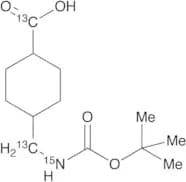
cis,trans-(1,1-Dimethylethoxy)carbonyl Tranexamic Acid-13C2,15N
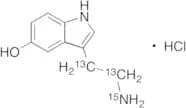
CAS:Controlled Product<p>Applications Antifibrinolytic agent. Used in the preparation of Tranexamic Acid (T714505).<br></p>Formula:C1113C2H2315NO4Color and Shape:NeatMolecular weight:260.3Serotonin-13C2,15N Hydrochloride (~90%)
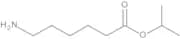
<p>Applications Serotonin-13C215N Hydrochloride, is a labelled Serotonin (S274980). Serotonin is a monoamine neurotransmitter.<br></p>Formula:C813C2H12N15NO•HClPurity:~90%Color and Shape:NeatMolecular weight:179.193646Isopropyl 6-Aminohexanoate
CAS:Controlled ProductFormula:C9H19NO2Color and Shape:NeatMolecular weight:173.25N-Nitroso-N-phenyl-glycine Anilide
CAS:Controlled ProductFormula:C14H13N3O2Color and Shape:NeatMolecular weight:255.272N-(3S)-1-Azabicyclo[2.2.2]oct-3-yl-5,6-dihydro-1-Naphthalenecarboxamide
CAS:Controlled Product<p>Applications N-(3S)-1-Azabicyclo[2.2.2]oct-3-yl-5,6-dihydro-1-Naphthalenecarboxamide is an impurity of Palonosetron (P165800), a serotonin 5-HT3 receptor antagonist used in the prevention and treatment of chemotherapy-induced nausea and vomiting (CINV). Antiemetic.<br>References Clark, R.D., et al.: J. Med. Chem., 36, 2645 (1993), Wong, E.H.F., et al.: Br. J. Pharmacol., 114, 851 (1995), Grunberg, S.M., et al.: Expert. Opin. Pharmacother., 4, 2297 (2003), Eisenberg, P., et al.: Ann. Oncol., 15, 330 (2004), Siddiqui, M.A.A., et al.: Drugs, 64, 1125 (2004),<br></p>Formula:C18H22N2OColor and Shape:NeatMolecular weight:282.38cis-Tranexamic Acid-13C2,15N
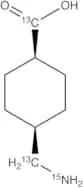
CAS:Controlled Product<p>Applications Labelled cis-Tranexamic Acid (T714500). Antifibrinolytic agent; blocks lysine binding sites of plasminogen. Hemostatic.<br>References Andersson, et al.: Scand. J. Haematol. 2, 230 (1965), Melander, B., et al.: Acta Pharmacol. Toxicol., 22, 340 (1965), Bonnar, J., et al.: Br. Med. J., 313, 579 (1996), Dunn, C.J., et al.: Drugs, 57, 1005 (1999),<br></p>Formula:C613C2H1515NO2Color and Shape:NeatMolecular weight:160.19Carbidopa Monohydrate
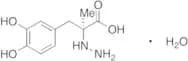
CAS:Controlled Product<p>Applications Carbidopa Monohydrate (cas# 38821-49-7) is a useful research chemical.<br></p>Formula:C10H14N2O4·H2OColor and Shape:White To Off-WhiteMolecular weight:244.24Dapoxetine-d6 Hydrochloride
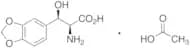
CAS:Controlled Product<p>Applications Labelled Dapoxetine (D185700). Selective serotonin reuptake inhibitor (SSRI).<br>References Feret, B., et al.: Formulary, 40, 227 (2005),<br></p>Formula:C21H18D6ClNOColor and Shape:NeatMolecular weight:347.91DL-threo-β-(3,4-Methylenedioxyphenyl)serine Acetate Salt
CAS:Controlled ProductFormula:C12H15NO7Color and Shape:NeatMolecular weight:285.25O-Methyl-3,3',5,5'-tetraiodothyronamine Hydrochloride
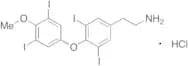
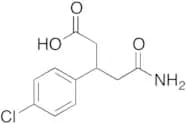
Controlled Product<p>Applications O-Methyl-3,3',5,5'-tetraiodothyronamine is a derivative of p-Tyramine (T898500); an adrenergic.<br>References Brandacher, G., et al.: Curr. Drug Metab., 8, 289 (2007); Oresic, M., et al.: J. Exp. Med., 205, 2975 (2008)<br></p>Formula:C15H13I4NO2•(HCl)Color and Shape:NeatMolecular weight:746.8936463-(4-Chlorophenyl)glutaramic Acid
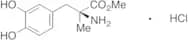
CAS:Controlled ProductFormula:C11H12ClNO3Color and Shape:NeatMolecular weight:241.67L-a-Methyl DOPA Methyl Ester Hydrochloride
CAS:Controlled ProductFormula:C11H15NO4·ClHColor and Shape:Off WhiteMolecular weight:261.70(S)-(-)-Carbidopa
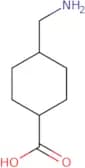
CAS:Controlled Product<p>Stability Unstable in Solution<br>Applications (S)-(-)-Carbidopa is a peripheral decarboxylase inhibitor that is commonly used in combination with L-DOPA (D533751) for treatment of Parkinsonism. S(-)-Carbidopa ( has also been shown to prolong the elimination half-life of L-DOPA from blood plasma and skeletal muscle.<br>References Henry, G.M. et al.: Psychosom. Med., 38, 95 (1976); Leguire, L.E. et al.: Invest. Ophthalmol. Vis. Sci. 34, 3090 (1993); Deleu, D. et al.: Naun. Schmied. Arch. Pharmacol. 348: 576 (1993);<br></p>Formula:C10H14N2O4Color and Shape:NeatMolecular weight:226.23trans-4-(Aminomethyl)cyclohexanecarboxylic acid
CAS:<p>Trans-4-(aminomethyl)cyclohexanecarboxylic acid (AMCA) is a histamine antagonist that is used to treat bowel disease. It may also be useful for the treatment of other inflammatory diseases and as an anticoagulant. AMCA has been shown to be safe and effective for the prevention of postoperative bleeding in patients who are undergoing major surgery. This drug is a potent inhibitor of platelet aggregation, but does not affect the function of erythrocytes or leukocytes. AMCA inhibits platelet aggregation by blocking the binding of adenosine diphosphate (ADP) to its receptor on platelets, thus inhibiting ADP-mediated activation of phospholipase A2 and arachidonic acid release from membranes. An increase in blood levels of AMCA may lead to cardiac toxicity and bleeding events.</p>Formula:C8H15NO2Purity:Min. 95%Molecular weight:157.21 g/molCarbidopa Impurity 2
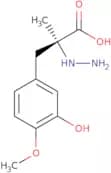
CAS:Controlled Product<p>Carbidopa Impurity 2 is an impurity of carbidopa, a drug product that is used to treat Parkinson's disease. Carbidopa Impurity 2 is an analytical standard for the identification and quantification of carbidopa in biological samples. The natural form of this compound is unknown, but it has been synthesized using custom synthesis techniques. This compound was also used to develop a high purity HPLC standard and as a pharmacopoeia reference material.</p>Formula:C11H16N2O4Purity:Min. 95%Molecular weight:240.26 g/molUNC0224
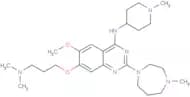
CAS:<p>UNC0224 is a selective inhibitor of G9a with a Ki of 2.6 nM and IC50 of 15 nM. UNC0224 also potently inhibits GLP with assay-dependent IC50 values of 20-58 nM.</p>Formula:C26H43N7O2Purity:99.80%Color and Shape:SolidMolecular weight:485.67trans-trans-4,4'-Iminodimethylenedi(cyclohexanecarboxylic acid)
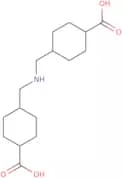
CAS:<p>Trans-trans-4,4'-Iminodimethylenedi(cyclohexanecarboxylic acid) is a hydrophobic particle that is soluble in water. It has an average particle diameter of 20 nm and a viscosity of 10 cps. Trans-trans-4,4'-Iminodimethylenedi(cyclohexanecarboxylic acid) is used in skin care products as a thickener and viscosity enhancer. It provides a silky feel to the skin and improves the skin's elasticity. This product also helps to protect the skin from UV radiation by forming a barrier on the surface of the skin. The natural polymer can be produced from glycerin or amide to produce different properties for different applications. Trans-trans-4,4'-Iminodimethylenedi(cyclohexanecarboxylic acid) is an amphoteric molecule that can react with both acidic</p>Formula:C16H27NO4Purity:Min. 95%Molecular weight:297.39 g/molCarbidopa impurity F
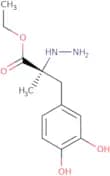
CAS:Controlled Product<p>Carbidopa is an impurity of the drug L-DOPA, which is used as a treatment for Parkinson's disease. Carbidopa is a prodrug that is converted to L-DOPA by decarboxylase, an enzyme in the body. The conversion process can be inhibited by the presence of carbidopa impurity F (CIF), which binds to carboxamides and forms a stable complex with them. This prevents CIF from binding to decarboxylase and blocking its ability to convert carbidopa into L-DOPA. CIF has been shown to have anti-parkinsonian effects by reducing the severity of symptoms associated with Parkinson's disease such as muscular rigidity and tremors.</p>Formula:C12H18N2O4Purity:Min. 95%Color and Shape:PowderMolecular weight:254.28 g/molEdrophonium
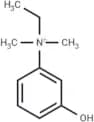
CAS:<p>Edrophonium: quick-acting, brief cholinesterase inhibitor for arrhythmias, myasthenia gravis diagnosis, and curare antidote.</p>Formula:C10H16NOColor and Shape:SolidMolecular weight:166.24



![N-(3S)-1-Azabicyclo[2.2.2]oct-3-yl-5,6-dihydro-1-Naphthalenecarboxamide](/_next/image/?url=https%3A%2Fstatic.cymitquimica.com%2Fproducts%2FTR%2Fthumb-webp%2FA795305.webp&w=3840&q=75)