Monosaccharides
Monosaccharides are the simplest form of carbohydrates and serve as fundamental building blocks for more complex sugars and polysaccharides. These single sugar molecules play critical roles in energy metabolism, cellular communication, and structural components of cells. In this section, you will find a wide variety of monosaccharides essential for research in biochemistry, molecular biology, and glycoscience. These compounds are crucial for studying metabolic pathways, glycosylation processes, and developing therapeutic agents. At CymitQuimica, we offer high-quality monosaccharides to support your research needs, ensuring precision and reliability in your scientific investigations.
Subcategories of "Monosaccharides"
- Alloses(11 products)
- Arabinoses(21 products)
- Erythroses(11 products)
- Fructoses(9 products)
- Fucoses(36 products)
- Galactosamine(41 products)
- Galactose(261 products)
- Glucoses(365 products)
- Glucuronic Acids(51 products)
- Glyco-substrates for Enzyme(77 products)
- Guloses(6 products)
- Idoses(4 products)
- Inositols(15 products)
- Lyxoses(4 products)
- Mannoses(65 products)
- O-Glycans(48 products)
- Psicoses(3 products)
- Rhamnoses(10 products)
- Riboses(61 products)
- Sialic Acids(100 products)
- Sorboses(4 products)
- Sugars(173 products)
- Tagatoses(4 products)
- Taloses(8 products)
- Xyloses(20 products)
Show 17 more subcategories
Found 6088 products of "Monosaccharides"
Sort by
Purity (%)
0
100
|
0
|
50
|
90
|
95
|
100
2-Acetonyl-1,3,4,6-tetra-O-acetyl-2-deoxy-b-D-galactopyranoside
<p>2-Acetonyl-1,3,4,6-tetra-O-acetyl-2-deoxy-b-D-galactopyranoside is a synthetic sugar that has been modified to contain an acetyl group at the C2 position. The synthesis of this compound is based on the modification of galactose with acetic anhydride. This product has been shown to be resistant to hydrolysis by esterases or glucuronidases and can also inhibit bacterial growth in culture. It is a monosaccharide with a CAS number of 85583-40-7. It is also used as a precursor for the synthesis of complex carbohydrates.</p>Purity:Min. 95%myo-Inositol 1,2,3,5,6-pentakisphosphate
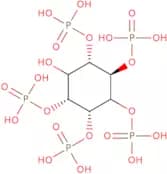
CAS:<p>Myo-inositol 1,2,3,5,6-pentakisphosphate (IP5) is a naturally occurring molecule that has been shown to have anti-viral properties. It inhibits the influenza virus by preventing the release of viral particles and may also inhibit other viruses. IP5 also has anti-cancer activity in colorectal carcinoma cells by inhibiting estrogen receptor modulators and v600e mutations. Myo-inositol 1,2,3,5,6-pentakisphosphate binds to the enzyme protein kinase C which prevents its activation and subsequently prevents the phosphorylation of certain proteins. This leads to cell death by preventing cancer cells from proliferating.</p>Formula:C6H17O21P5Purity:Min. 95%Molecular weight:580.06 g/molBenzyl 2-acetamido-3-O-allyl-4,6-O-benzylidene-2-deoxy-a-D-glucopyranoside
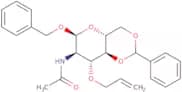
CAS:<p>This is a custom synthesis of a complex carbohydrate. The compound is an oligosaccharide, polysaccharide, or modification of saccharides. It is composed of one or more sugars and has undergone methylation, glycosylation, and/or carbamylation. This product can be used for the production of pharmaceuticals, cosmetics, and other chemical products. It has a CAS No. 60920-72-1 and can be purchased in high purity with fluoroination as a synthetic modification on the sugar moiety.</p>Formula:C25H29NO6Purity:Min. 95%Molecular weight:439.5 g/mol6-O-Tosyl-2,3-O-isopropylidene-a-L-sorbofuranose
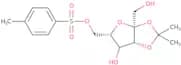
CAS:<p>6-O-Tosyl-2,3-O-isopropylidene-a-L-sorbofuranose is a fluorinated monosaccharide that can be used in the synthesis of oligosaccharides and polysaccharides. It has been shown to react with various nucleophiles to form glycosylation products. 6-O-Tosyl-2,3-O-isopropylidene-a-L-sorbofuranose is commercially available as a white solid.</p>Formula:C16H22O8SPurity:Min. 95%Molecular weight:374.41 g/mol5-Acetamino-4-hydroxy-2-(4-nitro-phenoxy)-6-(1,2,3-trihydroxy-propyl)-tetrahydro-pyran-2-carboxylic acid methyl ester
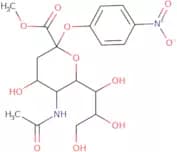
CAS:<p>5-Acetamino-4-hydroxy-2-(4-nitro-phenoxy)-6-(1,2,3-trihydroxy-propyl)-tetrahydro-pyran-2-carboxylic acid methyl ester is a synthetic glycosylated molecule that is available as custom synthesis. It is an oligosaccharide that has been modified with fluorination, saccharide modification, and click chemistry. It can be used for the synthesis of polysaccharides. It has a CAS number of 59694-35-8 and a molecular weight of 614.06 g/mol.</p>Formula:C18H24N2O11Purity:Min. 95%Molecular weight:444.39 g/mol2,3:5,6-Di-O-isopropylidene-D-gulofuranose
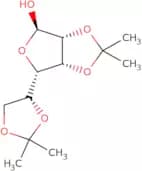
CAS:<p>2,3:5,6-Di-O-isopropylidene-D-gulofuranose is a sugar that belongs to the group of carbohydrates. It can be synthesized from 2,3:5,6-Di-O-isopropylidene-D-mannitol and D-gluconic acid. This sugar has been shown to be an efficient glycosylation agent for alkylation reactions. It has also been used in the synthesis of oligosaccharides and monosaccharides.</p>Purity:Min. 95%Phosphatidyl 1-(D-2,3-dideoxy-myo-inositol)
CAS:<p>Phosphatidyl 1-(D-2,3-dideoxy-myo-inositol) is a cell cycle inhibitor that belongs to the group of apoptosis proteins. It has been shown to induce apoptosis in prostate cancer cells and T-cell leukemia cells. This protein has protease activity and can bind to IGF-I, which is a growth factor that plays a role in tumor development. Phosphatidyl 1-(D-2,3-dideoxy-myo-inositol) also inhibits the growth of certain bacteria through an ester hydrochloride treatment. This protein can cause apoptosis by binding to a response element on the promoter of target genes, which leads to changes in gene expression.</p>Formula:C28H57O9PPurity:Min. 95%Molecular weight:568.72 g/mol2-(Benzyloxycarbonylamino)-2-deoxy-D-galactose
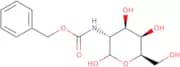
CAS:<p>2-(Benzyloxycarbonylamino)-2-deoxy-D-galactose is a synthetic, fluorinated carbohydrate. It is a monosaccharide with the chemical formula C6H11NO5 and is soluble in water. The glycosylation of 2-(benzyloxycarbonylamino)-2-deoxy-D-galactose has been shown to be more stable than that of other sugars, such as glucose or maltose. This modification can be accomplished by a click reaction. 2-(Benzyloxycarbonylamino)-2-deoxy-D-galactose can be used to modify proteins, such as antibodies and enzymes, by glycosylating amino acid residues on the protein surface.</p>Formula:C14H19NO7Purity:Min. 95%Molecular weight:313.3 g/mol1,4-Di-[(Trishydroxymethyl)aminomethane]-1,4-tertratamide
<p>1,4-Di-[(Trishydroxymethyl)aminomethane]-1,4-tertratamide is a methylated saccharide that can be used as a reagent for the click modification of polysaccharides and oligosaccharides. The fluorinated analogue of 1,4-di-[(trishydroxymethyl)aminomethane]-1,4-tertratamide has been shown to be an effective inhibitor of bacterial growth in vitro. This compound is also suitable for glycosylation and high purity synthesis.</p>Purity:Min. 95%1,3,4-Tri-O-acetyl-2-deoxy-D-ribopyranose
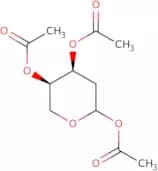
CAS:<p>1,3,4-Tri-O-acetyl-2-deoxy-D-ribopyranose is a custom synthesis of a complex carbohydrate. It is an Oligosaccharide with a molecular weight of 534.88 g/mol. The chemical modification includes the methylation and glycosylation of this saccharide. This carbohydrate has fluorination at the 2' position and has been synthesized using Click chemistry. The purity of this compound is high and it can be used for research purposes.</p>Formula:C11H16O7Purity:Min. 95%Molecular weight:260.24 g/mol2,3,4,6-Tetra-O-benzyl-D-galactopyranose - non-animal origin
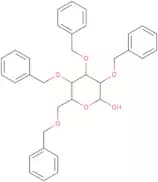
CAS:<p>Intermediate for the anomeric modification of Gal, including galactosylation</p>Formula:C34H36O6Purity:Min. 95%Molecular weight:540.65 g/molIsopropyl 2,3,4,6-tetra-O-benzyl-b-D-glucopyranoside
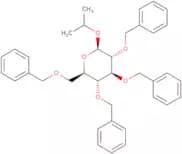
CAS:<p>Isopropyl 2,3,4,6-tetra-O-benzyl-b-D-glucopyranoside is a synthetic glycosylation product. It can be used as a building block for the synthesis of oligosaccharides and sugar derivatives. The product is available in custom synthesis and can be fluorinated to create new compounds. Isopropyl 2,3,4,6-tetra-O-benzyl-b-D-glucopyranoside can also be methylated to create new compounds. This product is mainly used in the preparation of saccharides and polysaccharides. It has a purity level of more than 99% and is not modified with any other functional groups.</p>Formula:C37H42O6Purity:Min. 95%Molecular weight:582.73 g/mol2-C-Methyl-D-erythritol 4-phosphate
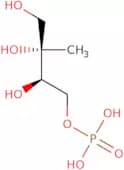
CAS:<p>2-C-Methyl-D-erythritol 4-phosphate is a natural product that can be found in plants. It has been used as a substrate molecule for kinetic study of phosphorolytic enzymes and as an antimicrobial agent in cell culture.</p>Purity:Min. 95%4-Methoxyphenyl 2,6-di-O-toluoyl-b-D-galactopyranoside
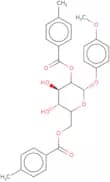
CAS:<p>4-Methoxyphenyl 2,6-di-O-toluoyl-b-D-galactopyranoside is a fluorinated saccharide with an acetate ester group at the reducing end. It is a custom synthesis and can be used for glycosylation or methylation of saccharides. This compound has high purity and can be custom synthesized to customer specifications. It is also a synthetic compound, which means that it does not occur naturally in nature. The CAS number for this compound is 1820570-59-9.</p>Formula:C29H30O9Purity:Min. 95%Molecular weight:522.56 g/molBenzyl 2-acetamido-3,6-di-O-benzoyl-2-deoxy-a-D-galactopyranoside
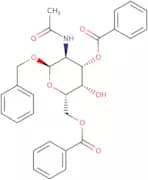
CAS:<p>Benzyl 2-acetamido-3,6-di-O-benzoyl-2-deoxy-a-D-galactopyranoside is a water soluble white solid. It is the monosaccharide of an oligosaccharide made up of D-galactose and benzoyl groups that are attached to each other with a glycosidic bond. The chemical name for this compound is 3,6'-diacetyloxybenzoic acid, O-(2,3,4,5,6,-pentaacetyl)-D-galactopyranose. This compound has been custom synthesized in our lab and its final purification was done by high performance liquid chromatography (HPLC) on a Chiralpak AD column. The purity of this compound was determined by HPLC analysis to be 98%, as well as by high resolution mass spectrometry (HRMS).</p>Formula:C29H29NO8Purity:Min. 95%Molecular weight:519.54 g/molMethyl 2,3,4-tri-O-acetyl-6-O-trityl-a-D-galactopyranoside
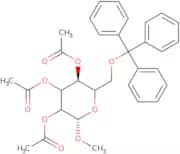
CAS:<p>Methyl 2,3,4-tri-O-acetyl-6-O-trityl-a-D-galactopyranoside is a glycosylation agent that can be used in the synthesis of saccharides. It is a triacetate derivative that can be synthesized from D-galactose and methyl triflate. Methyl 2,3,4-tri-O-acetyl-6-O-trityl-a-D galactopyranoside is soluble in water and has an acetyl content of 98%.</p>Formula:C32H34O9Purity:Min. 95%Molecular weight:562.62 g/mol4-Aminobenzyl b-D-thiogalactopyranoside
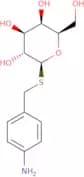
CAS:<p>4-Aminobenzyl b-D-thiogalactopyranoside is a chemical compound that belongs to the group of glycosylation, complex carbohydrate, Methylation, Click modification, Polysaccharide, Fluorination, saccharide, Modification and sugar. It is a synthetic product that can be modified according to customer requests. 4-Aminobenzyl b-D-thiogalactopyranoside is an oligosaccharide that has been custom synthesized for high purity. This product can be used in various applications such as pharmaceuticals and biochemistry research.</p>Formula:C13H19NO5SPurity:Min. 95%Color and Shape:PowderMolecular weight:301.36 g/mol6-O-tert-Butyldimethylsilyl-3,4-O-carbonyl-D-galactal
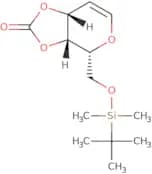
CAS:<p>6-O-tert-Butyldimethylsilyl-3,4-O-carbonyl-D-galactal is a modification of the sugar galactal. It is an oligosaccharide that can be synthesized from galactose and 6-O-tert-butyldimethylsilylchloride. It is used as a starting material for the synthesis of complex carbohydrates, as well as polysaccharides. This product has an average purity of 98% and is available in quantities of 50 grams.</p>Purity:Min. 95%1,3,5-Tri-O-benzoyl-2-deoxyribofuranose
CAS:<p>1,3,5-Tri-O-benzoyl-2-deoxyribofuranose is a custom synthesis of a complex carbohydrate. It has been modified by methylation and glycosylation to form an Oligosaccharide. This product is also fluorinated and synthesized in the laboratory using click chemistry. The compound is available at high purity with low impurities.</p>Formula:C26H22O7Purity:Min. 95%Molecular weight:446.45 g/mol2-Acetamido-3,4,6-tri-O-acetyl-2-deoxy-D-glucopyranosyl chloride - Stabilised with 2% CaCO3
CAS:<p>2-Acetamido-3,4,6-tri-O-acetyl-2-deoxy-D-glucopyranosyl chloride - Stabilised with 2% CaCO3 is a complex carbohydrate. It is synthesized by the reaction of 2 Acetamido-3,4,6 triacetyl-2 deoxy D glucose and Chloromethyl chloroformate in presence of sodium carbonate at pH 8.5 for 3 hours. The product is purified using column chromatography and recrystallized with water to give white crystalline powder. It has been used as an inhibitor of glycosidases and methyltransferases as well as a glycoprotein crosslinking agent.</p>Formula:C14H20ClNO8Purity:Min. 95%Color and Shape:Off-White PowderMolecular weight:365.76 g/mol


![1,4-Di-[(Trishydroxymethyl)aminomethane]-1,4-tertratamide](/_next/image/?url=https%3A%2Fstatic.cymitquimica.com%2Fproducts%2F3D%2Fthumb-webp%2FMD12057.webp&w=3840&q=75)