Monosaccharides
Monosaccharides are the simplest form of carbohydrates and serve as fundamental building blocks for more complex sugars and polysaccharides. These single sugar molecules play critical roles in energy metabolism, cellular communication, and structural components of cells. In this section, you will find a wide variety of monosaccharides essential for research in biochemistry, molecular biology, and glycoscience. These compounds are crucial for studying metabolic pathways, glycosylation processes, and developing therapeutic agents. At CymitQuimica, we offer high-quality monosaccharides to support your research needs, ensuring precision and reliability in your scientific investigations.
Subcategories of "Monosaccharides"
- Alloses(11 products)
- Arabinoses(21 products)
- Erythroses(11 products)
- Fructoses(9 products)
- Fucoses(36 products)
- Galactosamine(41 products)
- Galactose(261 products)
- Glucoses(365 products)
- Glucuronic Acids(51 products)
- Glyco-substrates for Enzyme(77 products)
- Guloses(6 products)
- Idoses(4 products)
- Inositols(15 products)
- Lyxoses(4 products)
- Mannoses(65 products)
- O-Glycans(48 products)
- Psicoses(3 products)
- Rhamnoses(10 products)
- Riboses(61 products)
- Sialic Acids(100 products)
- Sorboses(4 products)
- Sugars(173 products)
- Tagatoses(4 products)
- Taloses(8 products)
- Xyloses(20 products)
Show 17 more subcategories
Found 6088 products of "Monosaccharides"
Sort by
Purity (%)
0
100
|
0
|
50
|
90
|
95
|
100
Butyl α-D-glucopyranoside
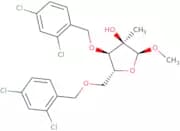
CAS:<p>Butyl a-D-glucopyranoside is an antimicrobial agent that inhibits the growth of photosynthetic organisms. It has been shown to have high cytotoxicity against Gram-positive bacteria, including Enterobacter and Bacillus. Butyl a-D-glucopyranoside also exhibits strong antimicrobial activity against Gram-negative bacteria such as Escherichia coli, Salmonella enterica, Klebsiella pneumoniae, and Pseudomonas aeruginosa. This compound also has potent activity against fungi and yeast. The mechanism of action is not known but may involve the inhibition of tyrosol synthesis or the disruption of microbial membranes.</p>Formula:C10H20O6Purity:Min. 95%Color and Shape:PowderMolecular weight:236.26 g/molMethyl 3,5-di-O-(2,4-dichlorobenzyl)-2-C-methyl-α-D-ribofuranoside
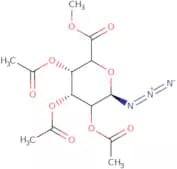
CAS:<p>Building block for the synthesis of 2'-âC-âmethyl substituted nucleosides</p>Formula:C21H22Cl4O5Purity:Min. 95%Color and Shape:Yellow PowderMolecular weight:496.21 g/molMethyl 2,3,4-tri-O-acetyl-b-D-glucopyranuronosyl azide
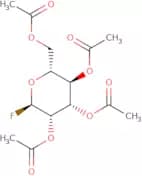
CAS:<p>Methyl 2,3,4-tri-O-acetyl-b-D-glucopyranuronosyl azide is a fluorinated carbohydrate. It is a monosaccharide and an oligosaccharide that is synthesized from a synthetic glycosylation reaction. This product can be used in the production of polysaccharides or as a click modification to modify the sugar moiety of other molecules. Methyl 2,3,4-tri-O-acetyl-b-D-glucopyranuronosyl azide has CAS No. 67776-38-9 and is available in high purity.</p>Formula:C13H17N3O9Purity:(%) Min. 98%Color and Shape:White PowderMolecular weight:359.29 g/mol2,3,4,6-Tetra-O-acetyl-a-D-mannopyranosyl fluoride
CAS:<p>This product is a fluorinated glycosylation compound that has been synthesized using click chemistry. It is a high-purity, custom synthesis with a purity of >99%. The molecular weight is 477.7 with a monoisotopic mass of 477.2. This compound is an oligosaccharide, monosaccharide, saccharide, and carbohydrate complex carbohydrate that has been modified for methylation and glycosylation.</p>Formula:C14H19FO9Purity:Min. 95%Color and Shape:PowderMolecular weight:350.29 g/mol2,7-Anhydro-D-sedoheptulose-2,3,4,5,6,7-13C6
<p>2,7-Anhydro-D-sedoheptulose-2,3,4,5,6,7-13C6 is a custom synthesis of a complex carbohydrate. It is an oligosaccharide that is modified with methylation and glycosylation. This compound has been synthesized by Click modification and fluorination. 2,7-Anhydro-D-sedoheptulose-2,3,4,5,6,7-13C6 is water soluble and has a high purity. It is used as a research tool in the field of saccharides and carbohydrates.</p>Purity:Min. 95%2-Acetamido-2-deoxy-b-D-glucopyranosyl L-asparagine
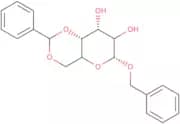
CAS:<p>Acetamido-2-deoxy-b-D-glucopyranosyl L-asparagine is used in studies of Aspartylglycosaminuria (AGU) which is a rare, inherited lysosomal storage disease caused by a deficiency in the enzyme aspartylglucosaminidase.</p>Formula:C12H21N3O8Purity:Min. 98 Area-%Color and Shape:White PowderMolecular weight:335.31 g/molBenzyl 4,6-O-benzylidine-β-D-galactopyranoside
CAS:<p>Benzyl 4,6-O-benzylidine-b-D-galactopyranoside is a benzoylated sugar. It is prepared by reacting benzoyl chloride with benzene and then with the sugar in an equimolar ratio. The reaction proceeds via a nucleophilic substitution at the 2' position of the sugar followed by an elimination of water. Benzyl 4,6-O-benzylidine-b-D-galactopyranoside reacts with dibutyltin to form a benzoylated tin compound that can be used as a catalyst for organic synthesis.</p>Formula:C20H22O6Purity:Min. 95%Color and Shape:White To Off-White SolidMolecular weight:358.39 g/molN-(e-Aminocaproyl)-b-L-fucopyranosyl amine
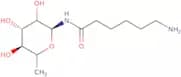
CAS:<p>This compound is a fluorination reagent that is used in carbohydrate synthesis. It can be used to modify complex carbohydrates, such as polysaccharides and oligosaccharides, by attaching a single fluorine atom at the C-2 position of an aminocaproyl moiety. This product can also be used to attach glycosylation sites and methyl groups. The purity of this product is greater than 99%.</p>Formula:C12H24N2O5Purity:Min. 95 Area-%Color and Shape:White PowderMolecular weight:276.33 g/molN1-β-D-Arabinopyranosylamino-guanidine hydrochloride
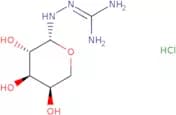
CAS:<p>N1-b-D-arabinopyranosylamino-guanidine HCl is a modified carbohydrate. It is a synthetic monosaccharide that is custom synthesized by methylation and glycosylation. This product has high purity and can be used for modification of saccharides or oligosaccharides to create new carbohydrates with desired properties.</p>Formula:C6H14N4O4•HClPurity:Min. 95%Color and Shape:White to light beige solid.Molecular weight:242.66 g/molN-Acetyl-L-talosaminuronic acid
CAS:<p>N-Acetyl-L-talosaminuronic acid is a natural product that has been shown to have anti-inflammatory activity in experimental models of inflammatory bowel disease. N-Acetyl-L-talosaminuronic acid inhibits the production of proinflammatory cytokines, such as tumor necrosis factor alpha (TNFα), by binding to TNFα receptors on the surface of cells. This can be attributed to its ability to inhibit ATP levels and reduce oxidative stress, which are both factors that contribute to inflammation. N-Acetyl-L-talosaminuronic acid also has been shown to inhibit inflammatory responses in human monocytes and neutrophils. It binds specifically to her2+ breast cancer cells and inhibits their growth in culture. Furthermore, it has been shown to have cytotoxic effects on bladder cancer cells and can be used for the treatment of bladder cancer.</p>Formula:C8H13NO7Purity:Min. 95 Area-%Color and Shape:PowderMolecular weight:235.19 g/molMethyl β-D-arabinopyranoside
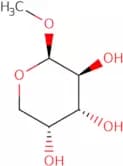
CAS:<p>Methyl b-D-arabinopyranoside is a fluorine containing molecule that has been shown to be an excellent marker for suberin. It is insoluble in water, and can be detected by resonator diffraction. The chemical composition of methyl b-D-arabinopyranoside was determined using liquid crystal composition and plates. A polymer particle with a macroscopic size was used to determine the fluorescence of methyl b-D-arabinopyranoside. Fluorescence analysis showed that methyl b-D-arabinopyranoside is a green fluorescent material with a maximum emission wavelength of 514 nm. Hydroalcoholic extraction was used to isolate this compound from the plant Ricinus communis L., where it was found in constant proportions.</p>Formula:C6H12O5Purity:Min. 95%Color and Shape:PowderMolecular weight:164.16 g/molL-Erythrose
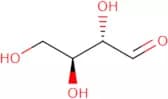
CAS:<p>L-Erythrose is a monosaccharide that contains an hydroxyl group on the second carbon atom. It can be synthesized by a synthetic scheme involving glycolaldehyde and hydroxylamine. L-Erythrose has been shown to inhibit the enzyme phosphoglycerate kinase, which converts 2-phosphoglycerate into phosphoenolpyruvate. L-Erythrose has also been shown to inhibit dehydroascorbic acid reductase, which converts dehydroascorbic acid into ascorbic acid, and galactitol reductase, which converts galactitol into D-tagatose. The mutant strain of Escherichia coli K12 that was engineered to produce L-erythrose showed a decreased susceptibility to phage infection and an increased resistance to oxidative stress. In addition, the polyol pathway in E. coli was induced by L-erythrose treatment.</p>Formula:C4H8O4Purity:(%) Min. 90%Color and Shape:Slightly Yellow PowderMolecular weight:120.1 g/molSalicylic acid D-glucuronide
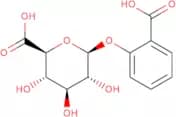
CAS:<p>Salicylic acid D-glucuronide is the major metabolite of aspirin, which is formed by hydrolysis of acetylsalicylic acid. It has been demonstrated to have anti-inflammatory and analgesic effects. Salicylic acid D-glucuronide is excreted in urine and can be detected in human serum. The formation rate of this metabolite varies with the individual's age, sex, and kidney function.<br>Salicylic acid D-glucuronide can be formed in vitro using hydrochloric acid and acetylsalicylic acid as substrates. This reaction is catalyzed by the enzyme uridine diphosphate glucuronyltransferase (UGT). Salicylic acid D-glucuronide has been shown to form covalent adducts with hydroxyl groups from other molecules in vivo and in vitro, including proteins (e.g., albumin) and DNA bases (e.g.,</p>Formula:C13H14O9Purity:Min. 95%Color and Shape:PowderMolecular weight:314.24 g/molL-Sorbose
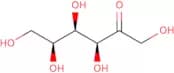
CAS:<p>Resource for the industrial synthesis of ascorbic acid alias Vitamin C</p>Formula:C6H12O6Purity:Min. 98 Area-%Color and Shape:White Off-White PowderMolecular weight:180.16 g/mol1,2:3,5-Di-O-Isopropylidene-α-L-xylofuranose
CAS:<p>1,2:3,5-Di-O-Isopropylidene-a-L-xylofuranose is a fluorinated sugar that is used as a building block in the synthesis of complex carbohydrates and oligosaccharides. It has a CAS number of 131156-47-3. 1,2:3,5-Di-O-Isopropylidene-a-L-xylofuranose is an active component in the modification of saccharide and polysaccharide structures by click chemistry. It can be modified with various functional groups such as methylation or monosaccharide to produce specific compounds. This product is available for custom synthesis.</p>Formula:C11H18O5Purity:Min. 95%Color and Shape:PowderMolecular weight:230.26 g/molZiyuglycoside II
CAS:<p>Ziyuglycoside II is a steroidal alkaloid that has been shown to have anti-angiogenic properties. It is a natural compound extracted from the Chinese herb ziyuglycoside. This compound has been shown to inhibit the activation of toll-like receptor 4, which plays an important role in inflammation and immunity. Ziyuglycoside II also inhibits the production of reactive oxygen species and autophagy, leading to cell death by apoptosis. This compound has been shown to be effective against bowel disease and epithelial mesenchymal transition (EMT). Ziyuglycoside II has also been shown to have matrix effects on the cells Hl-60, which are related to tumor metastasis.</p>Formula:C35H56O8Purity:Min. 95%Color and Shape:White To Off-White SolidMolecular weight:604.81 g/mol6-O-Benzyl-D-mannose
<p>6-O-Benzyl-D-mannose is a methylated monosaccharide. It is an important intermediate in the synthesis of oligosaccharides and polysaccharides. 6-O-Benzyl-D-mannose can be used for modification of saccharides, carbohydrates and sugars. This product has high purity and a custom synthesis.</p>Formula:C13H18O6Purity:Min. 95%Molecular weight:270.28 g/molMethyl α-L-rhamnopyranoside
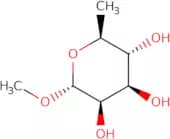
CAS:<p>Methyl α-L-rhamnopyranoside is a conjugate molecule made via a Fisher glycosylation with MeOH. It has been shown to have pesticidal activities and can be used in the production of pesticides or glycoconjugates. Methyl α-L-rhamnopyranoside is of interest as a vaccine adjuvant, due to its ability to activate the immune system. This compound also has anti-inflammatory properties, which may be due to its inhibition of prostaglandin synthesis.</p>Formula:C7H14O5Purity:Min. 95 Area-%Color and Shape:White PowderMolecular weight:178.18 g/molSorbitan monostearate
CAS:<p>Sorbitan monostearate is a lipid-soluble compound that is used as a surfactant and emulsifier in food products. It has been found to be nontoxic when administered at concentrations up to 5000 mg/kg of body weight for 28 days. Sorbitan monostearate has been shown to be nontoxic in vitro, but the long-term toxicity of this compound has not been established. Sorbitan monostearate also exhibits hydrogen bonding interactions with calcium pantothenate, sodium salts, and coumarin derivatives. The model system used was an artificial membrane composed of chitosan quaternary ammonium and monolaurate. This study found that sorbitan monostearate is able to permeabilize the membrane at an optimum concentration.</p>Formula:C24H46O6Color and Shape:White PowderMolecular weight:430.62 g/molPhenyl 2,3,4-tri-O-benzyl-b-L-thiofucopyranose
CAS:<p>Phenyl 2,3,4-tri-O-benzyl-b-L-thiofucopyranose is a synthetic monosaccharide that is modified with fluorine. It is also known as 3,4,6-tri-O-benzyl-2,3,4,6-tetra-O-(trifluoromethyl) fucopyranose. This compound is a complex carbohydrate that belongs to the group of glycoconjugates and polysaccharides. Phenyl 2,3,4-tri-O-benzyl-b-L-thiofucopyranose has been shown to be useful in glycosylation reactions as well as in click chemistry reactions. This compound can be used for the synthesis of oligosaccharides and polysaccharides with custom modifications. Phenyl 2,3,4 tri O benzyl b L thiof</p>Formula:C33H34O4SPurity:Min. 95%Color and Shape:PowderMolecular weight:526.69 g/mol